


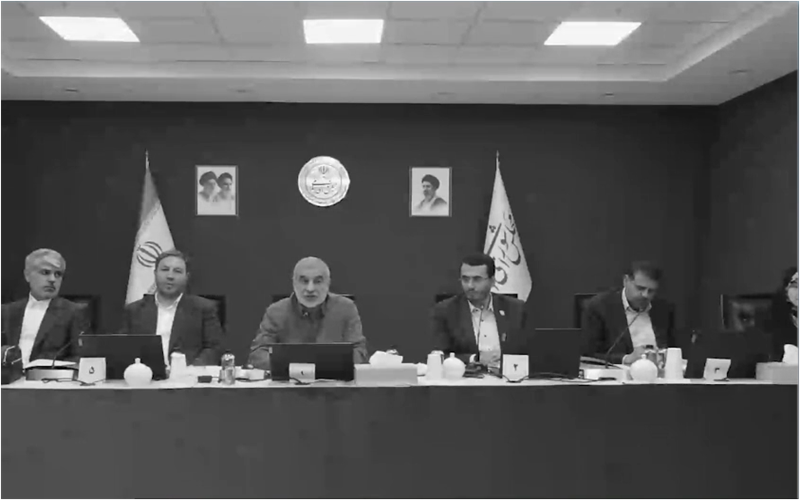

Regime officials warn of an “explosion” in prices and a repeat of the 2019 unrest, while rival factions openly fight over power and responsibility.
The Iranian regime is facing a growing convergence of economic and political crises. While regime officials publicly call for economic measures adapted to “wartime conditions,” their own statements reveal growing concern that further price increases could trigger a new wave of social unrest.
At the same time, factional warfare within the ruling establishment is becoming increasingly open, exposing divisions that were previously concealed behind calls for unity.
On August 19, parliamentarian Hamidreza Haji-Babaei warned about the consequences of rising prices and shocks to the cost of essential services, including gas, electricity, water, and gasoline. Another parliamentarian, Mohammad Saeedi, issued an even more direct warning, describing the situation as an “explosion of high prices” and urging officials to pay attention to what he called the “bomb” of inflation.
These statements are significant because they come from within the regime itself. They demonstrate that officials are not merely confronting an economic problem; they are increasingly concerned about the political and security consequences of that problem.
Fear of Another Gasoline Shock
The issue of gasoline has become particularly sensitive.
Parliamentarian Ahmad Meibodi criticized the government’s handling of fuel policy, warning against what he described as unscientific and irrational decision-making. He invoked the experience of November 2019, when a sudden gasoline price increase triggered nationwide protests that were violently suppressed.
His warning was explicit: decisions made without public participation could transform an economic problem into a major security crisis.
This is more than an argument over economic policy. It reflects the regime’s underlying fear that another sudden increase in the cost of living could become a catalyst for renewed protests.
The regime therefore finds itself caught in a trap. It needs additional revenues and economic reforms, yet many of the measures available to it risk further impoverishing a population already struggling with inflation and deteriorating living conditions.
Any new shock to gasoline, electricity, water, or other essential services could therefore have consequences far beyond the economic sphere.
Economic Pressure Is Fueling Political Infighting
The economic crisis is unfolding alongside an increasingly bitter struggle within the regime’s political factions.
A recent report by the regime-affiliated outlet Rouydad24 described the conflict among conservative factions as a struggle that has expanded beyond parliament and the media into religious institutions and the streets. It portrayed competing factions associated with the Paydari Front and Mohammad Bagher Ghalibaf as increasingly confronting one another over political influence and future positions.
The significance of these disputes lies not simply in the rivalry itself, but in what it reveals about the condition of the ruling system.
For years, regime factions could present a united front when confronting popular opposition. But as the political space has narrowed and the pressure on the system has increased, competition over power and resources has become more visible.
The regime-affiliated report itself acknowledged that those who previously promoted “unity” and political “purification” are now fighting one another over positions and influence.
In other words, the struggle is increasingly taking place within the ruling camp itself.
A Regime Trapped Between Economic Crisis and Social Anger
The combination of economic hardship and political infighting presents a particularly difficult challenge for the regime.
It cannot easily raise prices without risking renewed public anger. Yet it also cannot indefinitely avoid addressing the fiscal and structural problems that have produced the crisis.
At the same time, the factions competing for power are increasingly blaming one another for the consequences.
The result is a vicious cycle: economic deterioration increases public discontent; public discontent increases the regime’s fear of unrest; that fear intensifies factional accusations and political infighting; and the resulting paralysis makes meaningful economic solutions even harder to implement.
The warnings coming from inside the regime are therefore revealing.
When officials themselves speak of an “explosion” of prices and warn that economic decisions could become a security crisis, they are acknowledging a reality that propaganda cannot conceal: the regime’s economic crisis is inseparable from its political crisis.
And as rival factions increasingly turn against one another, the system’s internal cohesion is becoming another casualty of the mounting pressure from below.