



Contradictory policies, mass casualties, diplomatic withdrawals, and open infighting expose a regime struggling to maintain control
Recent statements by senior Iranian officials and state-affiliated media outlets have offered an unusually candid glimpse into the depth of the crisis engulfing the Iranian regime. Far from projecting stability, these admissions reveal a system grappling with violent urban conflict, internal disarray, economic collapse, and growing international isolation.
Admission of Violent Urban Warfare
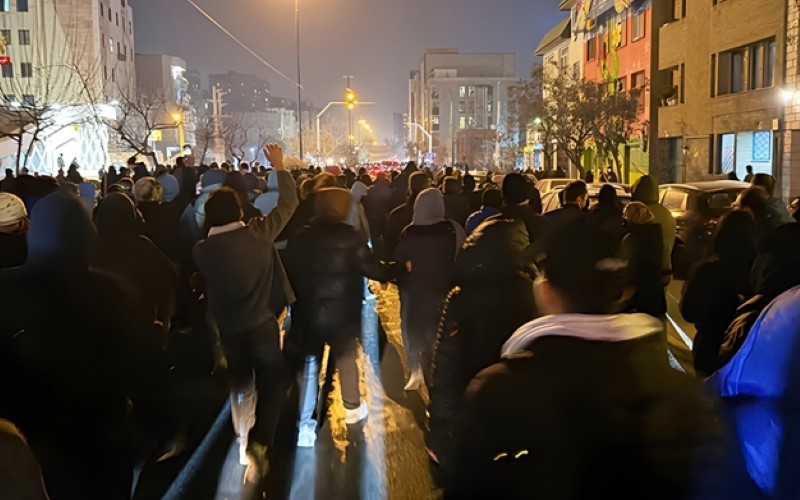
In a striking acknowledgment, Iran regime’s parliamentary speaker Mohammad Bagher Ghalibaf described the current situation as “very violent urban warfare,” referring to armed clashes and the “brutal killing of several thousand people,” including civilians, members of the Basij militia, and security forces. Such language, unprecedented in its bluntness, directly contradicts months of official claims that unrest had been contained.
By labeling the situation as urban warfare, the regime implicitly concedes that it is no longer dealing with sporadic protests but with a sustained internal conflict in multiple cities.
Internet Policy Chaos Signals Loss of Control
The regime’s handling of internet access has become a symbol of its confusion. While a government spokesperson announced that internet restrictions could remain in place for years, President Masoud Pezeshkian stated just one day later that he had urged senior officials to lift the restrictions immediately.
This contradiction underscores a fractured decision-making process and the failure of absolute internet blackouts, which have intensified public anger rather than suppressing dissent.
Security Breakdown Reaches the Capital
Further undermining claims of stability, Foreign Ministry officials confirmed that several diplomatic missions have temporarily withdrawn staff from Iran. Though framed cautiously, the admission signals serious security concerns in Tehran itself—a development that highlights the regime’s diminishing ability to guarantee even basic safety.
Economic Hardship Used as Political Leverage
As living conditions deteriorate, senior officials continue to deflect responsibility. Pezeshkian attributed economic hardship primarily to U.S. sanctions, despite simultaneously acknowledging that government-led economic measures have imposed severe strain on the population.
Meanwhile, parliamentary leaders announced the suspension of ministerial impeachments due to the “current conditions of the country,” effectively halting oversight at a moment of acute corruption and mismanagement. This move amounts to granting the executive branch unchecked authority during a national crisis.
Regional Maneuvering Amid Domestic Turmoil
While facing unrest at home, Tehran is seeking security assurances abroad. Officials have warned of alleged foreign plots to fragment the region, a narrative that appears designed to mask fears of the regime’s own territorial and political fragmentation.
Efforts to finalize comprehensive security agreements with Iraq are widely seen as attempts to tighten border control and suppress opposition movements operating beyond Iran’s borders.
Human Rights Pressure and Judicial Defensiveness
Under mounting international scrutiny, Iranian officials have mounted a defensive campaign to justify mass arrests and executions. Claims of “fair” and “time-consuming” judicial processes appear aimed at countering global outrage over looming death sentences and politically motivated prosecutions.
These statements highlight the regime’s increasing sensitivity to international human rights pressure, even as repression intensifies domestically.
Open Infighting and Fear of Collapse
Perhaps most revealing are the signs of open panic within the ruling elite. Pezeshkian openly warned parliament that removing ministers could cause “heavy losses,” admitting that the system lacks viable replacements and could unravel if even a few officials are sidelined.
Parliamentary statements warning against “ongoing sedition” further reflect deep mistrust within the regime’s own ranks and fears that new waves of unrest are imminent.
A Regime on the Edge
Taken together, these official admissions portray a government caught in a spiral of repression, fear, and paralysis. The acknowledgment of urban warfare, combined with policy contradictions, suspended oversight, and visible elite infighting, suggests a ruling structure struggling to survive rather than govern.
The narrative emerging from Iran’s own officials is no longer one of control—but of a system standing on the edge, attempting to contain a crisis that has already surpassed its capacity to manage.