


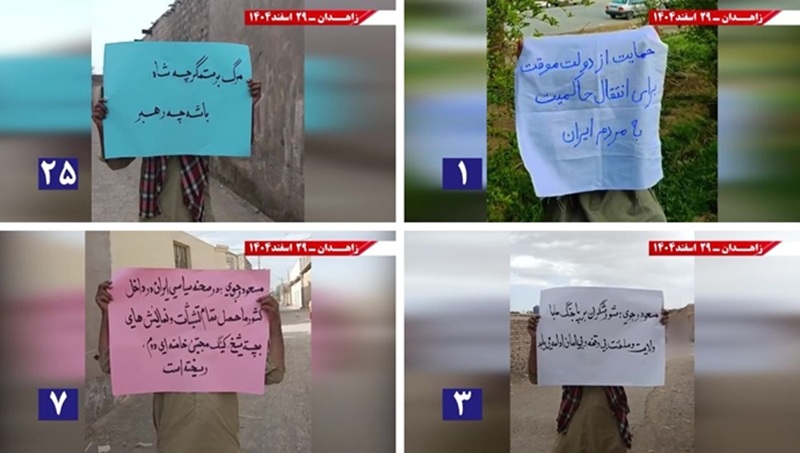

NCRI’s democratic transition plan offers the only credible path beyond the regime’s collapse and hereditary power grabs.
As the clerical regime in Tehran staggers through one of the most fragile and crisis-ridden phases of its existence, the question of Iran’s political future has moved from seminar rooms and opposition circles into the heart of society. It is no longer a theoretical debate. It is an urgent, existential question for a nation wounded by repression, war, and economic collapse.
The scars of the brutal massacre of January 2026 still weigh heavily on a mourning society, layered atop years of political and military failures, unprecedented international isolation, and a collapsing economy. These are not separate crises; together, they have eroded the regime’s foundations to the point where its authority is neither socially accepted nor internally stable. Even within the ruling apparatus, visible signs of paralysis, factional rupture, and structural disintegration are on open display.
In this context, the elevation of Mojtaba Khamenei as the new Supreme Leader is less a demonstration of strength than a confession of weakness. A system that long cloaked itself in the language of “republic” and “divine mandate” has now laid bare its true nature: power does not change hands through the will of the people, but through a quasi-hereditary, family-centered arrangement at the summit of the state. This is not an evolution; it is an admission that the current order is incapable of renewing its legitimacy and can only reproduce itself through dynastic succession.
Choosing a leader from within a single family, inside a structure that once claimed to embody “popular sovereignty” under divine guidance, reveals the extent to which the ruling establishment has been forced to abandon even its own ideological façade. What remains is a model that resembles the authoritarian monarchies of the past far more than any modern republic. This is not a sign of confidence; it is the final expression of a regime that can no longer answer society’s demands and can manage its internal crises only through relentless repression.
Taken together, these developments show a power structure that has reached an advanced stage of decay. After more than four decades of religious despotism—paid for in blood, imprisonment, and social devastation—the Iranian people are more prepared than ever to move beyond this exhausted order. The country stands at the threshold of a historic moment, one that can mark the opening of a new chapter in its political life and finally push the era of theocracy toward its end.
This political crisis at the very top coincides with one of the regime’s deepest structural weak points. The costly regional wars and direct military confrontations with the United States and Israel have exposed the hollowness of its ideological adventurism. Far from advancing Iran’s national interests, these policies have inflicted massive damage on the country’s military and economic infrastructure, dragged the nation into recurring security crises, and intensified international isolation and sanctions. The outcome is clear: ordinary Iranians pay the price while the regime sinks deeper into illegitimacy.
In such circumstances, the continuation of this rule is not a solution to Iran’s crises; it is their main engine. Unsurprisingly, the demand for a fundamental overhaul of the political system is spreading across social strata. Over recent years, waves of protests and popular uprisings have given this demand a concrete form. Today, that accumulated social will coincides with the regime’s visible exhaustion, creating what many observers rightly describe as a decisive turning point in Iran’s contemporary history.
Yet experience—both in Iran and worldwide—shows that the fall of a dictatorship, by itself, does not guarantee freedom or democracy. When an authoritarian system collapses without a clear, democratic, and institutional roadmap for the day after, societies can quickly slide into chaos or witness the resurgence of new forms of authoritarianism in different clothes. That is why the central question facing Iran today is not only how this regime ends, but how power is transferred to the people in a way that is orderly, legitimate, and irreversible.
It is precisely in this context that the announcement of a Provisional Government by the National Council of Resistance of Iran (NCRI) must be understood. The proposal is not an abstract political gesture; it is a response to the inevitable power vacuum that follows the fall of any entrenched dictatorship. If that vacuum is left unmanaged, it becomes fertile ground for chaos, foreign manipulation, or the re-emergence of yet another authoritarian project. The idea of a provisional, time-limited government is therefore not symbolic—it is a conscious attempt to guarantee that the transition leads to popular sovereignty rather than to another closed circle at the top.
The proposed Provisional Government is explicitly grounded in Maryam Rajavi’s Ten-Point Plan, which has for years been one of the clearest articulated platforms for a democratic future in Iran. The objective is not to entrench a new ruling elite, but to manage a defined six‑month transition whose central mission is straightforward: create the conditions for free, fair, and genuinely competitive elections. In this model, the provisional cabinet is a bridge between dictatorship and a representative order, tasked with opening the political space, guaranteeing civil and political freedoms, and handing the fate of the country back to the people through the ballot box.
At the heart of this plan are principles that form the backbone of any modern democracy: popular sovereignty via free elections, separation of religion and state, full equality between women and men, the abolition of the death penalty, an independent judiciary, freedom of parties and media, recognition of the cultural and political rights of Iran’s diverse nationalities within a united country, and a non-nuclear Iran committed to peaceful coexistence with the international community. The significance of this platform lies not just in the principles themselves, but in the fact that they are defined as operational guidelines for the transition period. A Provisional Government operating within this framework is bound to hand over power to elected representatives; the transitional phase cannot be turned into a vehicle for personal or factional rule.
By contrast, several other “transition” schemes currently circulating lack such institutional and democratic safeguards. The proposal associated with the former crown prince, for example, is built less on robust mechanisms for devolving power to citizens than on the centrality of his own role as a personal leader of the process. A model that begins and ends with individual authority, without binding commitments to institutional checks, elections, and the separation of powers, inevitably risks reproducing the same personality-centered politics that has repeatedly led Iranians into disaster. The country does not need a change of faces at the top; it needs a change of rules.
Today’s Iran cannot afford to repeat its historical cycles. A society that has fought for more than a century—from the Constitutional Revolution to the anti-monarchical uprising and the recent nationwide protests—cannot be asked to stake its future once again on the concentration of power in a single person or family. The only path out of the vicious circle of despotism is a system in which political power is neither inherited nor derived from personal charisma, but stems from the free and informed will of the citizenry.
Iran now stands before a fateful choice: either replay the old patterns of personalized rule and dynastic nostalgia, or open a genuinely new chapter in its political history. The announcement of a Provisional Government anchored in a program that places popular sovereignty at its core is an attempt to ensure that, this time, history bends toward freedom, democracy, and the true rule of the people.
Crucially, this initiative does not draw its legitimacy from backroom deals or foreign sponsorship, but from decades of organized resistance, sacrifice, and a relentless insistence on the right of Iranians to choose their own destiny. Its goal is not to seize power for itself, but to transfer power to the people through elections and the rule of law. In doing so, it offers a concrete answer to one of the most urgent needs of this moment: the responsible, democratic management of the post-dictatorship transition.
At a time when the ruling system has squandered what little legitimacy it still claimed, and when the nation needs a clear, credible path forward more than ever, the proposal for a Provisional Government can serve as the meeting point of three forces: the people’s will for change, the accumulated experience of the resistance, and a strategic vision for a free and democratic Iran. Supporting such an initiative is therefore not just another political choice among many; it is a response to a historic necessity and, in many ways, a national duty.
Every Iranian who cares about freedom, the sovereignty of the people, and the dignity of the country can play a role in this decisive moment. By backing a transition that treats power not as the property of an individual or a clan, but as a trust held by the nation, they can help open a new chapter in Iran’s history—one in which the state finally serves its citizens, rather than the other way around.