


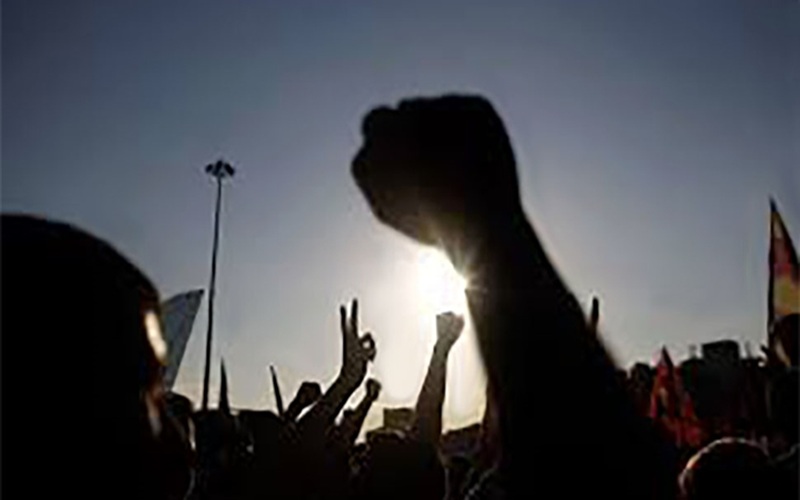

As Iran’s regime intensifies repression following a fragile ceasefire, the National Council of Resistance of Iran calls for global recognition of a third path: support for the Iranian people’s struggle for freedom.
In the wake of the 12-day war between Israel and Iran’s ruling theocratic regime, the political fallout has spread far beyond the battlefield. Although the conflict concluded with a fragile ceasefire, its deeper reverberations are now being felt within Iran itself. Among those who welcomed the cessation of hostilities was the Iranian Resistance, which has consistently advocated a clear and principled political solution: “No to war, no to appeasement—yes to the Iranian people’s uprising for regime change.”
This position, often referred to as “the third option,” contrasts starkly with the regime’s narrative and centers not on external military solutions or conciliatory diplomacy, but on empowering Iran’s own citizens to determine their future.
A Strategy of Repression Amid Fragile Calm
Contrary to the regime’s propaganda, the Iranian Resistance’s support for the ceasefire reflects a coherent political line rooted in the struggle for liberty. For decades, the clerical regime has used war, chaos, and regional destabilization to maintain power and deflect domestic dissent. Now, in the aftermath of the latest war, the true danger to the regime arises not from foreign enemies but from within—the simmering discontent of the Iranian people.
In recent days, Tehran has ramped up its campaign of repression. Widespread arrests, pressure on families of political prisoners, and an expanding security crackdown have gripped the country. Simultaneously, reports have emerged of increased activity by resistance units across Iranian cities. Public chants of “Death to Khamenei” and “Death to the dictator” have spread, shaking the foundations of the regime. Official statements even referred to these chants as “protest slogans,” a reluctant acknowledgment of the growing depth of resistance.
A Volatile Society on the Edge
This tense domestic climate lends new weight to past warnings by former regime officials, one of whom likened Iran’s society to a dormant volcano. That analogy now appears increasingly prescient. From the 2017 uprising, to the nationwide protests of November 2019, and the 2022 rebellion following Mahsa Amini’s death, Iran’s society has proven its willingness to rise up repeatedly against tyranny.
Even the regime’s Chief Prosecutor recently issued an unprecedented threat against the so-called “rebellious centers,” calling on their members to surrender to authorities. While framed as a legal warning, such rhetoric reveals the regime’s fear of the organized resistance that continues to challenge its legitimacy.
The Failure of Appeasement and the Cost to Iranians
The Iranian Resistance also strongly criticizes the West’s appeasement policies. From Western support of the Shah’s dictatorship to the present-day efforts to revive the nuclear deal, international efforts to accommodate Tehran have consistently backfired. These policies have come at a high cost to the Iranian people—seen in the mass executions of the 1980s and the brutal suppression of recent uprisings.
Now, the time has come for the international community to change course. Instead of military intervention or continued appeasement, the Iranian people seek recognition of their right to resist. This includes imposing targeted sanctions on regime officials and severing their financial and diplomatic lifelines.
As Mrs. Maryam Rajavi, President-elect of the National Council of Resistance of Iran, has repeatedly stated:
“I have consistently emphasized the Third Option: neither appeasement nor war, but regime change at the hands of the Iranian people and their organized, legitimate, and just Resistance.”
The Real Outcome of the War
For the Iranian people, the war’s true consequence was not on the battlefield but in the regime’s shaken core. Their voices for freedom have grown louder, making it ever clearer that the only real and human path forward is the third option: supporting the Iranian people in their quest to overthrow the theocracy and establish a democratic, secular republic based on human rights.
This path—rooted in nonviolence, self-determination, and broad international support—is the only solution that can bring lasting peace to Iran and stability to the broader region.