


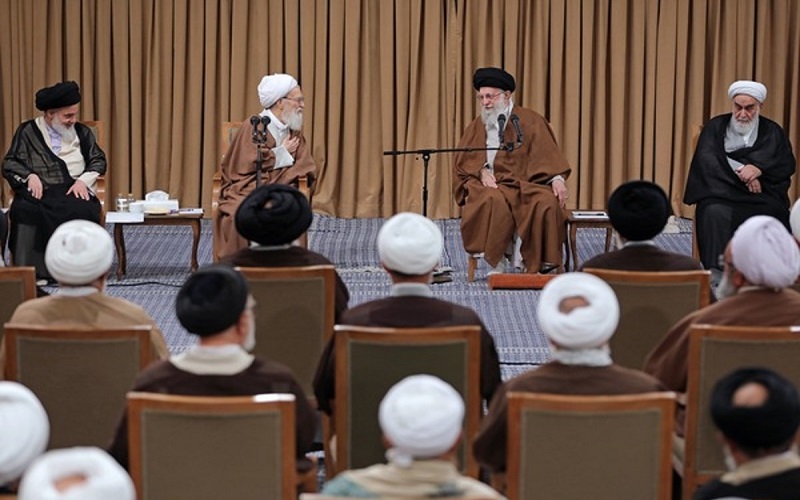

On November 7, Iran’s Supreme Leader Ayatollah Ali Khamenei addressed the Assembly of Experts, emphasizing the critical role of this body in selecting the “next leader.” He expressed gratitude for their readiness, urging them to maintain vigilance in fulfilling this duty, which he called essential for ensuring the regime’s continuity and preventing deviation. The Assembly, established by the regime’s founder Ruhollah Khomeini, is tasked with choosing the supreme leader—a pivotal function in the theocratic system.
In his remarks, Khamenei reassured his audience, stating, “The movement of the system will not stop.” He underscored that, upon his death, the Assembly of Experts would determine his successor. However, his comments struck a nerve, interpreted by many as a subtle acknowledgment of his mortality and a harbinger of uncertainty about the regime’s future amid escalating internal and external crises.
Reactions Within the Regime
Khamenei’s statements sparked an unusual emotional response among the Assembly of Experts. Cleric Heydari Kashani revealed that members of the Assembly were so moved by his words that “they started to cry and could not stop themselves.” This public display of emotion underscored the anxiety surrounding the prospect of a regime without Khamenei.
The regime’s representatives quickly mobilized to counter the wave of speculation and concern. Friday prayer leaders across Iran, who also serve as Khamenei’s provincial representatives, sought to dispel rumors and reinterpret his comments. Seyyed Abolhasan Mahdavi, the Friday prayer leader of Isfahan, aimed to reassure the public, declaring, “I’m telling the enemies not to be too happy; he is in good health.” Referring to Heydari Kashani’s account, Mahdavi dismissed claims that Khamenei had urged immediate action to identify a successor or caused members of the Assembly to weep.
Hossein Shafi’i Darabi, the Friday prayer leader of Sari, went further, asserting that even if Khamenei were to pass away, the system would remain intact. While these statements ostensibly targeted external “enemies,” they primarily sought to address the growing unease among regime supporters.
Contradictions and Escalating Speculation
Despite their efforts, the Friday prayer leaders’ responses were riddled with contradictions. Excessive emphasis on Khamenei’s “good health” and dismissals of emotional reactions within the Assembly only amplified public speculation. Accusations of “lying” against critics and the disjointed nature of their defenses further eroded their credibility.
For instance, Mahdavi’s acknowledgment of the Assembly of Experts’ “Secret Commission” responsible for identifying the next leader inadvertently validated rumors of preparations for a leadership transition. Such admissions fueled perceptions of vulnerability within the regime, highlighting its readiness for a post-Khamenei era while simultaneously denying such a need.
A Crisis of Legitimacy
The unfolding events and responses from regime officials can be interpreted through two lenses. On one hand, Khamenei’s remarks and the subsequent reactions might reflect a calculated effort to manage the potential crisis of his absence and ensure a smooth transfer of power. On the other hand, they point to a deeper legitimacy crisis, with the regime grappling with uncertainty about its future without its central figure.
What remains undeniable is the regime’s heightened sensitivity to rumors and its struggle to project stability. The repeated attempts to deny speculations about Khamenei’s health and future leadership betray a profound fear of a power vacuum. The regime’s vulnerability to such scenarios underscores the fragility of its foundations and the critical role Khamenei plays in maintaining cohesion.
As the shadow of Khamenei’s potential absence looms larger, the regime’s contradictions and missteps in addressing these concerns may inadvertently accelerate the very instability it seeks to avoid.