


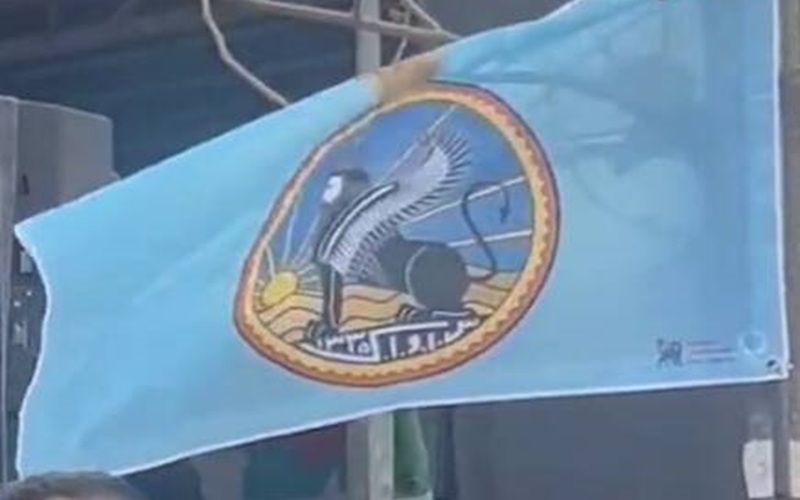

The public display of SAVAK insignia in Germany is not a nostalgic political gesture. It is an attempt to normalize the legacy of torture, dictatorship, and authoritarian violence under the guise of monarchist revivalism.
The shocking display of the SAVAK emblem during a gathering of monarchist supporters in Regensburg, Bavaria, was not merely an act of political provocation or extremist nostalgia. It was a political declaration — a deliberate attempt to rehabilitate one of the most notorious instruments of repression in modern Iranian history.
Displaying the symbol of SAVAK, the Shah’s secret police apparatus, in the heart of democratic Europe carries implications far beyond symbolic misconduct. It represents the normalization of torture, the glorification of authoritarian violence, and the whitewashing of crimes committed against generations of Iranians.
This incident is therefore not only a matter for the Iranian diaspora. It is also a test for democratic societies and the legal principles upon which postwar Europe was built.
Europe’s Anti-Fascist Consensus
After the catastrophe of World War II, Europe reached a fundamental conclusion: democracy must not become a gateway for the return of fascism.
Germany, in particular, institutionalized this lesson through laws designed to protect democratic order against extremist ideologies. Under Section 86a of the German Criminal Code, the use of symbols associated with unconstitutional and extremist organizations — including Nazi insignia and fascist propaganda — is prohibited. Germany’s legal framework also criminalizes the denial or trivialization of crimes against humanity, including Holocaust denial and the glorification of Nazi crimes.
These laws were not created solely to ban the swastika. They were designed to prevent the resurrection of political cultures rooted in repression, racial supremacy, and systematic violence.
Against this backdrop, the public display of SAVAK imagery in Germany becomes far more than a fringe political stunt. It directly collides with the spirit of Europe’s anti-fascist legal and moral order.
SAVAK and the Machinery of Fear
For many Iranians, SAVAK was not merely an intelligence agency. It was the operational backbone of political terror under the monarchy.
Like the Gestapo in Nazi Germany or other twentieth-century authoritarian security structures, SAVAK existed to silence dissent before it could emerge. Surveillance, arbitrary detention, torture, forced confessions, and extrajudicial killings were central components of its function.
Human rights organizations repeatedly documented these abuses during the Shah’s rule. In the mid-1970s, international reports identified Iran as one of the world’s leading practitioners of torture and political repression.
Methods associated with SAVAK — including electric shock torture, prolonged isolation, and brutal interrogation techniques — became synonymous with systemic state violence. The killing of political prisoners such as Bijan Jazani and his associates in the Evin hills, while blindfolded and restrained, reflected the same logic of extrajudicial elimination used by authoritarian death squads elsewhere in the twentieth century.
To publicly celebrate the emblem of such an institution is not an expression of democratic opposition. It is an attempt to sanitize the legacy of political terror.
The Authoritarian Core of Monarchist Extremism
The Regensburg incident also exposes a deeper ideological problem within sections of the monarchist movement surrounding Reza Pahlavi.
For years, some factions within this movement have attempted to rebrand the Pahlavi era as a model of modern governance while systematically minimizing or denying the realities of dictatorship, censorship, torture, and political repression under the Shah. The reappearance of SAVAK symbolism strips away that façade.
Fascism is not defined solely by dictatorship. It is characterized by the fusion of personality cults, hyper-nationalism, historical mythmaking, and authoritarian security structures. The glorification of SAVAK reflects precisely this political culture.
The excessive emphasis on racial superiority, imperial nostalgia, and ultranationalist mythology promoted by hardline monarchist circles bears disturbing similarities to European fascist traditions that sought legitimacy through fabricated historical grandeur and the suppression of dissent.
The public rehabilitation of figures such as Parviz Sabeti — one of the most prominent officials within SAVAK’s internal security apparatus — further reveals this trajectory. Attempts to normalize his image in exile politics are not about historical debate. They are about legitimizing authoritarian methods for a future political project.
Two Faces of Authoritarianism
The most dangerous misconception in Iranian politics is the assumption that authoritarianism exists only within the ruling religious establishment.
In reality, Iran today faces two interconnected forms of extremism: the ruling theocratic fascism of the clerical state and the authoritarian nostalgia promoted by sections of the monarchist movement.
Both currents share essential characteristics:
- hostility toward pluralism,
- intolerance of dissent,
- reliance on intimidation and political violence,
- and the centralization of power around authoritarian leadership.
If hardline supporters of the clerical regime use violence and repression inside Iran, extremist monarchist factions attempt to normalize the symbols and language of political terror abroad.
These parallel authoritarian tendencies ultimately reinforce one another. Each relies on the existence of the other to present itself as the “lesser evil,” while both obstruct the emergence of a democratic and pluralistic alternative for Iran’s future.
Why Democratic Societies Cannot Ignore This
Germany and other European democracies cannot afford to dismiss such incidents as marginal provocations.
Allowing the public glorification of SAVAK symbols risks legitimizing a culture of political violence that directly contradicts the democratic values Europe claims to defend. It is also an insult to the victims of torture and repression under both the monarchy and the current clerical dictatorship.
The Iranian people’s struggle for freedom has never been a struggle to replace one form of dictatorship with another. It has been a struggle to end the cycle of authoritarian rule altogether.
That is why opposing the revival of SAVAK symbolism is not merely a historical issue. It is part of a broader political battle over the future identity of Iran itself.
No Future for Fascism in Iran
In a democratic Iran governed by an independent judiciary and grounded in international human rights standards, all perpetrators of torture and crimes against humanity — whether under the monarchy or the current theocracy — must ultimately face accountability.
Crimes against humanity do not expire with time. Just as former Nazi collaborators continued to face prosecution decades after World War II, those responsible for systematic torture and political repression in Iran cannot simply be rehabilitated through exile politics or media campaigns.
Safeguarding Iran’s democratic future requires rejecting fascism in every form — whether cloaked in religious absolutism or wrapped in royal symbolism.
The confrontation with the ghost of SAVAK in Regensburg is therefore not a peripheral dispute. It is one front in the larger struggle to prevent authoritarianism from rebranding itself and returning once again under a different flag.