


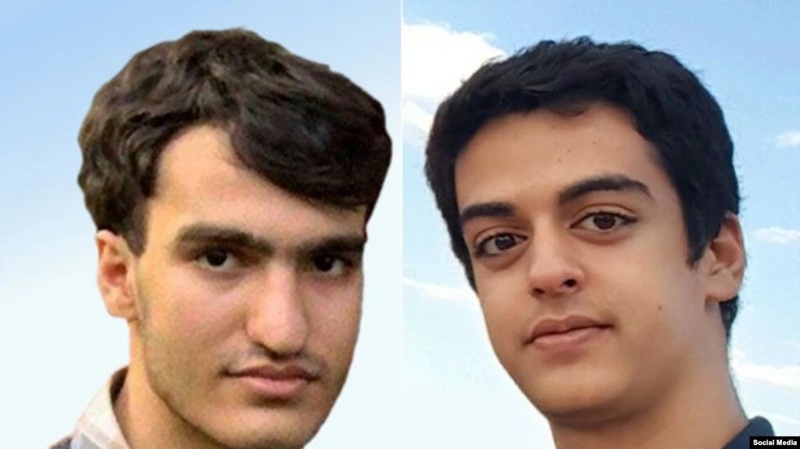

Two imprisoned elite students reject the Iranian regime’s so-called “amnesty,” turning a propaganda gesture into a powerful declaration of resistance, dignity, and unwavering commitment to freedom.
In the Iranian regime’s prisons, where executions, torture, and psychological pressure are routinely used to crush dissent, two young political prisoners have delivered a response that transformed a regime propaganda maneuver into an indictment of tyranny itself.
Amirhossein Moradi and Ali Younesi — two elite students from Sharif University imprisoned for support of the People’s Mojahedin Organization of Iran — have both publicly rejected the judiciary’s so-called “amnesty” offer.
Their letters are not merely prison statements. They are political manifestos forged through years of imprisonment, isolation, and the memory of executed comrades. In a political climate where the regime seeks to portray selective “pardons” as signs of mercy, Moradi and Younesi answered with language rooted in defiance, historical memory, and moral clarity.
“We Neither Forgive Nor Forget”
According to reports from Evin Prison, Amirhossein Moradi was repeatedly summoned in recent weeks to receive an official judiciary notice concerning the remainder of his sentence. He refused to accept it.
After rumors circulated regarding his possible release under the title of “amnesty,” Moradi published a letter that carried the tone not of a prisoner seeking freedom, but of a man refusing humiliation.
“The smiling faces of my dearest friends — Vahid, Pouya, Babak, Mohammad, Shahrokh, and Abolhassan — as they were transferred from Evin to the killing grounds of Ghezel Hesar remain before my eyes,” he wrote.
The names he invoked were not abstract memories. They were fellow prisoners executed after refusing to surrender to the regime. Moradi deliberately placed their sacrifice at the center of his response, rejecting any personal salvation detached from the broader struggle against repression.
“I neither wanted nor want your disgraceful amnesty,” he declared.
Then came the sentence that captured the essence of his position:
“It is we, the oppressed people of Iran, who are in the position to forgive you. But know this with certainty: we neither forgive nor forget.”
Moradi’s letter went beyond rejecting an administrative decree. It reversed the moral equation the regime attempted to impose. In his view, the judiciary — an institution associated with executions and mass repression — possesses no ethical authority to grant mercy.
His closing words reflected extraordinary political steadfastness:
“Until the people of Iran are freed from you, I will not even think about my own release from prison, nor will I beg it from you.”
“Freedom Is a Stolen Right”
A day later, Ali Younesi issued his own response after receiving a similar judiciary notification during a family visit in Ghezel Hesar Prison.
Like Moradi, Younesi categorically rejected the offer.
“I have never requested amnesty, nor will I ever do so,” he wrote.
Then, in one of the most powerful lines contained in either letter, he added:
“Freedom is a stolen right; we do not beg for stolen rights — we fight to reclaim them.”
The statement distilled years of political imprisonment into a single moral principle. Freedom, in Younesi’s words, is not a privilege granted by rulers but an inherent right illegitimately stolen through repression.
Younesi also anchored his position in the memory of executed prisoners:
“I have role models: six proud cellmates who went to the gallows with dignity. They did not bargain for their lives. Shame on me if I bargain for my freedom.”
This language reflects a political culture deeply rooted in sacrifice and collective resistance. Rather than distancing themselves from repression to secure personal release, both prisoners explicitly tied their fate to those who had already paid with their lives.
Turning “Amnesty” into an Indictment
The regime’s judiciary appears to have attempted to frame the remaining seven months of the students’ prison sentences as an act of benevolence under a symbolic “22 Bahman amnesty.” But the context exposes the emptiness of that narrative.
Moradi and Younesi were initially sentenced to 16 years in prison after proceedings widely criticized by human rights advocates. Following appeals and a Supreme Court review, their sentences were eventually reduced to six years and eight months.
Even with the reduced sentence, both men have now spent more than six years in prison without a single day of furlough.
Against this backdrop, the regime’s attempt to “forgive” the final months of imprisonment appears less like mercy and more like a political performance designed to manufacture legitimacy.
Both prisoners refused to participate in that performance.
Younesi directly challenged the judiciary’s moral standing by invoking the words of executed political prisoner Vahid Bani Amerian:
“Are we the ones who should defend ourselves, or are you?”
Younesi then transformed the question into an accusation aimed squarely at the regime:
“Are we the ones who should forgive, or are you?”
The Moral Center of Resistance
Perhaps the most striking aspect of these letters is that neither focuses primarily on personal suffering.
There is no plea for sympathy. No appeal for pity.
Instead, both letters repeatedly return to the families of executed prisoners — especially grieving mothers and fathers whose children were killed by the regime.
“The right to forgive belongs more than anyone to the grieving mothers and fathers,” Younesi wrote.
He continued:
“Whatever remains of prison, exile, suffering, and hardship is nothing but duty. Fighting for the freedom of the Iranian people is not a source of regret or pain — it is the greatest source of honor.”
This language reflects a political identity shaped not by victimhood, but by conscious resistance. The two students portray imprisonment not as defeat, but as participation in a broader historical struggle.
A Generation the Regime Failed to Break
The Iranian regime has spent decades attempting to silence politically active students through arrests, torture, executions, and forced confessions. Yet the letters of Moradi and Younesi demonstrate something the authorities continue to underestimate: prison has not extinguished the political resolve of a generation raised under repression.
Instead of expressing gratitude for reduced punishment, these young prisoners publicly denied the regime’s moral legitimacy.
Instead of bargaining for freedom, they aligned themselves with executed comrades.
Instead of asking for mercy, they declared that history itself will judge those responsible for repression.
Their words reveal a political culture that the machinery of prison has failed to destroy — one built on memory, sacrifice, and refusal to surrender.
And in doing so, Amirhossein Moradi and Ali Younesi transformed what the regime intended as a symbolic gesture of “amnesty” into a declaration of resistance that reaches far beyond prison walls.