


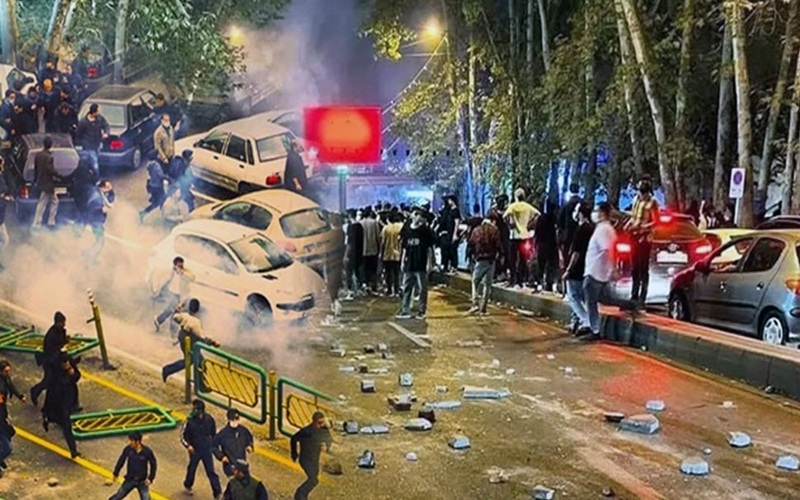

After 47 years of repression at home and confrontation abroad, Iran’s regime is confronting the political, economic, and social consequences of the system it has built.
There are moments in the life of a political system when accumulated choices cease to be choices and become consequences. The Iranian regime appears to be entering precisely such a moment.
After nearly five decades of rule built around two fundamental pillars—domestic repression and external terrorism—the regime is increasingly confronting the accumulated consequences of the policies it has pursued at home, across the region, and internationally. The question before it is no longer simply how to manage one crisis or another. It is whether it can continue along the same path without confronting a much deeper political and structural rupture.
The regime faces two possibilities: continue on the same course, which is already tightening its grip around its own political and economic system, or retreat from the policies that have defined its rule. The second option, however, would require something far more fundamental than a tactical adjustment. It would mean confronting the foundations of the system itself.
Recent warnings appearing in state-affiliated media illustrate the growing pressure. Arman Melli, in its August 25, 2026 edition, acknowledged that the current situation is different because sanctions now have greater international legal and institutional backing, potentially making their implementation broader and more binding. It also pointed to increasingly restrictive policies adopted by some neighboring countries and warned that others could gradually follow the same course.
This is important because it reflects the erosion of an environment in which the regime could rely on international hesitation, regional accommodation, and competing interests to cushion the consequences of its policies. That space appears to be narrowing.
But external pressure is only one side of the crisis.
The Collapse of Social Capital
The regime’s deeper problem lies inside Iran itself: the collapse of its social and economic foundations.
For decades, the authorities have attempted to compensate for the absence of genuine popular legitimacy through propaganda, coercion, ideological mobilization, and the expansion of the security apparatus. Yet none of these can permanently substitute for public consent.
This is precisely where the regime’s current deadlock becomes visible.
Sharq, in its August 25 edition, pointed to what it described as the weakness of social capital as one of the most important obstacles to deep and structural economic reforms—reforms it characterized as essential for national development and continued survival.
The significance of this admission should not be underestimated. Even within the regime’s own media, the problem is increasingly being recognized not merely as inflation, unemployment, sanctions, or mismanagement in isolation, but as a fundamental crisis of social trust and legitimacy.
Economic reform requires public cooperation. Structural reform requires social confidence. A government that has lost both cannot easily demand sacrifices from a population that increasingly sees those sacrifices as serving the ruling establishment rather than society.
The regime’s parliament speaker, Mohammad Bagher Ghalibaf has made a similar point in blunt terms. He acknowledged that military power alone cannot preserve the system if people are hungry and if financial circulation, economic growth, and national production are absent.
That statement inadvertently exposes the regime’s central contradiction. Vast expenditures on military and security capabilities cannot compensate for an economy unable to provide basic security and prosperity to its population.
The governor of the Central Bank has added another dimension to the picture, emphasizing the deterioration of the country’s economic foundations. He stated that Iran’s oil exports had fallen to zero and that, unlike countries such as Iraq and Qatar, Iran could not access its foreign-exchange reserves.
Whether every element of such statements is accepted at face value or not, their political significance is unmistakable: senior officials are increasingly describing a system whose economic room for maneuver has become severely constrained.
The Real Deadlock
Yet the regime’s greatest obstacle is not sanctions alone, nor the shortage of foreign currency, nor even the collapse of production.
Its greatest obstacle is that solving these problems would require confronting the political model that produced them.
The two pillars of the regime’s nearly five-decade existence—repression at home and intervention abroad—are not accidental policies that can simply be switched off. They are deeply embedded in the structure of power.
Reducing repression would create political space for a society that has repeatedly demonstrated its willingness to challenge the regime. Curtailing external intervention would affect institutions and networks that have become integral to the regime’s regional strategy. Genuine economic reform, meanwhile, would threaten entrenched networks of privilege, corruption, and political control.
This is why the regime finds itself caught in a structural trap.
It cannot easily continue its existing policies without deepening the very crises threatening its survival. But abandoning those policies could undermine the foundations upon which its power rests.
The result is a system increasingly compelled to choose between continuing a destructive trajectory and confronting the political consequences of changing course.
And there is one reality the ruling establishment understands better than anyone: the Iranian people have not disappeared. Beneath the propaganda, repression, economic hardship, and political maneuvering, public anger continues to accumulate.
The regime may attempt to postpone the reckoning through repression, economic improvisation, or temporary concessions. But postponement is not resolution.
After 47 years of sowing repression, economic destruction, corruption, and regional confrontation, the regime is entering the season in which it must confront the harvest of its own policies.
The fundamental question is therefore not whether the current system can survive another crisis.
It is whether a system that has exhausted its economic resources, eroded its social capital, narrowed its international space, and lost the confidence of its own population can continue indefinitely without fundamentally changing itself.
The answer may ultimately be determined not in the regime’s offices, but by the society it has spent decades attempting to control.