


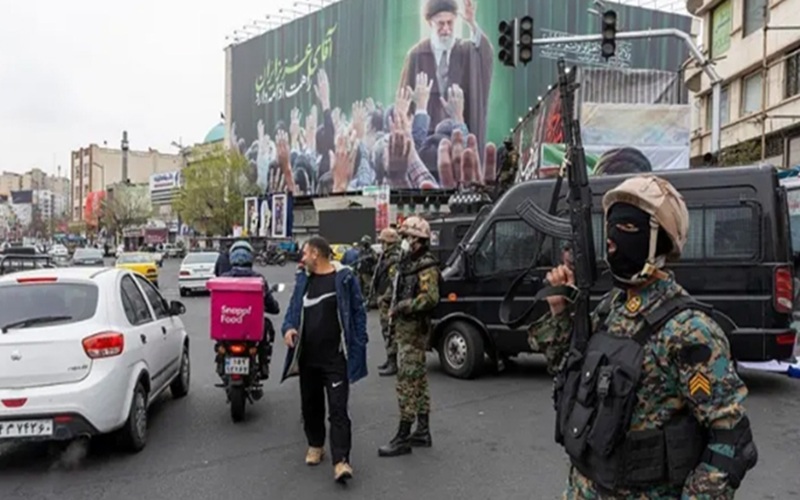

As regime insiders warn that public patience is running out and call for negotiations, the continued glorification of war reveals a deeper fear: losing the shield that has protected the regime from popular unrest.
The Iranian regime’s contradictory behavior has become increasingly difficult to conceal. While regime-affiliated experts warn that the public’s capacity to endure worsening economic and social pressures is nearing its limit, and officials increasingly point to negotiations and an end to the current isolation as the only way out, the regime continues to glorify war and revenge.
This contradiction raises a fundamental question: If the regime is genuinely concerned about the country’s future, why does it continue to beat the drums of war when its own officials warn that even another shock to living costs could ignite a social explosion?
On August 21, regime cleric Naser Rafiei acknowledged this danger on state television. Referring to the possibility that a spark could trigger a wider conflagration, he warned officials to be careful, saying that “an ill-considered price increase could create this spark” and urging them to pay attention because the country had already experienced such situations.
The warning is revealing. The regime understands that the social situation is volatile. It knows that another economic shock could turn accumulated anger into open unrest.
Yet the rhetoric of war and revenge continues.
War Is Not a Sign of Strength
The insistence on war cannot simply be interpreted as evidence of strength. In fact, the opposite may be closer to the truth.
To understand why, it is necessary to examine the nature of the ruling system and its four-decade-long relationship with war and repression.
From its earliest years, the regime repeatedly used war as a means of diverting attention from domestic grievances. During the Iran-Iraq War, the slogan of continuing the war “until the sedition is removed from the world” was used to place the country’s political and social demands under the shadow of a permanent state of emergency.
The eight-year war came at an enormous cost, with vast destruction, hundreds of thousands of casualties, and immense economic losses. More importantly for the regime, the wartime environment provided a powerful justification for suppressing dissent and postponing demands for political and social change.
The pattern did not disappear with the end of that war.
War and Repression: Two Pillars of Survival
Over the decades, the regime has repeatedly relied on two interconnected mechanisms to preserve itself: domestic repression and the exploitation of external conflict.
Conflict creates fear. Fear creates an atmosphere in which dissent can be portrayed as a threat to national security. And once society is placed under the pressure of war, the regime can attempt to justify greater repression at home.
This logic was openly reflected in the regime’s political history when its founder described the war as a “blessing.” Whatever the enormous human and economic costs, the continuation of conflict offered the ruling establishment a means of mobilizing society around survival while suppressing political opposition.
The same logic remains visible today.
Following a temporary ceasefire after a 40-day war, regime cleric Gholamreza Ghasemian openly argued that the war should resume, declaring that the regime’s fate would be determined through such conflicts and that it had gained nothing from a situation of neither war nor peace.
Such statements expose the underlying calculation: for elements within the regime, war is not merely a foreign-policy issue. It is also a political instrument.
Why Is Peace So Threatening?
This helps explain the regime’s hostility toward negotiations and its continued emphasis on revenge.
A genuine reduction in tensions would remove one of the regime’s most useful political shields. If the external threat recedes, attention inevitably returns to the internal crisis: inflation, unemployment, poverty, corruption, repression, and the absence of basic political freedoms.
The regime would have fewer excuses for the conditions inside the country.
Most importantly, without the atmosphere of war, the demands of Iranian society become harder to suppress under the banner of national security.
This is why the regime’s repeated calls for revenge should not automatically be interpreted as expressions of confidence. They can equally be read as signs of fear—fear that an end to conflict could expose the depth of the crisis at home.
The Regime’s Real Dilemma
The contradiction is now stark.
On one side, regime insiders acknowledge that the public is under extraordinary pressure. Naser Rafiei’s warning about the possibility of a price increase becoming the spark for a larger explosion is only one manifestation of this concern.
On the other side, voices within the ruling establishment continue to portray renewed conflict as necessary for the regime’s survival.
These two positions are not necessarily contradictory from the regime’s perspective. They reveal its dilemma.
The authorities know that society is approaching its limits. Yet they also fear what might happen if the conditions that have historically helped them contain that anger disappear.
The result is a vicious cycle: economic hardship generates anger; repression attempts to contain it; external conflict provides political cover; and the continuation of conflict further deepens the economic and social crisis.
“Peace and Freedom” Versus Permanent Conflict
For Iran’s organized resistance movement, the demand for an end to war has therefore been presented alongside the demand for freedom. The distinction is crucial: ending conflict is not merely a diplomatic objective but also a way of removing the conditions that allow repression to flourish under the pretext of national security.
The regime, by contrast, has increasingly treated war as a shield against internal unrest.
But that shield is becoming harder to sustain.
The population is already confronting soaring living costs, declining purchasing power, and diminishing access to basic necessities. Continued war can only intensify these pressures. Every new economic burden adds fuel to an already volatile social environment.
The regime’s own warnings about the possibility of a “spark” are therefore significant.
A Regime Trapped by Its Own Strategy
The continued cries of revenge do not erase the underlying reality. They reveal it.
A government confident in its ability to address the grievances of its population would not need perpetual conflict to maintain political control. A government capable of restoring economic stability would not fear every increase in the price of basic necessities as a potential trigger for mass unrest.
The regime’s predicament is that the very instrument it has repeatedly used to protect itself—conflict—has become increasingly dangerous for its own survival.
The more it prolongs war, the greater the economic pressure on society. The greater the economic pressure, the closer society moves toward explosion. And the more the regime fears that explosion, the more heavily it relies on repression and the rhetoric of war.
This is not a demonstration of strength. It is a structural trap.
The question facing the regime is therefore not simply whether it can continue shouting about revenge. The deeper question is how long it can continue using war as a shield while the social pressures behind that shield continue to accumulate.
The answer may ultimately be determined not on a battlefield, but in the streets of Iran.