
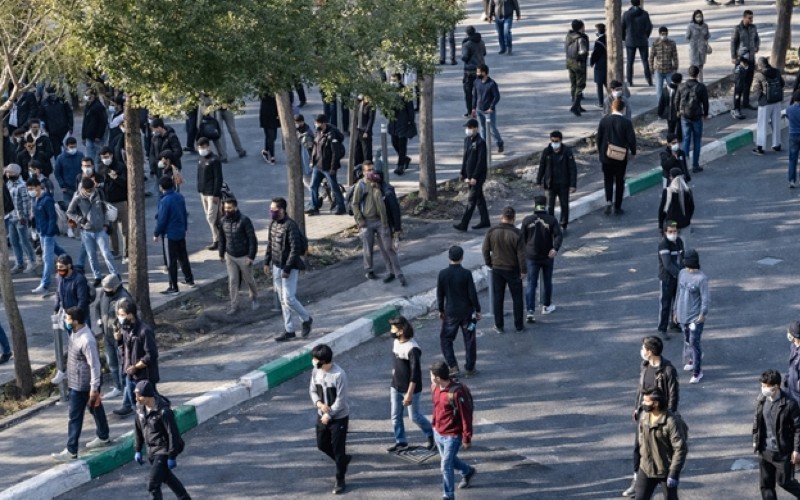

From economic confession to warnings of uncontrollable unrest, regime-aligned newspapers unintentionally expose the depth of Iran’s political and social crisis.
As protests continue across Iran, a notable shift has emerged—not in the streets, but in the language of the regime’s own media. Newspapers affiliated with, or tolerated by, the ruling establishment are no longer denying unrest. Instead, they are documenting it with growing alarm, inadvertently revealing a regime that understands the depth of the crisis but lacks viable solutions.
Taken together, recent articles published in outlets such as Etemad, Arman-e Melli, Jahan-e Sanat, and Vatan-e Emrooz form a fragmented but revealing portrait: a system increasingly fearful of society itself.
From Denial to Admission: Protests as a Structural Reality
In Etemad, sociologist Taghi Azad Armaki openly acknowledges what the regime’s authorities long sought to obscure: Iran has become a “protest society.” Writing ten days after demonstrations erupted in response to the dollar surpassing 144,000 tomans, the paper confirms that protests have spread to more than 70 cities, including areas with no prior history of organized dissent.
The article concedes that these demonstrations are not spontaneous or isolated. They are the result of years of accumulated grievances—runaway inflation, collapsing purchasing power, stagnant wages, and repeated reliance on repression or short-term economic “sedatives” to silence public anger. The continued street presence of protesters, Etemad admits, validates long-standing warnings from economists and sociologists that Iran is approaching a breaking point.
Most striking is Armaki’s warning to the state itself: repression no longer suppresses dissent—it intensifies it. For a regime that has historically relied on force, this admission reflects deep strategic anxiety.
Economic Collapse Reaches the Middle Class
Arman-e Melli moves the alarm further up the social ladder. The paper stresses that economic hardship has now engulfed the middle class, traditionally a stabilizing force in Iranian society. According to the article, when even this group “can no longer endure,” the condition of poorer and marginalized populations becomes self-evident.
The newspaper explicitly recognizes the legitimacy of public anger, stating that no authority can credibly deny people’s right to protest under such conditions. Temporary measures such as cash handouts or food vouchers are described as ineffective painkillers—incapable of preventing the next wave of protests.
This framing reflects a regime grappling with a dangerous realization: economic collapse is no longer peripheral. It is systemic, visible, and politically destabilizing.
Elite Voices Confirm the Depth of Discontent
In Jahan-e Sanat, even establishment insiders break with traditional rhetoric. Former Minister of Culture Ali Jannati acknowledges that continued sanctions, uncontrolled money printing, and the failure to repatriate oil revenues have fueled public outrage. He explicitly states that many protesters—particularly in the bazaars—are “right” in their demands and have taken to the streets because they saw no alternative.
Similarly, Mohammad Kazem Anbarlouei, a senior figure in the regime’s Islamic Coalition Party, concedes that market protests stem directly from currency collapse and price chaos. His insistence that “the market needs stability” underscores the regime’s fear of losing the bazaar—a sector historically critical to political control.
When figures from both the so-called reformist and principlist camps validate the protests, it signals not pluralism, but panic.
Fear of the Next Phase: From Protest to Loss of Control
The most revealing anxiety appears in Vatan-e Emrooz, a hardline outlet that frames unrest as a looming security threat. While acknowledging deep structural economic grievances—chronic inflation, unemployment, inequality—it warns that these conditions could be “exploited” and spiral beyond control.
The article’s core fear is not the current scale of protests, but their potential trajectory. It repeatedly references the danger of a spark igniting widespread unrest that the state may no longer be able to contain. Calls for “immediate and sincere” attention to economic demands are less about reform and more about preventing collapse.
This is the language of a regime that recognizes it is standing on unstable ground.
A Crisis of Legitimacy, Not Just Economics
Across these outlets, one pattern is unmistakable: declining political legitimacy. Etemad cites polling data suggesting that if elections were held today, over 25 percent more people would abstain, adding to an already massive block of disengaged and dissenting citizens. The implication is stark—electoral participation, once a symbolic pillar of regime legitimacy, is eroding rapidly.
Even regime-friendly analysts admit that hunger, malnutrition, and shrinking household consumption are widespread. When a system can no longer ensure basic living standards, it begins to lose not only consent, but fear-based compliance.
Conclusion: A Regime Afraid of Society
What unites these articles is not concern for reform, but fear of consequence. Iran’s state-aligned media now openly describe a society that is angry, exhausted, and increasingly ungovernable. The regime understands that suppression, economic stopgaps, and rhetorical concessions have failed.
In attempting to manage the narrative, these outlets have instead exposed a deeper truth: the ruling system fears the people more than it trusts its own power. A government that publicly debates how to prevent protests from “getting out of control” is already confronting the limits of coercion.
The streets may carry the sound of dissent—but the regime’s own newspapers now echo it, in the language of alarm.