


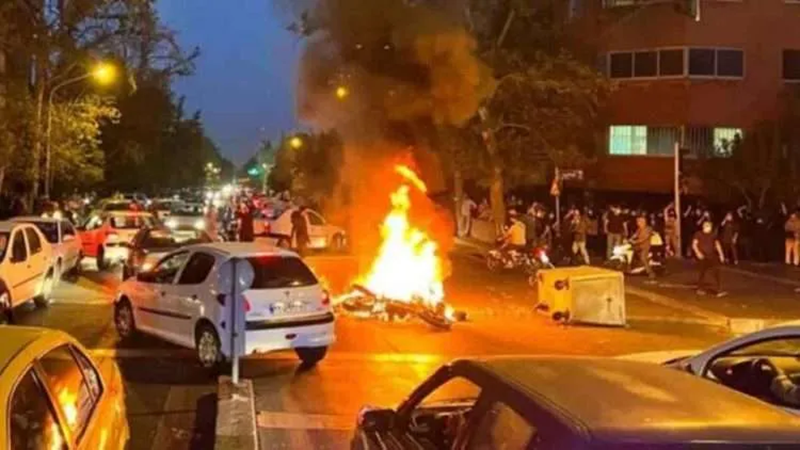

Parliamentary education spokesperson reveals up to 45% of protesters in some provinces were under 20, exposing the regime’s growing fear of a defiant generation.
Recent statements by senior figures of the Iranian regime have once again exposed the significant role of students in nationwide protests. Ehsan Azimi Rad, the spokesperson of the Education Commission of the regime’s parliament openly acknowledged the large-scale participation of teenagers in the recent uprisings—an admission that underscores the regime’s deep anxiety about a generation unwilling to remain silent.
According to remarks published on February 18, 2026 by the state-affiliated media outlet Entekhab, Azimi Rad stated:
“Approximately 17 percent of those participating in the recent protests were teenagers, the majority of whom were students.”
He further admitted:
“In some provinces, up to 45 percent of the protesters were under the age of 20.”
These figures indicate that rebellious students have become one of the central pillars of the protests. The official even acknowledged that “in some schools, an entire class had participated in the protests,” describing the situation as “undesirable.”
Contradictions with the Regime’s Narrative
These admissions stand in contrast to previous claims by the regime’s Supreme Leader, who had attributed the protests to foreign interference. The regime’s own officials now present a different picture—one that reflects deeply rooted domestic discontent.
The visible and organized presence of rebellious students demonstrates that dissatisfaction extends far beyond political elites and into the core of society.
Claims of Release, Yet Talk of “Crimes”
Azimi Rad also commented on detained students, claiming:
“All detained students have been released. At present, no student remains in custody.”
However, in the same breath, he stressed the need for accountability for those who had committed “crimes.” This contradictory stance raises serious questions. If all students have indeed been released, why reintroduce the language of criminality?
Earlier reports had pointed to widespread arrests of teenagers, with numerous families speaking of security pressure and intimidation. While regime officials now attempt to project an image of control, their repeated focus on rebellious students suggests deep concern at the highest levels of power.
Schools as a Security Concern
Azimi Rad, went on to call for strengthening ideological and educational programs in line with the regime’s “Fundamental Transformation Document.” He emphasized that the Ministry of Education must implement programs aimed at preventing the recurrence of student participation in protests.
“The interaction between students, teachers, and schools must be organized in such a way that we do not witness such participation,” he stated.
These remarks reveal that schools have increasingly become viewed through a security lens by the regime. The fact that an official would highlight that “even an entire class” took part in demonstrations illustrates the breadth of dissatisfaction.
Rebellious students are no longer a marginal phenomenon. They have become part of the country’s social reality.
Regime Expressions of “Regret” Amid Deadly Crackdown
In another part of his remarks, the regime official expressed regret over casualties and said, “Planning must be done so that such incidents are not repeated in schools.” He added that “if any student is in detention, the matter must be followed up.”
Yet these expressions of regret stand in stark contrast to reports indicating that at least 300 students were killed by the regime’s repressive forces during the January uprising. The gap between rhetorical concern and the regime’s security-driven response highlights a profound contradiction.
He also referred to the “intellectual and mental roots” of the issue, describing it as dangerous. He acknowledged economic hardships faced by teachers, implicitly linking socioeconomic grievances to unrest.
A Generation That Refuses Silence
The admissions by Iranian regime officials lay bare an essential reality: a generation raised under four decades of repression and restriction has now stepped onto the political stage.
The regime’s visible fear of schools and universities reflects a society in profound turmoil. Four decades of suppression have failed to extinguish public dissent. The prominent presence of rebellious students signals a widening and irreparable rift between Iranian society and the regime’s power structure—one that increasingly points toward demands not for reform, but for fundamental change.