


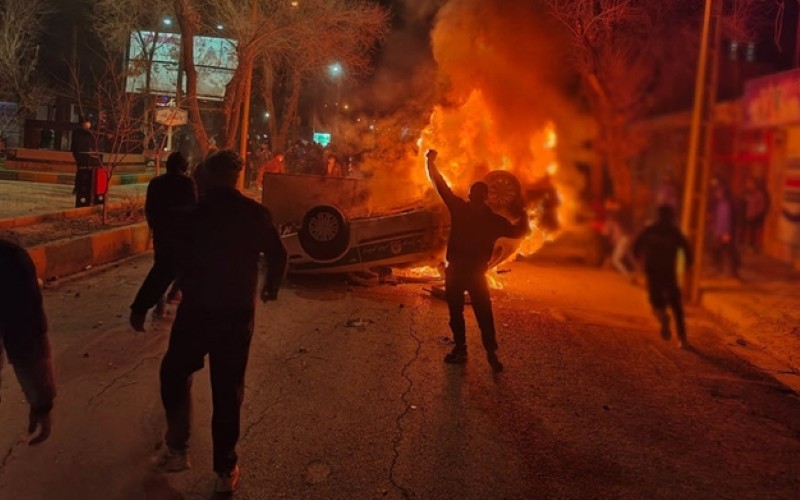

From armed clashes in Dalahu to coordinated attacks on municipal and tax centers in major cities, resistance units push the uprising into new territory
Uprising Intensifies Across Urban and Rural Iran
Newly received images from the continuing January 2026 uprising reveal a sharp escalation in confrontations between resistance units and regime forces across Iran. From armed clashes and the disarmament of IRGC personnel in the western county of Dalahu to the burning of tax offices and other regime’s buildings in Tehran and Isfahan, resistance networks operating under the slogan “We will take Iran back” have broken through the regime’s security blockade and extended the geography of the uprising to remote towns and villages.
Dalahu: Armed Resistance and Disarmament of IRGC Forces
In one of the most significant developments, resistance youths in the village of Qalkhani, located in Dalahu County, confronted units of the Islamic Revolutionary Guard Corps and the Ministry of Intelligence on January 22, 2026. Regime forces had launched a violent raid aimed at arresting five injured protesters.
According to available footage and reports, local resistance fighters repelled the assault, forced regime units to retreat, and succeeded in disarming four IRGC members. Four Kalashnikov rifles were seized during the confrontation, while intelligence forces reportedly fled the area under pressure from local residents and resistance units.
Attacks on Regime Financial and Administrative Centers
Visual reports from Tehran’s Nezamabad district document the burning of regime-linked facilities widely associated with repression and economic exploitation. Similar actions were reported in Gorgan and at Tehran Customs facilities on January 9, where protesters blocked streets despite heavy deployment of tear gas.
Chants including “Death to Khamenei” and “This year is the year of blood—Khamenei will be overthrown” echoed through the streets as protesters confronted security forces and targeted symbols of state authority.
Municipal Buildings Set Ablaze Across Multiple Cities
Further footage shows municipal buildings set on fire in Shahreza, Isfahan Province, and in Baghestan, underscoring a coordinated escalation against institutions viewed as tools of repression and extortion. Protesters described municipalities as central instruments for enforcing regime pressure on citizens.
At the same time, protests and street clashes were reported in Lahijan, Rudsar, Mobarakeh, Hamedan, Kermanshah, Abadan, Zarrinshahr, Qaemshahr, and Phase 4 of Mehrshahr in Karaj, highlighting the nationwide scope of the unrest.
A Clear Rejection of All Forms of Dictatorship
Across these flashpoints, demonstrators repeatedly emphasized a decisive political boundary against both past and present authoritarianism. Chants such as “Death to the oppressor, whether Shah or Supreme Leader,” “Women, Resistance, Freedom,” and “Free Iran” reflected a broad national demand for popular sovereignty and democratic governance.
Residents in several areas were seen openly supporting resistance units, chanting “Victory, victory,” signaling growing public confidence in the uprising and its capacity to reclaim Iran from authoritarian rule.