


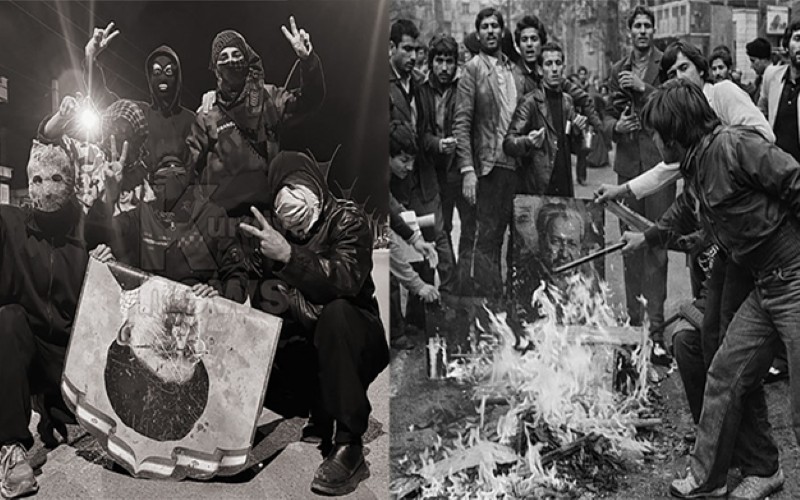

How more than a century of resistance has led to a nationwide demand for freedom, dignity, and the end of all forms of inherited rule in Iran
If we imagine Iran’s last 120 years of uprisings as a staircase, each generation has climbed one step higher toward freedom and equality. No single uprising stood alone. Each one pushed society forward, weakened dictatorship, and prepared the ground for the next wave of resistance. From this perspective, every uprising has brought Iran closer to the final defeat of authoritarian rule.
The January 2026 uprising (Dey 1404) must be understood as one of the most important stages in this long journey. It represents a clear and collective rejection of all forms of inherited dictatorship—whether royal, religious, or ideological. What Iranians are demanding today is not a reform of tyranny, but its complete burial.
What All Dictatorships in Iran Have Had in Common
Despite their different names and appearances, dictatorships in modern Iran have followed the same basic pattern. They have relied on a familiar set of tools to keep absolute power:
- Turning every aspect of life into a “security issue”
- Ignoring or abusing the constitution through unchecked political and ideological power
- Presenting the ruler—whether king or supreme leader—as sacred and untouchable
- Refusing to answer public demands, whether economic, social, or political
- Silencing all voices except the official one
- Controlling the economy to enrich loyal elites while widening social inequality
- Weakening education and promoting ignorance to prevent critical thinking
- Imprisoning, exiling, or killing critics and opponents
- Building dictatorship into permanent institutions and systems
In such systems, thoughts, beliefs, and even personal identities must pass through the filter of the ruling power. Anyone who refuses to submit is labeled an enemy and becomes a target of propaganda, defamation, imprisonment, exile, or execution.
Understanding these mechanisms helps explain why the January 2026 uprising is so significant. It directly challenges the foundations of dictatorship, not just its surface symbols.
Why Freedom Matters
A society without freedom does not merely lack elections or political parties. It slowly loses its creativity, dignity, and human potential. When people are denied freedom of thought and expression, they cannot even ask basic questions—let alone search for answers or solutions.
True freedom means political freedom in its full sense: freedom of belief, speech, writing, criticism, and choice. At its core, it defines the relationship between the state and the individual. By this standard, the ruling system of velayat-e faqih has failed completely. For 47 years, it has relied on lies, repression, and the destruction of truth to survive.
The Regime’s Strategic Failures
Despite its brutality, the clerical regime has failed again and again:
- It failed to turn ignorance into a permanent condition for society
- It failed to drag the nation behind its war-driven ideology
- It failed to impose compulsory hijab and institutionalized misogyny
- It failed to crush people’s will through poverty, corruption, and fear
Instead of submission, these policies produced resistance. Instead of silence, they gave rise to generations of defiance.
From Past Uprisings to a National Will
From the protests of June 1981 to the nationwide uprisings of 2017, 2019, and 2022, all previous movements are now converging. They have found their collective expression in the expanding and determined uprising of January 2026.
This uprising is no longer isolated or temporary. It is evolving into a nationwide will—shared across cities, generations, and social groups. Its direction is clear: ending inherited dictatorship once and for all.
There is little doubt that if this movement continues on its current path, it will mark a historic chapter in Iran’s future. One in which the land of Iran becomes, permanently, a graveyard for dictatorship—and a foundation for freedom, equality, and human dignity.