


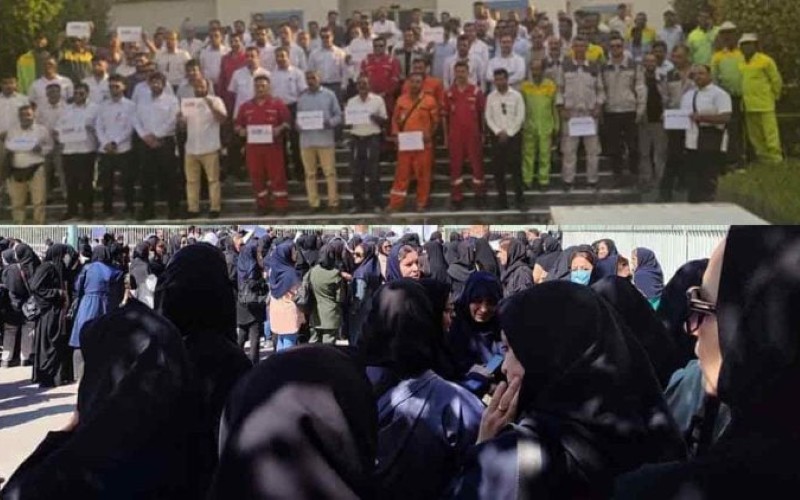

On Tuesday, September 30, 2025, coordinated demonstrations by teachers, health workers, bakers, oil personnel, retirees and farmers underscored a mounting social revolt driven by economic hardship and institutional injustice.
A broad, sustained wave of protest rolled across Iranian cities on Tuesday, September 30, 2025, as groups from different sectors voiced the same core grievances: unpaid wages and subsidies, systemic discrimination, and an economy that no longer secures basic livelihoods. Video footage and field reports circulating on social media show demonstrations from Tehran to Mashhad, Yazd to Ahvaz, and Tabriz to Kermanshah—evidence of unrest that is both deepening and expanding geographically.
Teachers and education job applicants: “Justice betrayed”
In the capital, hundreds of candidates for the Ministry of Education’s recruitment exam staged their third consecutive day of protests outside the ministry. Many had devoted a year to preparing for what they were told would be a fair selection process — only to face last-minute rule changes, late publication of exam guidance, and massive reductions in promised positions. Officials had earlier pledged roughly 30,000 openings; the actual legitimate capacity was declared at 11,000, and thousands were eliminated from the list on procedural grounds. Angry applicants chanted that the process had been hijacked by quota systems that favor insiders and incumbent staff. Independent and rights-focused reporting has repeatedly documented crackdowns and punitive measures taken against teachers and education activists across Iran this year.
September 30—Tehran, Iran
Teachers rallied outside the Ministry of Education, protesting discriminatory hiring exam policies on spousal and employment scores. They chanted: “We won’t back down until we get our rights!”#IranProtests pic.twitter.com/qnEPUqBpww— People's Mojahedin Organization of Iran (PMOI/MEK) (@Mojahedineng) September 30, 2025
Healthcare staff in Tabriz: wages delayed, morale shattered
In Tabriz, medical staff and hospital workers gathered in front of the main university medical building to protest chronic pay delays, meagre bonuses, and stark disparities in overtime and allowances between administrative and frontline personnel. Nurses pointed to mounting workloads and warned that managerial neglect is putting lives at risk. These demonstrations form part of a longer pattern of unrest among health workers who demand both wage justice and implementation of legally mandated benefit rules.
September 30—Tabriz, northwest Iran
Healthcare staff of Tabriz University of Medical Sciences rallied, protesting non-implementation of Health Ministry rulings, delayed benefits, and discrimination in pay. They warned continued neglect burdens frontline workers.#IranProtests pic.twitter.com/l9vkdzYiWx— People's Mojahedin Organization of Iran (PMOI/MEK) (@Mojahedineng) September 30, 2025
Bakers: unpaid subsidies and a bread crisis
Protests by bakers—one of the most volatile fault lines in recent months—spread from Yazd to Mashhad and Khorramabad. Bakers allege long delays in receiving state subsidies and point to mismanagement of the Nanino bread distribution system that has raised production costs and squeezed incomes. In several cities vendors accused the state system and affiliated enterprises of corruption and payment arrears, chanting that the government “promises but never pays” while ordinary families face empty tables. The baker demonstrations echo similar nationwide actions documented repeatedly this year.
September 30—Yazd, central Iran
Bakers rallied outside the governor’s office, protesting unpaid subsidies and unresolved trade issues that threaten their livelihood.#IranProtests pic.twitter.com/6yXBsLQLpu— People's Mojahedin Organization of Iran (PMOI/MEK) (@Mojahedineng) September 30, 2025
Oil sector and Ahvaz–Asaluyeh: labour unrest at the economic core
Workers and pensioners in Ahvaz and the oil hubs of Asaluyeh and the South Pars platforms staged protests demanding immediate payment of overdue wages, benefits and the enforcement of judicial rulings on labour entitlements. Contractors and platform personnel warned that their patience has ended and that persistent noncompliance with court orders and delayed payments threaten both livelihoods and production continuity in Iran’s most strategic sector. Reports show these protests are part of a mounting labour movement across energy and heavy industry.
September 30—Asaluyeh & Shirinu, southern Iran
Hundreds of contract workers of Pars Oil & Gas rallied again at South Pars platforms, demanding enforcement of court ruling 3188 and payment of benefits. Their message: workers’ patience is running out.#IranProtests pic.twitter.com/dHJpKNC4pa— People's Mojahedin Organization of Iran (PMOI/MEK) (@Mojahedineng) September 30, 2025
Retirees, farmers and other groups: solidarity across grievances
Retirees in Kermanshah representing multiple pension funds protested delays and inadequacy of pensions, while farmers and tractor owners in Yazd demanded restoration of fuel allocations essential to seasonal work. In Rasht, investors in a stalled commercial complex rallied over broken contractual promises. Other assemblies—victims of spouse-support laws, public-sector retirees, and municipal workers—joined the broader chorus for economic justice. These sectoral protests, though locally specific, point to a shared reality: a growing conviction that institutional channels have failed and popular patience has been exhausted.
September 30—Kermanshah, western Iran
Retirees from civil service, military, Social Security, healthcare, telecommunications, and other funds rallied, demanding justice and fair pensions. They chanted: “We won’t rest until we get our rights!”#IranProtests pic.twitter.com/hTlYxc2djK— People's Mojahedin Organization of Iran (PMOI/MEK) (@Mojahedineng) September 30, 2025
The demonstrations on September 30, 2025, are a warning sign: when teachers, nurses, bakers, oil workers and retirees march together—each naming their own grievances but united by economic desperation—the pressures on the state are both immediate and cumulative. Policymakers who ignore these converging crises do so at their own peril; for millions of Iranians, the demand is simple and urgent: dignity, timely pay, and the protection of livelihoods.