


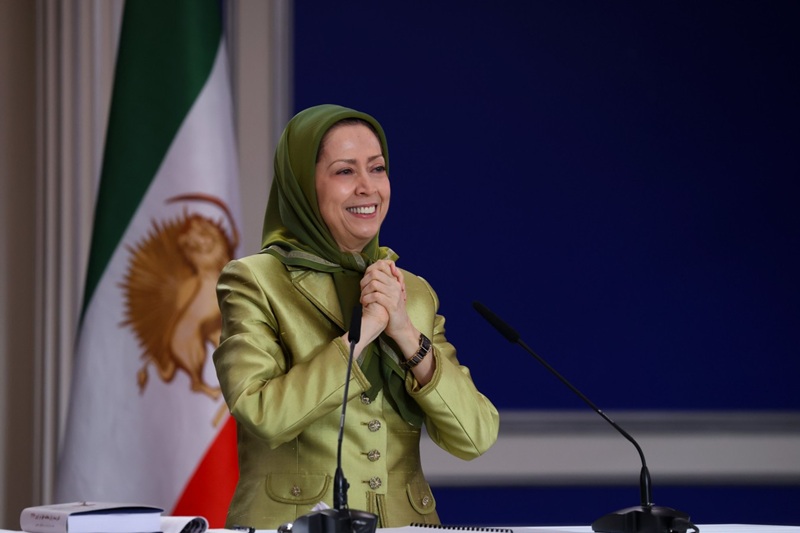

Why Maryam Rajavi’s Ten-Point Plan Represents a Coherent Roadmap for a Free Iran
Iran is not merely a geopolitical entity in crisis. It is a civilization-state with millennia of intellectual, cultural, and political development. Throughout its modern history, the Iranian people have repeatedly demonstrated their demand for liberty, accountable governance, social justice, and national dignity. Every major uprising—from constitutionalism to contemporary protests—has centered on one fundamental demand: popular sovereignty.
It is within this historical continuum that the Ten-Point Plan for the future of Iran, first presented in 2006 at the European Parliament by Maryam Rajavi, must be understood. The plan is not a rhetorical manifesto. It is a structured democratic framework for political transition and post-theocratic governance.
Popular Sovereignty as the Foundational Principle
The first pillar of the plan is explicit: rejection of the doctrine of Velayat-e Faqih and affirmation of a republic based on universal suffrage and pluralism. This is not merely an electoral mechanism; it is a constitutional paradigm. Legitimacy derives from the ballot box, not divine mandate.
A genuinely democratic republic, as outlined in the plan, blocks structurally any regression toward authoritarian concentration of power. The free circulation of political authority through competitive elections creates systemic resilience against dictatorship.
Civil Liberties as Structural Safeguards
The Ten-Point Plan guarantees freedom of expression, freedom of the press, freedom of assembly, freedom of political parties, and freedom in cyberspace. These are not ornamental rights; they are functional safeguards that prevent the monopolization of narrative and power.
The plan further calls for the dissolution of repressive institutions—including the Islamic Revolutionary Guard Corps (IRGC), the Quds Force, the Basij militia, the Ministry of Intelligence, and other coercive apparatuses embedded in civilian life. In transitional justice theory, dismantling repressive infrastructure is a precondition for durable democratization.
Human Rights and the Rule of Law
Central to the program is adherence to the Universal Declaration of Human Rights. The plan explicitly demands the abolition of the death penalty and the prohibition of torture. It calls for accountability regarding past political massacres and for the elimination of censorship and ideological inquisition.
An independent judiciary—based on presumption of innocence, the right to defense, public trials, and judicial independence—is positioned as a cornerstone of the new republic. The abrogation of religiously imposed penal codes and revolutionary courts signals a shift from ideological jurisprudence to international legal standards.
Secularism and Equal Citizenship
The separation of religion and state forms another core principle. Secular governance, in this framework, does not negate religious freedom; it protects it. By ensuring that no creed is imposed through state power, the plan guarantees equality before the law for all citizens, regardless of faith.
Equally central is full gender equality in political, social, cultural, and economic life. The plan explicitly supports equal participation of women in political leadership, freedom of choice in dress, marriage and divorce rights, and equal access to education and employment. Gender parity is not framed as a symbolic reform but as a structural requirement for democratic legitimacy.
National Cohesion Through Decentralization
The program addresses the rights of Iran’s ethnic communities by endorsing autonomy within a unified national framework, consistent with proposals advanced by the National Council of Resistance of Iran. The objective is the elimination of systemic discrimination while preserving territorial integrity—an approach consistent with comparative federal and decentralized governance models.
Economic Justice and Free Enterprise
The Ten-Point Plan supports a market economy grounded in equal opportunity. It calls for the protection of workers, farmers, nurses, teachers, civil servants, and retirees, while also endorsing private enterprise and competitive markets.
This synthesis reflects a social-market orientation: economic dynamism combined with social protections. National wealth, under this vision, would be redirected from militarization and ideological expansionism toward domestic prosperity, infrastructure, and poverty alleviation.
Environmental Restoration
The plan acknowledges the extensive environmental degradation under clerical rule and commits to environmental protection and rehabilitation. Sustainable development is framed not as a secondary policy domain but as a national priority tied to long-term human security.
A Non-Nuclear Iran and Responsible Foreign Policy
The final principle is clear: a non-nuclear Iran free of weapons of mass destruction, committed to peaceful coexistence and international cooperation.
A state whose legitimacy stems from domestic consent does not require external confrontation to sustain itself. Expansionism, proxy warfare, and nuclear brinkmanship are characteristics of regimes seeking strategic leverage to offset internal illegitimacy. A democratic Iran, as envisioned in this plan, would instead pursue regional stability and mutually beneficial engagement.
An Integrated Democratic Architecture
The most analytically significant feature of the Ten-Point Plan is its internal coherence. Each principle reinforces the others. Secularism strengthens judicial independence. Judicial independence protects civil liberties. Civil liberties sustain electoral legitimacy. Electoral legitimacy underpins peaceful foreign policy. Economic justice stabilizes democratic participation.
This is not a collection of aspirational clauses. It is an organically interconnected democratic architecture.
International Recognition
Over the years, the plan has garnered attention and support from lawmakers in the United States Congress and various European parliaments, as well as from international jurists and policymakers. Such endorsements suggest that the framework is viewed abroad as a credible blueprint for democratic transition rather than a symbolic opposition platform.
Conclusion
The future of Iran will ultimately be determined by its people. Yet transitions require more than protest; they require institutional design. The Ten-Point Plan articulated by Maryam Rajavi provides such a design—rooted in universal suffrage, secular governance, human rights, gender equality, economic opportunity, environmental stewardship, and peaceful international engagement.
In political theory terms, it represents a constitutional roadmap from theocracy to pluralist democracy.
For a nation that has repeatedly paid the price of authoritarian relapse, the value of a coherent democratic blueprint cannot be overstated.