


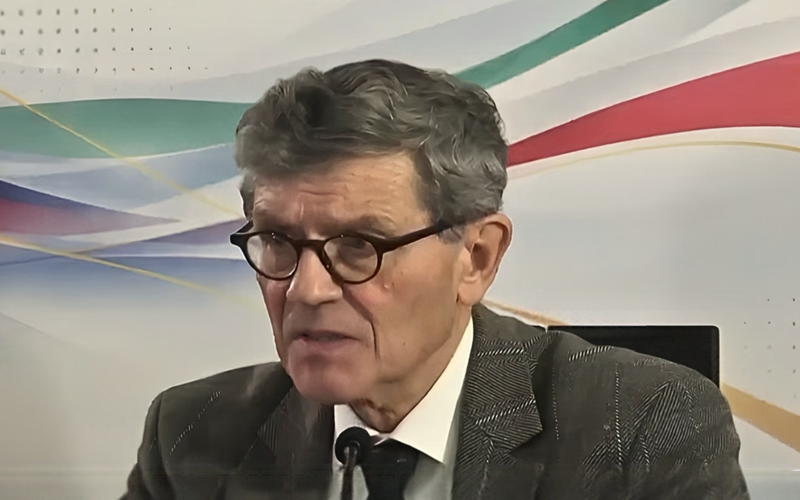

Hans-Ulrich Seidt argues that both diplomatic engagement with Iran’s regime and foreign military action have failed to deliver fundamental change, calling for a strategy centered on Iran’s organized opposition.
At a conference in Berlin titled “The Crisis in Iran and the Democratic Solution,” Dr. Hans-Ulrich Seidt, former German ambassador to Afghanistan and South Korea, called for a fundamental reassessment of German and European policy toward Iran. He argued that decades of diplomatic engagement and the limitations of foreign military action demonstrate the need for a strategy that recognizes Iran’s organized opposition as a central force for democratic change.
Seidt, who served as Germany’s ambassador to Afghanistan from 2006 to 2008 and to South Korea from 2009 to 2012, said European policy had traditionally focused on managing individual problems, including Iran’s nuclear program, missile development, regional activities, and human rights violations. Although this approach was presented as comprehensive, he argued, it lacked an overarching strategic perspective.
The fundamental question, Seidt said, should not simply be what can be achieved through negotiations with Iran’s regime, but what drives its political and ideological objectives and what role the opposition can play in shaping the country’s future.
Diplomacy and Military Action Have Failed to Deliver Change
Seidt argued that neither diplomatic negotiations nor foreign military intervention had succeeded in compelling Iran’s regime to fundamentally change its domestic or foreign policies.
He pointed to the failures of externally imposed regime change in neighboring Iraq and Afghanistan and questioned the strategic results of the US and Israeli military campaign against Iran in 2026. In his assessment, the limited results of military action, alongside the shortcomings of diplomatic engagement, underscore the need for an alternative approach.
The former ambassador said the European Union and Germany should pursue a policy aimed at change from within Iran rather than relying on foreign intervention or negotiations that leave the regime’s underlying structures intact.
He cited Iran’s successive waves of nationwide protests since 2017, including the 2026 uprising, as evidence of the Iranian people’s determination to fight for a different political future.
A realistic European strategy, he argued, must therefore support the resistance of Iranian women and men inside the country and make their struggle a central component of policymaking.
Why Organized Opposition Matters
Seidt stressed that sustainable political change requires more than widespread public discontent. It also depends on organized resistance networks, an established opposition structure, a long-term political program, and a clearly defined plan for a transitional period following the regime’s end.
He argued that a democratic future for Iran would require a republic based on the separation of religion and state, alongside a defined framework for a time-limited political transition.
Without these elements, he said, political transformation under current conditions would be difficult to envisage. European policymakers must therefore identify and engage with political forces that maintain an active presence in Iran, sustain organized resistance, and have developed concrete programs for the country’s future.
This, Seidt argued, requires a shift away from treating Iran’s political crisis exclusively as a matter of relations between governments.
NCRI and PMOI Must Be Part of Europe’s Strategy
Seidt specifically identified the National Council of Resistance of Iran (NCRI) and the People’s Mojahedin Organization of Iran (PMOI/MEK) as forces that Germany and Europe should incorporate into their strategic calculations.
Reflecting on the nuclear negotiations that led to the 2015 agreement, he said that although the diplomatic process achieved an arms-control arrangement, it failed to address the Iranian regime’s broader exercise of power and regional influence.
The lesson, he argued, is that European policy must take a comprehensive view of Iran’s political system, including the organized opposition capable of advancing an alternative.
“If we overlook this strategic force, fail to incorporate it into our calculations and, above all, ignore it as a party to dialogue, we will lose an important political opportunity to advance internal transformation in Iran,” Seidt said.
He concluded that Germany and the European Union must recognize the NCRI and PMOI as strategic factors in shaping Iran’s future. For Seidt, a credible policy toward Iran requires moving beyond a narrow focus on negotiations and security concerns to address the question of political change itself.
His message was clear: a sustainable democratic future for Iran must be rooted in the Iranian people’s own resistance, supported by an organized opposition and a defined political alternative.