As Iran approaches the 40th day since the brutal killings of protesters during the January 2026 uprising (Dey 1404), two imprisoned elite students — Ali Younesi and Amirhossein Moradi — have issued powerful and defiant messages from prison.
The statements, published on the campaign page supporting the two political prisoners, reaffirm the continuation of the path of resistance, honor the fallen martyrs of the uprising, and draw a clear line against all forms of dictatorship — whether religious or monarchical.
Younesi is currently held in Qezel Hesar Prison, while Moradi remains imprisoned in Evin Prison — two facilities notorious for holding political detainees and subjecting prisoners to harsh conditions.
Ali Younesi: “We Are Condemned to Victory”
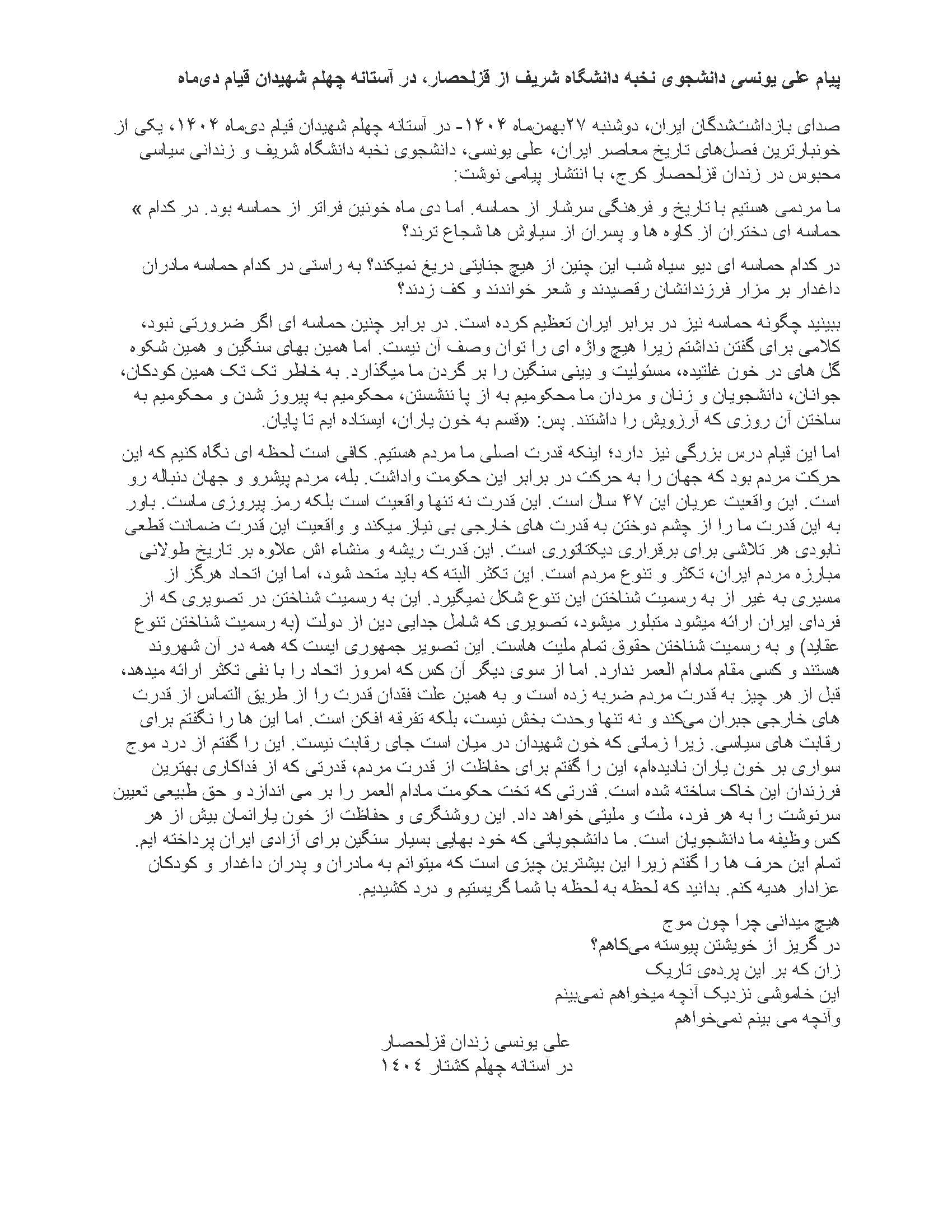
In his message, Ali Younesi, a jailed student from Sharif University, described the January massacre as an event surpassing even the epic traditions of Iranian history.
“We are a people with a history full of heroism,” he wrote, “but the bloody January was beyond epic.”
Younesi invoked the depth of sacrifice shown by young women and men who stood against repression, emphasizing that no words are capable of fully describing the scale of courage or the cruelty unleashed by the ruling regime. He referred to grieving mothers who stood at the graves of their children with defiant dignity — transforming mourning into resistance.
According to Younesi, the heavy price paid by the martyrs imposes a binding responsibility on survivors:
“We are condemned not to sit down. We are condemned to win. We are condemned to build the day they dreamed of.”
The People as the Primary Force of Change
Younesi stressed a central lesson of the uprising: the true power lies with the people of Iran themselves.
He argued that it was the people’s movement that forced the world to react — not foreign governments initiating change. For him, the events of the past 47 years demonstrate that “the people are the vanguard, and the world follows.”
He rejected reliance on foreign powers, insisting that belief in the people’s own strength is both the key to victory and the guarantee against the re-establishment of any form of dictatorship.
A Vision for a Democratic Republic
Younesi outlined a vision for Iran’s future built on:
- Separation of religion and state
- Recognition of religious diversity
- Equal rights for all nationalities
- A republic in which all are citizens
- No lifetime rulers
He warned that anyone who presents “unity” through the denial of pluralism ultimately weakens the people’s power and compensates for that weakness by appealing to foreign powers. Such approaches, he suggested, are divisive and harmful to the struggle.
“This is not about political competition,” he wrote. “When the blood of martyrs is on the ground, there is no place for rivalry.”
Younesi emphasized that safeguarding the sacrifices of the fallen is a special duty of students — many of whom have themselves paid a heavy price in the struggle for freedom.
He concluded from Qezel Hesar Prison with words expressing solidarity with grieving families, stating that he and his fellow students have cried and suffered alongside them every moment.
Amirhossein Moradi: “A Thousand Tulips Have Bloomed”
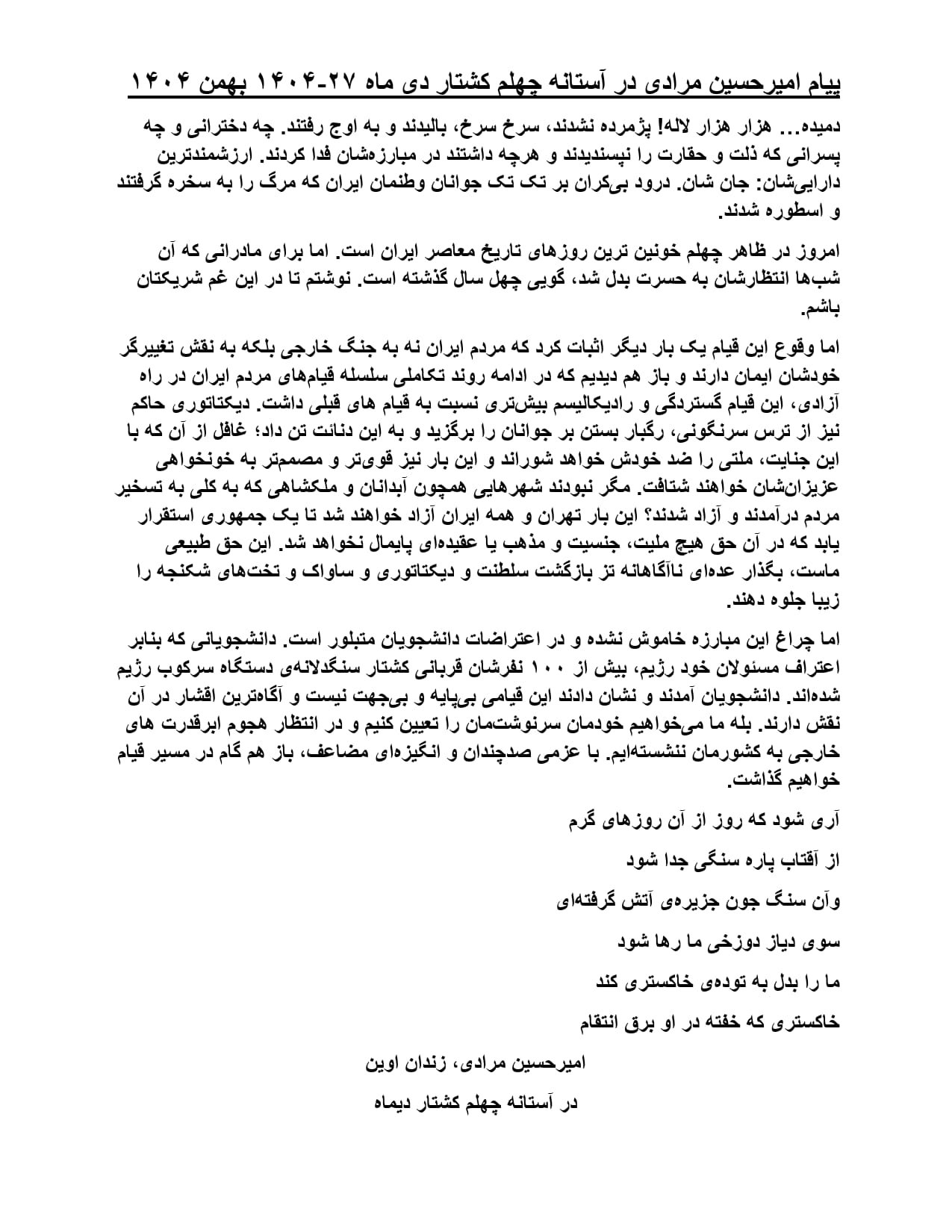
In a separate message from Evin Prison, Amirhossein Moradi opened with a line from a well-known patriotic song: “From the blood of the youth of the homeland, tulips have grown.” He declared that thousands upon thousands of such tulips have risen — unwithering, vibrant, and red.
Moradi paid tribute to young women and men who refused humiliation and sacrificed their most valuable possession — their lives — in the struggle against tyranny.
He described the 40th day not merely as a ritual commemoration, but as a reminder of the immeasurable grief of parents whose waiting turned into permanent loss.
The Uprising Was Indigenous and Conscious
Moradi emphasized that the uprising once again proved that the Iranian people do not look to foreign war or outside intervention for change. Rather, they believe in their own transformative role.
He characterized the January uprising as more widespread and more radical than previous nationwide protests, part of a historical evolution of resistance movements seeking freedom.
According to Moradi, the regime, fearing its overthrow, chose to open fire on the youth — committing a crime that will only intensify the people’s determination.
He referenced cities such as Abdanan and Malekshahi, where protesters reportedly took control of large areas, declaring that “this time Tehran and all of Iran will be free.”
Rejection of All Dictatorship
Moradi explicitly rejected any attempt to rehabilitate the monarchy or beautify past dictatorship, including references to SAVAK and torture chambers.
He insisted that the future Iran must be a republic in which:
- No nationality’s rights are violated
- No gender is discriminated against
- No religion or belief is suppressed
“This is our natural right,” he wrote.
Students at the Forefront
Moradi underscored the role of university students in the uprising, noting that, by the regime’s own admissions, more than 100 students were killed in the crackdown.
He affirmed that the movement is neither baseless nor directionless, but driven by the most aware segments of society. He reiterated that Iranians seek to determine their own destiny — without waiting for foreign superpowers.
With renewed determination, he vowed that the path of uprising will continue.
A Message from Behind Bars
The statements of Ali Younesi and Amirhossein Moradi carry particular weight because they come from behind the walls of Qezel Hesar and Evin — symbols of repression in the Islamic Republic.
Their words combine mourning with defiance, grief with political clarity, and remembrance with a forward-looking vision of a democratic republic based on popular sovereignty and pluralism.
As the 40th day of the January uprising martyrs approaches, these messages serve not only as tributes to the fallen but as reaffirmations of a continuing struggle — one they insist belongs to the Iranian people themselves, and one that rejects both theocracy and any return to monarchical dictatorship.