



In the Iranian year 1403 (March 20, 2024 – March 20, 2025), the regime’s Supreme Leader Ali Khamenei demonstrated the fragile state of his regime by significantly increasing the number of executions. Compared to the previous year, executions surged by 42%, revealing the regime’s deep fear of an imminent uprising and its desperate attempts to maintain control through terror.
A Record-Breaking Year of Executions
The Iranian regime set a new and alarming record for executions in 1403, with a total of 1,153 documented cases. This number is unprecedented in recent years. Notably, 961 of these executions—amounting to 83%—took place after Masoud Pezeshkian assumed the presidency in July 2024. Due to the regime’s secretive nature and unreported executions, the actual number is likely much higher.

The final month of the Iranian calendar year, Esfand (February 19–March 20, 2025), saw an alarming increase in executions. The number rose from 21 in Esfand 1402 to 121 in Esfand 1403—a nearly six-fold surge. This sharp increase underscores the regime’s reliance on capital punishment as a tool of repression.

Public Resistance and Rebellious Youth’s Response
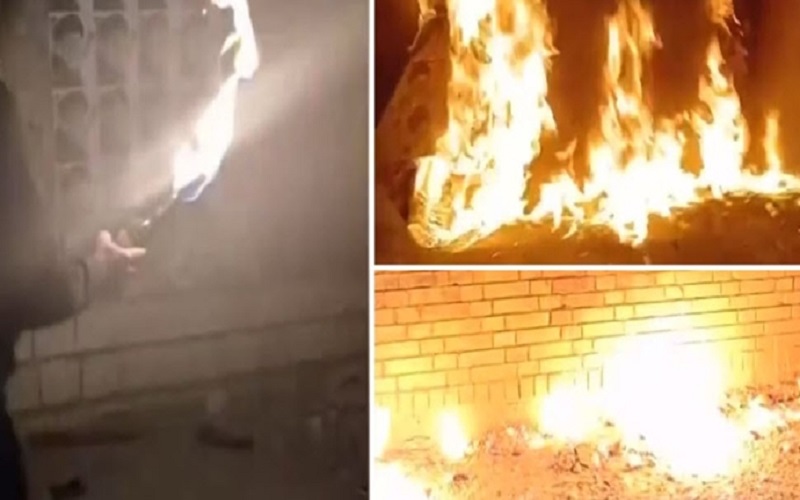
As the regime intensified its brutal crackdown, Iran’s rebellious youth launched a series of resistance operations. Their campaign, under the slogan “Fire answers execution,” sought to challenge the atmosphere of fear imposed by the regime.

First Phase: February 24, 2025
In response to the first wave of executions, rebellious youth carried out 15 operations across multiple cities, including Tehran, Isfahan, Mashhad, Zahedan, and Kermanshah. These actions were a direct response to the 17 executions carried out in the first two days of Esfand and the 854 executions under Pezeshkian’s presidency.
Second Phase: March 2, 2025
Continuing their campaign, the resistance youth executed 15 more operations. Their attacks included incendiary assaults on execution centers in Bavi (Khuzestan Province), police barracks in Kermanshah, and centers of fundamentalism and women’s suppression in Kerman. They also set fire to regime bases and government symbols, sending a strong message against the judiciary’s brutality.
Third Phase: March 5, 2025
In this round, 15 additional operations were conducted across cities such as Mashhad, Tehran, Hashtgerd, and Kerman. Targets included financial institutions linked to state corruption, a municipal building in Karaj, and centers of oppression in Miandorud and Mashhad.

Fourth Phase: March 10, 2025
As Khamenei ramped up executions during Ramadan, the rebellious youth responded with further operations, including:
- Setting fire to a fundamentalist center in Tehran.
- Incendiary attacks on the Khomeini Relief Committee in Kermanshah, an institution involved in looting public wealth.
- Attacks on IRGC Basij bases in Zarandin (Mazandaran Province), Shiraz, Mashhad, Sabzevar, Saravan, and Khash.
- Targeting regime symbols across multiple cities.

Regime’s Strategy of Fear and Resistance’s Defiance
The clerical regime has long relied on suppression, intimidation, and mass executions to maintain its grip on power. However, the events of 1403 have highlighted both its growing desperation and the escalating resistance against its rule. As the regime continues to face economic failures and political instability, it resorts to increased executions to stifle dissent.

In response, Iran’s rebellious youth have embraced a strategy of maximum resistance, launching bold operations to challenge state repression. Their actions serve as a powerful testament to the resilience of the Iranian people and their determination to break free from tyranny.