


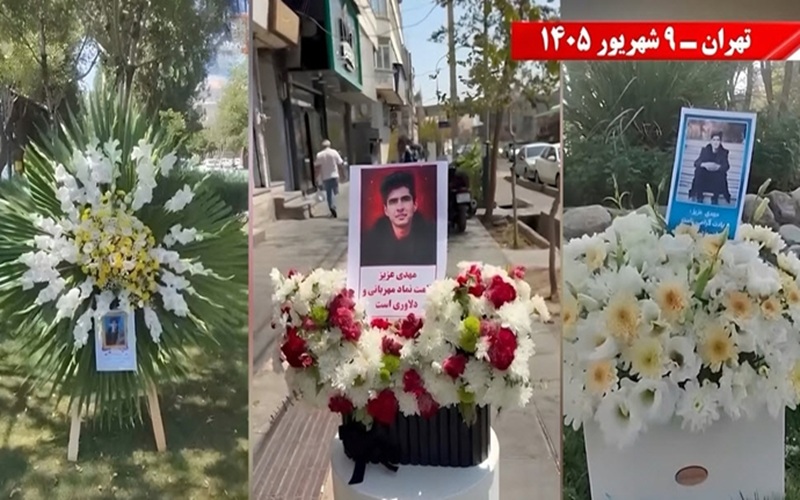

Despite the regime’s repression, PMOI Resistance Units placed bouquets and messages bearing Mehdi Khanaki’s image in public places, honoring a young political prisoner who refused to surrender under torture and threats of execution.
Forty days after the execution of 27-year-old political prisoner Mehdi Khanaki, PMOI Resistance Units returned his name to Iran’s streets.
In public places, despite the danger of arrest and severe punishment, Resistance Units placed bouquets and floral arrangements bearing Khanaki’s photograph and messages honoring his life and resistance. One wreath carried the words: “Mehdi the brave, we will never forget you. Your name is in our hearts, and your memory is with us every moment.” Another message read: “Dear Mehdi, your name is a symbol of kindness and courage.” A third declared: “Dear Mehdi, your memory is honored, your name is eternal, and your path continues.”
These acts of remembrance were more than gestures of mourning. In a country where the regime uses executions, arrests and intimidation to silence dissent, publicly honoring an executed political prisoner is itself an act of defiance.
The message from the Resistance Units was clear: the regime may execute individuals, but it cannot erase their names, their choices or the cause for which they stood.
A Young Lawyer Who Refused to Surrender
Mehdi Khanaki was a 27-year-old law graduate. From his arrest until his execution, less than five months passed. During that brief period, according to accounts from fellow prisoners, he endured prolonged physical and psychological torture, months of solitary confinement and relentless pressure to abandon his political convictions.
The regime executed him at dawn on July 22, after accusing him of membership in the People’s Mojahedin Organization of Iran (PMOI/MEK), active participation in the December protests, and involvement in obtaining and making weapons.
But the accounts left by those who shared his imprisonment portray a young man who refused to allow imprisonment to break his spirit.
One fellow prisoner recalled that Khanaki spent approximately four to five months in solitary confinement in Karaj Central Prison. Yet even in isolation, he maintained a strict daily routine. Within the few meters available to him, he reportedly walked approximately 1,500 meters every day. He organized his time carefully, incorporating prayer and exercise into his daily routine.
His discipline was not simply a means of passing the time. It reflected the determination of a prisoner who understood the fate awaiting him but refused to surrender psychologically to his captors.
“I Know I Will Be Executed”
Khanaki reportedly understood that an execution sentence was likely from an early stage of his imprisonment.
A detainee who encountered him at the Karaj Police Security detention center recalled Khanaki saying calmly:
“They seized a lot of weapons from me, and I will certainly be executed.”
Yet the knowledge that he would die did not destroy his morale. Fellow prisoners repeatedly described him as energetic, confident and steadfast.
One prisoner recalled Khanaki telling him:
“I am going to be executed. But pass on my greetings to the other guys.”
The simplicity of the statement makes it particularly striking. There was no expression of surrender or despair. Instead, Khanaki was already thinking about those he would leave behind and the message he wanted them to receive.
Another fellow prisoner described him as exceptionally kind and genuine, recalling that when they first met, Khanaki immediately asked whether he was a member of the PMOI. When he received an affirmative answer, Khanaki’s face reportedly lit up with happiness.
According to the same account, Khanaki knew what fate awaited him but remained humble, deeply committed and disciplined.
Defiance in the Courtroom
Khanaki’s most dramatic act of defiance came during his trial.
According to an account from one of his fellow prisoners, his trial was held in Branch Two of the Karaj Revolutionary Court, presided over by Judge Mehdi Shahsavari. After months of solitary confinement and severe pressure, Khanaki appeared before the court and refused to submit.
The prisoner recalled:
“Mehdi Khanaki stood eye to eye with the executioner with extraordinary courage and shouted, ‘Hail Maryam and Massoud Rajavi,’ breaking the atmosphere of fear in the courtroom.”
For the regime, the courtroom is intended to be a place where an accused prisoner is made to submit to the authority of the state. Khanaki turned it into another arena of resistance.
Another fellow prisoner wrote that Khanaki endured months of solitary confinement and unbearable pressure before appearing in court. Rather than allowing the torture to break him, he used the courtroom to demonstrate that his captors had failed to force him into submission.
They Offered Him Freedom—He Refused
The regime did not rely solely on torture.
According to accounts from Khanaki’s fellow prisoners, regime agents repeatedly approached him with offers, threats and promises designed to make him recant. They reportedly told him that he could be released if he wrote a letter of repentance.
He refused.
His response was consistent with the determination he had displayed throughout his imprisonment: freedom obtained through surrender was not freedom worth accepting.
His refusal is particularly significant in the context of the regime’s broader practice of forcing political prisoners to publicly recant their beliefs or make statements against their political activities. Khanaki chose instead to remain faithful to his convictions, even when he knew that doing so could cost him his life.
Resistance Until the End
Khanaki also reportedly went on hunger strike for approximately a week, first in the Police Security detention center and later in prison.
Those who knew him consistently emphasize the same characteristics: courage, discipline, kindness, energy and an unwavering refusal to surrender.
One fellow prisoner described him as:
“A steadfast Mojahed. I will never forget his values.”
Another recalled that the death sentence did not diminish his confidence. On the contrary, those who encountered him were reportedly astonished when they learned that the energetic and composed young man before them was a prisoner under sentence of death.
That contrast is central to understanding Khanaki’s legacy. The regime sought to turn the death sentence into an instrument of terror. Khanaki refused to allow it to determine his state of mind.
He continued to pray. He exercised. He maintained discipline. He encouraged his fellow prisoners. He resisted pressure to recant. And when brought before the court, he openly defied his captors.
Forty Days Later, His Name Returns to the Streets
That is why the actions of the PMOI Resistance Units on the 40th day of his execution carry particular significance.
The bouquets placed in public spaces were deliberately visible reminders that Mehdi Khanaki has not been forgotten.
They carried his photograph. They carried messages of remembrance. And they declared that his name remains alive among those continuing to resist the regime.
The risks involved should not be underestimated. In Iran, publicly displaying opposition symbols or honoring executed political prisoners can expose individuals to arrest, interrogation and imprisonment. The Resistance Units nevertheless chose to put Khanaki’s image and name back into public view.
Their actions transformed remembrance into resistance.
The regime executed Mehdi Khanaki in an attempt to silence him. Forty days later, his name appeared again in the streets—not through an official ceremony or a state memorial, but through acts carried out clandestinely by young people who risk their own freedom to keep his memory alive.
“Your Name Is Eternal, Your Path Continues”
Mehdi Khanaki entered prison as a 27-year-old law graduate and left it as a symbol of resistance for those who witnessed his final months.
His fellow prisoners remember a young man who knew he might be executed but refused to bend; a prisoner who endured solitary confinement and torture without abandoning his convictions; a young man who maintained his discipline and morale behind bars; and a defendant who confronted the regime’s judicial machinery without surrender.
He ultimately paid the price demanded by the regime for his refusal to submit.
But the flowers placed forty days later tell another story.
They say that an execution does not necessarily end a political prisoner’s influence. It can also turn his name into a rallying point for those who continue to resist.
“Mehdi the brave, we will never forget you.”
For the Resistance Units who placed those bouquets, remembrance was not simply looking back at a young man who was executed. It was a declaration that his courage continues to inspire resistance—and that the regime cannot execute the memory of those who refused to surrender.