


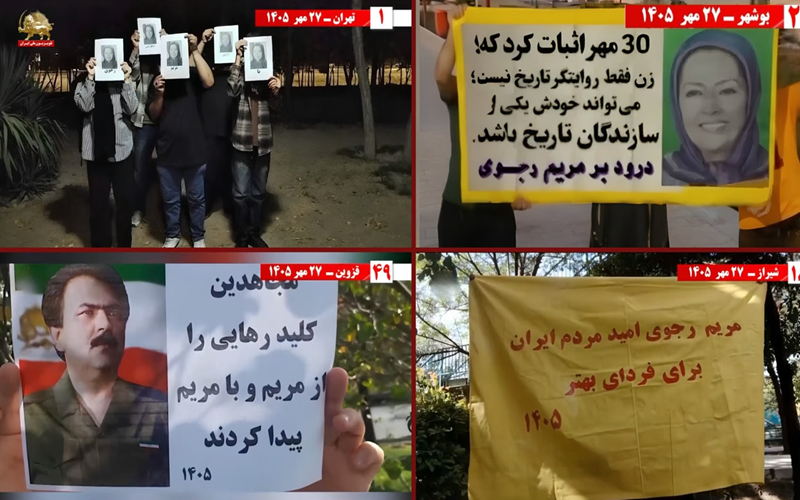

From Tehran and Mashhad to Shiraz, Isfahan, Ahvaz, and other cities, activists marked the October 22 anniversary with posters, banners, and coordinated actions promoting democracy, popular sovereignty, women’s leadership, and rejection of both monarchical and clerical dictatorship.
Resistance Units Mark Anniversary of Maryam Rajavi’s Designation Across Iran
PMOI Resistance Units reported 50 activities in cities across Iran marking the anniversary of Maryam Rajavi’s designation as the president-elect of the National Council of Resistance of Iran (NCRI) for the transitional period leading to the transfer of sovereignty to the Iranian people. The activities included coordinated public actions, posters, handwritten banners, leaflets, and slogans calling for freedom, democracy, and an end to dictatorship.
The reported activities took place in Tehran, Karaj, Mashhad, Shiraz, Bushehr, Rasht, Amol, Hamedan, Kermanshah, Ahvaz, Rafsanjan, Bukan, Kashan, Shahriar, Iranshahr, Bandar Abbas, Isfahan, Qazvin, and other locations.
The anniversary commemorates October 22, 1993, when the NCRI designated Rajavi as its president-elect for the transitional period following the overthrow of Iran’s clerical regime. The designation forms part of the coalition’s political framework for replacing the current system with a democratic republic.
For readers unfamiliar with the Iranian opposition, the NCRI is a coalition of opposition organizations and figures, with the People’s Mojahedin Organization of Iran (PMOI/MEK) as its principal constituent organization. Its Resistance Units are networks of activists who conduct political and symbolic activities inside Iran, including distributing leaflets, displaying slogans, and publicizing opposition messages despite the risks associated with dissent.
Women’s Leadership and Popular Sovereignty at the Center
A recurring theme of the reported activities was the role of women in bringing about political change. In Tehran, Shiraz, Bushehr, and Ahvaz, activists displayed messages describing Iranian women as a principal force for change and emphasizing their role in shaping the country’s future.
One slogan declared: “Women of Iran are the main force for change.”
Other messages presented Rajavi as a symbol of national solidarity and a democratic future. Posters and banners in Tehran called her a voice for democracy, human dignity, and human rights, while activists in Shiraz described her as a source of hope for a better future.
In Bushehr, a banner carried a message emphasizing women’s agency in history: “A woman is not merely a narrator of history! She can herself be one of the makers of history.”
The emphasis reflects the NCRI’s stated political program, which advocates women’s equality and participation in political leadership. It also places women’s rights within a broader demand for the transformation of Iran’s political system.
From Tehran to Mashhad: Calls for an End to Clerical Rule
In Tehran, activists conducted a coordinated five-person action and displayed photographs, posters, and handwritten leaflets bearing slogans such as “Democracy and freedom with Maryam Rajavi” and “A free Iran with Maryam Rajavi.”
Other messages declared that the Iranian people would reclaim their country and rebuild it, while another called Rajavi a symbol of national unity for a free Iran.
In neighboring Karaj, activists displayed posters and leaflets calling for the departure of the clerical leadership and the restoration of sovereignty to the people. One message stated: “The mullahs must go; sovereignty belongs to the Iranian people.”
In Mashhad, small groups displayed handwritten banners supporting the opposition leadership, including slogans declaring allegiance to Massoud and Maryam Rajavi.
Similar messages appeared in Kashan, where a poster called for an end to clerical rule, and in Bandar Abbas, where activists displayed messages describing Rajavi as a voice for the Iranian people’s demand for justice and freedom.
These activities presented the opposition’s central political demand as a transfer of power away from the ruling establishment and toward the Iranian people.
Resistance Activities Across Cities and Provinces
The reported actions extended beyond the largest urban centers, reaching cities in several regions of Iran.
In Kermanshah, posters emphasized a future Iran under Rajavi’s leadership and declared that the movement of young people seeking to overthrow the dictatorship would not stop. In Rasht, activists displayed messages calling for a free Iran and resistance against the ruling system.
In Iranshahr, banners called for freedom, justice, and national sovereignty. In Amol and Hamedan, activists displayed variations of the slogan “Our commitment is Maryam’s commitment; victory will be ours.”
In Rafsanjan, two-person actions featured handwritten banners and chants supporting Rajavi. One slogan explicitly rejected both forms of dictatorship: “Tomorrow’s Iran with Maryam Rajavi—neither Shah nor Mullah.”
The phrase “Neither Shah nor Mullah” is an important part of the NCRI’s political identity. It rejects both the clerical dictatorship established after the 1979 revolution and a return to hereditary monarchy under the former Pahlavi dynasty. The slogan presents the opposition’s preferred alternative as a democratic republic rather than a restoration of either previous or current authoritarian rule.
In Shahriar, activists displayed the image of the Simorgh, a mythical Persian bird associated with renewal and transformation, alongside messages about overcoming the system of clerical rule. In Qazvin, leaflets featuring Massoud Rajavi highlighted the historical significance attributed by the movement to Maryam Rajavi’s political leadership.
A Democratic Republic and a Defined Transitional Program
Several activities explicitly linked the proposed future of Iran to Maryam Rajavi’s Ten-Point Plan, the NCRI’s stated framework for a future democratic republic.
In Ahvaz, activists displayed messages describing implementation of the Ten-Point Plan as a guarantee of a free Iran. The plan outlines the opposition coalition’s proposed political framework, including universal suffrage, free elections, separation of religion and state, gender equality, and the protection of individual freedoms.
The distinction is significant because the anniversary is not simply a commemoration of an opposition figure. It also serves as an occasion for promoting a specific political alternative to the existing system.
Through their slogans and public displays, the Resistance Units sought to connect the demand for regime change with a vision of a post-clerical Iran based on popular sovereignty and democratic institutions.
Public Defiance Under a Repressive Political System
The reported activities relied largely on small groups, posters, leaflets, handwritten banners, and brief public displays. Their methods allowed activists to circulate political messages in public spaces without organizing large demonstrations.
The report describes activities across multiple cities, but it does not independently establish the identities of the participants, the number of people who saw the displays, or the broader public response. The figure of 50 refers to the activities reported by the Resistance Units, rather than an independently verified count of participants or separate mass protests.
Nevertheless, the range of locations and recurring political themes illustrates how the PMOI’s activist networks seek to maintain a visible opposition presence inside Iran. Their messaging combines rejection of clerical rule with opposition to monarchy, advocacy of women’s leadership, and calls for a democratic republic.
By marking the anniversary of Rajavi’s designation, the Resistance Units reaffirmed the NCRI’s proposed political direction: an end to the current dictatorship, a transition toward popular sovereignty, and the establishment of a democratic system in which Iran’s future is determined by its people.