


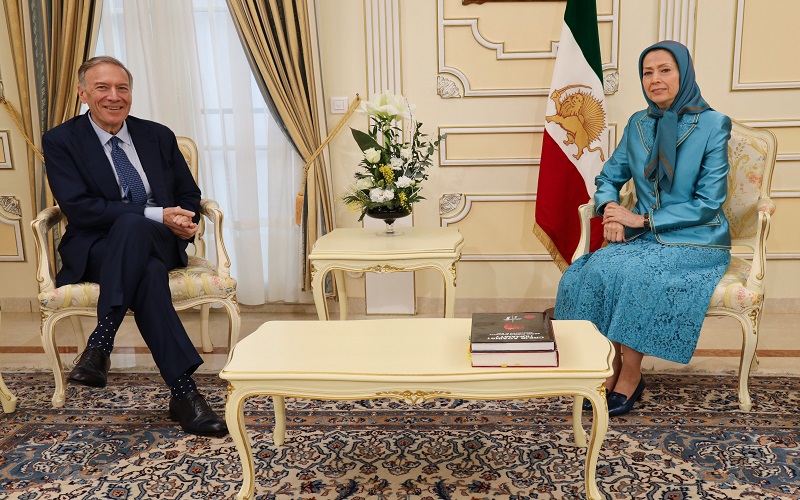

On January 9, the headquarters of the National Council of Resistance of Iran (NCRI) in Auvers-sur-Oise, France, hosted a momentous gathering that underscored the growing momentum against Iran’s ruling regime. The event featured prominent speakers, including NCRI President-elect Maryam Rajavi and former U.S. Secretary of State Mike Pompeo. Together, they painted a vivid picture of resilience, determination, and hope for a free Iran.
Maryam Rajavi: A Vision for Democratic Iran
Maryam Rajavi, President-elect of the NCRI, opened the event by highlighting the regime’s vulnerabilities. “2024 was a year full of serious defeats for the regime,” she stated, referencing widespread boycotts of sham elections, growing dissent, and economic instability marked by soaring inflation and mass poverty. She emphasized the significance of the fall of Bashar al-Assad in Syria as a turning point: “The Iranian people now see that overthrowing a criminal dictatorship is possible.”
Rajavi outlined the Resistance’s vision for Iran’s future, rooted in her 10-point plan. “Recognizing the Iranian Resistance is not one choice among many; it is the only practical and viable solution to confront the religious fascism ruling Iran,” she said. Her plan includes free elections, gender equality, and the separation of religion and state.
Mike Pompeo: The Regime’s Fragility Exposed
Former U.S. Secretary of State Mike Pompeo delivered a powerful speech, describing the Iranian regime as a “paper tiger” nearing its end. He pointed to the fall of the Assad regime as a harbinger of Tehran’s fate. “This too will happen in Iran,” he predicted, urging Resistance Units and the Iranian people to persevere. He reaffirmed U.S. support, stating, “The United States and the pressure campaign will return, making the regime even more fragile. You, the Resistance, you are on the right path.”
Along with Mrs. @Maryam_Rajavi, I spoke today on ending Tehran’s threat to the Middle East and the Iranian people. Recognizing the organized opposition inside Iran, which has been fighting the regime for decades to establish a free republic, must be an integral part of… pic.twitter.com/9gSe1jGsvl
— Mike Pompeo (@mikepompeo) January 9, 2025
Pompeo dismissed the idea of reforming the regime’s core institutions, particularly the Islamic Revolutionary Guard Corps (IRGC). “No one is going to change the nature of that regime,” he asserted, emphasizing that its foundations are built on oppression. He praised the NCRI’s leadership and Maryam Rajavi’s 10-point plan for a democratic Iran, which includes free elections, gender equality, and a non-nuclear future. “This plan does not demand regime change from outside,” Pompeo clarified. “It only demands recognition of the Iranian people’s plight and their right to resist.”
Honoring Sacrifice and Courage
Pompeo paid tribute to the sacrifices made by the Iranian Resistance, particularly the Mujahedin-e Khalq (MEK). He recalled the 1988 massacre of 30,000 political prisoners, most of whom were MEK members and supporters. “Iran will be free, but only by those who have sacrificed for decades, who have paid the highest price,” he said, recounting his visit to Ashraf 3, where he witnessed the profound dedication of the Resistance.
Closing Remarks
The gathering underscored a unified vision of hope and resilience. Maryam Rajavi declared, “Like its predecessor, the mullahs’ dictatorship must be and will be overthrown.” With voices of support from international figures like Mike Pompeo and the steadfast commitment of the Iranian Resistance, the fight for freedom in Iran continues with renewed vigor.
Key Takeaways
- Iranian Regime’s Fragility (Pompeo): The collapse of Assad’s regime signals Tehran’s looming downfall.
- Recognition of Resistance (Rajavi and Pompeo): Both speakers emphasized the NCRI’s role as the democratic alternative to the regime.
- Focus on the IRGC (Pompeo): Targeting the IRGC was urged as a critical step to weaken the regime’s oppressive backbone.
- No Foreign Intervention Needed (Pompeo): The Iranian Resistance seeks international acknowledgment of their right to resist, not external military action.
- Sacrifice and Resilience (Pompeo): Pompeo highlighted the decades-long struggle and sacrifices of the MEK and NCRI, underscoring their legitimacy and determination.