



Fifty revolutionary activities across Iranian cities bring messages of uprising, freedom, and the expansion of Resistance Units into schools and universities at the start of the 2026–2027 academic year.
As the new academic year began across Iran, Resistance Units stepped up their activities in cities across the country, carrying messages of uprising, freedom, and organized resistance into streets, schools, and universities.
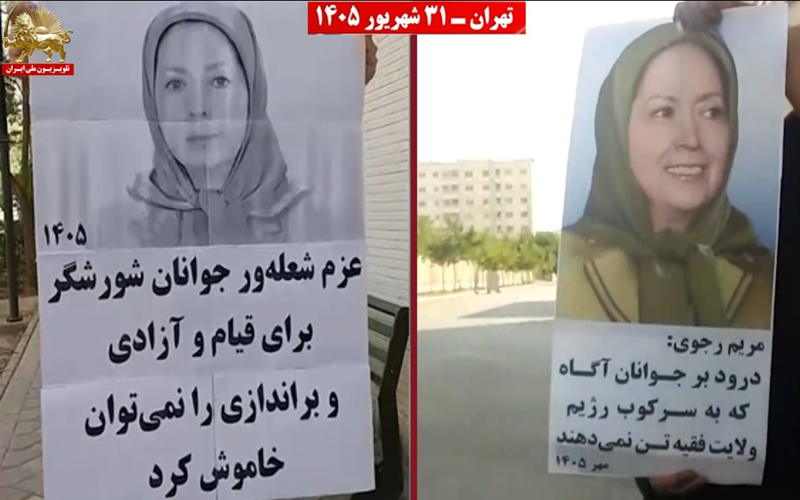
On September 22, 2026 (31 Shahrivar 1405), a total of 50 revolutionary activities were reported in Tehran, Karaj, Isfahan, Shiraz, Qazvin, Kerman, Gorgan, Lahijan, Abadan, and Mashhad. The activities included photo actions, posters and leaflet distributions, banners, and graffiti.
A central theme of these actions was the expansion of the Resistance Units in schools and universities, alongside calls for uprising, freedom, and an end to the clerical dictatorship.
The activities came as students returned to classrooms and campuses, turning the beginning of the academic year into another occasion for Resistance Units to challenge the regime’s atmosphere of repression and censorship.
Tehran and Karaj: Resistance messages at the start of the academic year
In Tehran and Karaj, Resistance Units carried out a series of activities including photo actions, poster and leaflet installations, and displays of handwritten and printed banners.
Many of the messages focused on the expansion of Resistance Units among students in schools and universities, the continuation of the uprising, and the struggle for freedom.
In Tehran, activists also placed posters on vehicles, bringing the message beyond fixed locations and into the city’s public spaces.
The slogans rejected the clerical dictatorship and emphasized that the younger generation can become an active force in the struggle for freedom and democratic change.
Isfahan: From graffiti to public displays
In Isfahan, Resistance Units combined two-person photo actions with banners and leaflets with graffiti carried out using spray paint.
The messages again centered on the expansion of Resistance Units in schools and universities, the continuation of the uprising, and the demand for freedom and resistance.
These actions brought the Resistance’s message directly into public spaces at a time when the regime seeks to project control over the country’s educational institutions and the younger generation.
Shiraz, Qazvin, and Kerman
Resistance activities were also reported in Shiraz, Qazvin, and Kerman.
In Shiraz, activists installed posters and leaflets and carried out photo actions featuring messages concerning schools, universities, Resistance Units, and the uprising.
In Qazvin, a two-person photo action featured large banners carrying messages about freedom, justice, and the People’s Mojahedin Organization of Iran (PMOI/MEK).
In Kerman, activists installed posters and carried out a photo action carrying political messages directed against the regime.
Together, these activities demonstrated the geographic spread of the Resistance Units’ campaign at the beginning of the academic year.
Gorgan, Lahijan, and Abadan
In Gorgan, Resistance Units distributed leaflets calling for the expansion of Resistance Units in schools and universities.
In Lahijan, activists installed leaflets focusing on the reopening of schools and colleges amid an atmosphere of protest and resistance.
In Abadan, graffiti carried a message centered on the uprising and freedom.
The actions linked the return to education with the broader struggle for political freedom, rejecting the regime’s attempt to separate everyday social life from the growing demand for change.
Mashhad: Students and youth at the center of the message
In Mashhad, a group action was carried out with a large fabric banner. Its messages focused on students and schoolchildren, freedom, and determination to overthrow the repressive clerical regime.
The emphasis on students and young people is particularly significant at the beginning of the academic year. Iran’s schools and universities have repeatedly become important spaces of protest and political expression, while the regime has sought to impose tighter ideological and security controls over students.
The Resistance Units’ activities sent the opposite message: that the younger generation is not merely an audience for political change but an active participant in the struggle for freedom.
The academic year begins with the message of resistance
The 50 activities reported across these cities formed a broad campaign of political and symbolic actions at the beginning of the 2026–2027 academic year.
From Tehran and Karaj to Isfahan, Shiraz, Qazvin, Kerman, Gorgan, Lahijan, Abadan, and Mashhad, Resistance Units used posters, leaflets, banners, photo actions, and graffiti to carry a common message: the struggle for freedom continues, and the organized resistance must expand among the younger generation.
The focus on schools and universities also underscored the importance of youth in Iran’s ongoing confrontation with the clerical dictatorship. By bringing the slogans of the uprising into public spaces at the opening of the academic year, the Resistance Units challenged the regime’s efforts to impose an atmosphere of fear and silence.
The message was clear: the new academic year is also a new season of resistance