


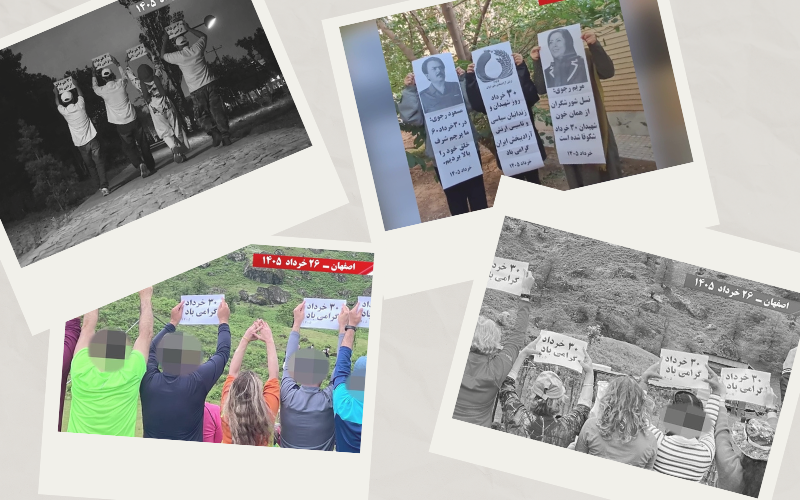

Commemorative events, banner displays, public actions, and resistance slogans appeared in more than twenty Iranian cities as activists honored political prisoners, fallen resistance members, and the anniversary of the National Liberation Army of Iran.
Nationwide Campaign Marks a Defining Date in the Iranian Resistance
Resistance Units and supporters of the Iranian Resistance conducted extensive activities across Iran to commemorate the 45th anniversary of June 20, observed by the opposition as the Day of Political Prisoners and Martyrs, and the anniversary of the founding of the National Liberation Army of Iran in 1987.
The coordinated campaign extended from major cities including Tehran, Mashhad, Tabriz, Isfahan, Shiraz, Ahvaz, Karaj, Rasht, Kermanshah, and Urmia to smaller cities and border regions such as Astara, Sardasht, Baneh, Gachsaran, Saravan, Zahak, and Fasa.
Activities included banner drops from bridges, large poster installations, flower tributes, photo actions, collective gatherings, and public displays of slogans supporting organized resistance and democratic change in Iran.
Tehran: Focus on Resistance, Political Prisoners, and Freedom
The largest concentration of activities was reported in Tehran, where activists displayed numerous banners and posters commemorating June 20 and honoring political prisoners and resistance martyrs.
Several banners described June 20, 1981, as the beginning of what participants called “the greatest and most glorious resistance in Iran’s history.” Others highlighted the role of the National Liberation Army, carrying slogans such as:
- “The Liberation Army is the only path to freedom.”
- “June 20, the Day of Martyrs and Political Prisoners.”
- “Death to oppression, whether the Shah or the Supreme Leader.”
Messages attributed to opposition leaders Massoud Rajavi and Maryam Rajavi were also prominently displayed, emphasizing resistance, sacrifice, freedom, and democratic change.
Participants conducted flower-laying ceremonies and commemorative gatherings honoring those killed in the struggle against the Iranian regime.
Resistance Messages Spread Across Major Cities
In Tabriz, banners called for an end to both clerical and monarchical dictatorship, declaring that “the rule of the mullahs and the rule of the Shah must come to an end.” Other messages described June 20 as a resistance movement built through “sacrifice, struggle, and perseverance.”
In Mashhad, activists emphasized the legacy of resistance martyrs and the continued struggle against authoritarian rule. Slogans included:
- “The rebellious generation has blossomed from the blood of the martyrs of June 20.”
- “Death to the oppressor, whether Shah or Supreme Leader.”
- “The National Liberation Army guarantees lasting peace, freedom, and Iran’s independence.”
In Isfahan, banners celebrated the anniversary while promoting the message that organized resistance remains the path toward freedom. One prominent slogan stated:
“June 20 is a historic turning point in the struggle for freedom.”
In Shiraz and Ahvaz, participants displayed banners reading:
“Long live the National Liberation Army of Iran.”
In Ahvaz, activists also issued a declaration announcing readiness for what they described as the “final battle” against the ruling establishment.
Urmia, Karaj, Rasht, and Kermanshah Highlight Democratic Change
In Urmia, banners promoted democracy and equality while expressing support for Maryam Rajavi’s vision for Iran. One slogan declared:
“Freedom is coming through determination and action.”
Karaj witnessed one of the most extensive campaigns outside Tehran. Participants highlighted June 20 as a milestone in Iran’s resistance movement and displayed slogans such as:
- “No force in the world is stronger than our will.”
- “The National Liberation Army is the only path to freedom.”
In Rasht, activists commemorated the anniversary with banners praising the National Liberation Army and emphasizing the continuation of resistance against the doctrine of absolute clerical rule.
In Kermanshah, slogans linked democratic governance to organized resistance and called for a democratic republic while describing the National Liberation Army as “the nightmare of the clerical regime.”
Activities Reach Smaller Cities Across Iran
The campaign extended far beyond Iran’s major urban centers.
In Astara, activists displayed a large banner reading:
“Iran is Rajavi, Rajavi is Iran.”
In Hamadan, banners commemorated the martyrs of June 20 and highlighted the emergence of a new generation of resistance activists inspired by their sacrifices.
In Qazvin, participants paid tribute to the PMOI and resistance martyrs, including Commander Vahid and his companions, while describing June 20, 1981, as the beginning of a historic resistance movement.
In Yazd, supporters identifying themselves as a combat unit of the National Liberation Army publicly pledged to continue their struggle against dictatorship, repeating the slogan:
“Death to the oppressor, whether Shah or Supreme Leader.”
Border Regions and Smaller Provinces Join the Campaign
Reports from Sardasht, Gachsaran, Baneh, Saravan, Zahak, and Fasa indicated that Resistance Units also carried out coordinated actions in these cities.
The most frequently displayed slogans included:
- “Long live the National Liberation Army of Iran.”
- “The National Liberation Army will return.”
- “June 20 is the historic chapter of resistance for freedom.”
- “Death to the oppressor, whether Shah or Supreme Leader.”
In Sardasht, activists displayed multiple banners linking June 20 to the beginning of organized resistance against religious dictatorship. In Gachsaran, supporters pledged to continue the struggle, while activists in Baneh, Saravan, Zahak, and Fasa displayed messages supporting resistance leaders and calling for the overthrow of the current regime.
Continuing the Legacy of June 20
Across more than twenty cities, participants used banners, posters, public displays, flower tributes, and collective actions to commemorate political prisoners and fallen resistance members while reaffirming support for organized resistance.
The dominant themes throughout the campaign were the remembrance of resistance martyrs, support for political prisoners, rejection of both monarchical and clerical dictatorship, and calls for a democratic future based on popular sovereignty.
By carrying out coordinated actions from Tehran and Mashhad to Sardasht and Saravan, Resistance Units sought to underline the enduring significance of June 20 as a symbol of sacrifice, resistance, and the continuing struggle for freedom in Iran.