



Coordinated operations in more than 30 cities target IRGC, Basij, judiciary, propaganda centers, and regime symbols as Resistance Units commemorate the 45th anniversary of June 20, 1981 and the founding of the National Liberation Army of Iran.
In the days leading up to June 20, 1981—the 45th anniversary of Iran’s nationwide revolutionary resistance, the Day of Political Prisoners and Martyrs, and the anniversary of the founding of the National Liberation Army of Iran—Resistance Units carried out an extensive series of operations across the country.
The activities, reported from dozens of cities, targeted institutions associated with repression, ideological control, and security enforcement, while also promoting messages supporting democratic change and organized resistance against the ruling clerical establishment.
The operations ranged from attacks on Basij and IRGC facilities to actions against regime propaganda centers, the burning of symbols of the Supreme Leader, and widespread public displays of resistance slogans.

Operations Against Security, Judicial, and Propaganda Centers
A significant number of actions focused on institutions viewed as pillars of the regime’s security and repression apparatus.
In Tehran, Resistance Units reportedly detonated an explosion at the Municipality of District 4, described as a gathering point for forces involved in suppressing anti-regime protests. Another operation targeted a Basij base affiliated with the IRGC using incendiary devices.
In Eslamshahr, a Basij base was reportedly struck by an explosion.
In Mohammadshahr, Karaj, Resistance Units targeted a judiciary building, while in Ahvaz, activists launched an incendiary attack against a Basij base.
In Iranshahr, two separate operations targeted the Islamic Propaganda Organization and the office of the Supreme Leader’s representative.
Additional attacks were reported against Basij facilities in Qaemshahr and Khash, where a Basij headquarters linked to the anti-riot Imam Ali Battalion was targeted.
In Chabahar, Resistance Units launched an incendiary attack against a cultural complex named after Qassem Soleimani and simultaneously burned a banner of Ali Khamenei.
Further actions against Basij facilities included:
- Khorramshahr – Basij base set ablaze
- Shahrekord – Basij base set ablaze
- Zahedan – Multiple Basij facilities set ablaze, including student Basij centers and IRGC-affiliated bases
- Neyshabur – Basij base set ablaze
- Sabzevar – Two Basij bases set ablaze
- Borujen – Religious and ideological center targeted and burned
- Farrokhshahr – Islamic Propaganda Organization building set ablaze
The geographical breadth of these operations highlighted the nationwide reach of the Resistance Units, spanning from Tehran and Karaj to Sistan and Baluchestan, Khuzestan, Khorasan, and Chaharmahal and Bakhtiari Province.
Campaign Against Regime Symbols
Alongside attacks on regime institutions, Resistance Units carried out a widespread campaign targeting images and banners of regime leaders.
In Tehran, activists burned banners featuring Ali Khamenei, Ruhollah Khomeini, and Mojtaba Khamenei in several locations.
Similar actions were reported in:
- Karaj – Two Khamenei banners burned
- Mashhad – Khamenei banner burned
- Isfahan – Khamenei banner burned
- Shiraz – Two Khamenei banners burned
- Sari – Khamenei banner burned alongside slogans opposing both dictatorship and monarchy
- Kerman – Khamenei banner burned
- Hamedan – Mojtaba Khamenei banner burned
- Zahedan – Mojtaba Khamenei banner burned with accompanying slogans supporting the National Liberation Army
- Shahrekord – Banners of Khamenei and Mojtaba Khamenei burned
- Sabzevar – Multiple banners of Khamenei and Mojtaba Khamenei burned
- Rafsanjan – Banners of Khomeini, Khamenei, and Mojtaba Khamenei burned
- Farsan – Khamenei and Mojtaba Khamenei banners burned
- Farrokhshahr – Khamenei banner burned
- Nikshahr – Khamenei banner burned
- Khash – Khamenei banner burned
Many of the actions were accompanied by slogans rejecting both forms of dictatorship and advocating democratic change.
Resistance Messages Appear Across Public Spaces
A parallel campaign of public messaging and graffiti spread resistance slogans and commemorative messages in cities across Iran.
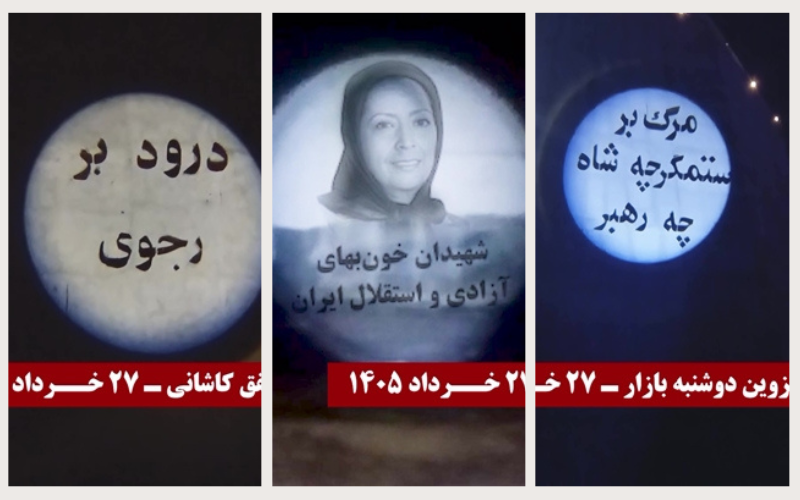
In Tehran, slogans appeared in Shaghayegh Street, Qazvin Street, and Goldad Park, including messages such as “Hail Rajavi,” “Death to the oppressor, whether Shah or Supreme Leader,” and tributes to fallen PMOI members.
In Mashhad, messages in Izadi Park and Ferdowsi Bazaar commemorated June 20 as a historic day of resistance and sacrifice.
In Isfahan, slogans honoring Iran’s martyrs and expressing support for organized resistance were displayed in Tooba Street and Moshfegh Kashani Street.
Additional public displays were reported in:
- Karaj – Qalam Street
- Sari – Mahyar Street
- Hamedan – Towhid Boulevard
- Bandar Abbas – Forough Street and Baran Residential Complex
- Ilam – Azadi Street and Chalsara Street
- Shahrekord – Saadi Street
- Javanshir (Kermanshah Province) – Javanshir Street
- Bukan – Shora Street
The slogans emphasized resistance against religious dictatorship, support for freedom and democracy, and the role of the National Liberation Army as a symbol of organized opposition.
Marking a Historic Anniversary
The latest wave of activities comes as supporters of the Iranian Resistance prepare to mark the 45th anniversary of June 20, 1981, widely regarded by opposition groups as a defining moment in the struggle against clerical rule.
The coordinated operations across dozens of cities demonstrate both the continued presence of organized resistance networks inside Iran and the persistence of anti-regime sentiment despite years of repression, arrests, and executions.
By simultaneously targeting security institutions, propaganda centers, judicial organs, and symbols of the ruling establishment while spreading political messages in public spaces, the Resistance Units sought to underscore their call for democratic change and their rejection of all forms of dictatorship in Iran.