


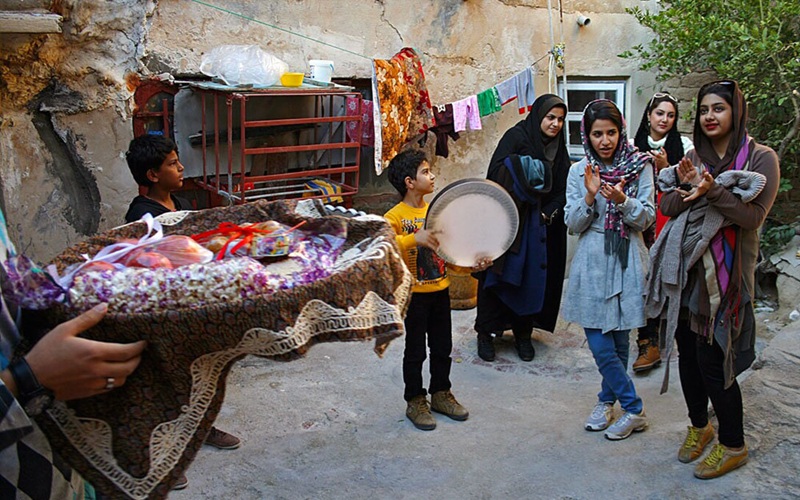

Runaway inflation and regime mismanagement have turned Iran’s longest night into a symbol of economic collapse, forcing families to abandon traditions or buy Yalda essentials on credit.
As Iranians approach Yalda, the longest night of the year and a centuries-old symbol of light prevailing over darkness, the reality facing millions of families is one of economic suffocation. Skyrocketing prices for Yalda essentials—from nuts and fruit to sweets and even basic snacks—have stripped this cultural celebration of its joy, exposing the devastating impact of the regime’s economic policies on everyday life.
Yalda 1404 has become more than a cultural moment; it is a stark mirror reflecting the collapse of purchasing power, the shrinking of household tables, and the forced transformation of consumption patterns. For the first time, items traditionally associated with celebration and abundance are now being sold on installment plans—an unprecedented indicator of how deeply Iran’s livelihood crisis has penetrated society.
Exploding Prices, Shrinking Tables
Field reports and official data show that prices for Yalda goods have surged dramatically within just one year. Nuts, once a staple of Yalda gatherings, are now priced at over 1.3 million tomans per kilogram in many markets. Premium items such as pistachios, hazelnuts, and cashews are reportedly selling for up to 2 million tomans per kilogram—nearly triple last year’s prices, when high-quality mixed nuts cost around 700,000 tomans per kilogram.
Sweets have not been spared. Ali Bahramand, head of Tehran’s Confectioners’ Union, has confirmed that there is no shortage of raw materials. The collapse in demand, he explained, is entirely due to price hikes. Boxes that once weighed 1.5 to 2 kilograms have now shrunk to 500 or 750 grams, while overall demand has dropped by nearly half compared to Yalda 1403. Sweets, once inseparable from Yalda gatherings, have become a low-priority luxury for many households.
Fruit of Hope, Now Out of Reach
Even Yalda’s most symbolic fruits—pomegranates and watermelons, long associated with hope, abundance, and endurance—have become unaffordable for many families. Market observations from cities across Iran indicate an unusually quiet fruit market ahead of Yalda, with no long lines or crowds. Union officials confirm that despite adequate supply, purchasing power has collapsed so severely that customers are simply absent.
This silence in the markets speaks louder than any statistic: the regime’s economic failure has drained even modest traditions of their social vitality.
Yalda on Credit: A New Symbol of Collapse
Perhaps the most telling sign of Iran’s deepening crisis is the emergence of installment sales for Yalda items. Online platforms now offer nuts, fruit, and even “Yalda packages” through checks, promissory notes, credit apps, or bank guarantees. Consumable goods that once symbolized celebration are now treated like durable assets—clear evidence of how far living standards have fallen under the clerical regime.
Cost estimates paint an even darker picture. A minimal Yalda spread—one kilogram of nuts, modest fruit, and one kilogram of sweets—now exceeds 3 million tomans. Adding a simple dinner pushes the cost of a basic Yalda gathering for a family of four to 4–5 million tomans, equivalent to one-third to one-half of the official minimum monthly wage in 1404. Hosting even a small gathering of ten people can raise costs to 10–15 million tomans, making this Yalda one of the most expensive in modern Iranian history.
When Even Installments Are Too Expensive
For many families, even installment purchases are out of reach. For them, Yalda passes not with fruit and sweets, but with silent glances at shop windows and quiet walks past markets. As one citizen told the state-run news agency ISNA, Yalda goods have effectively become luxury items, while many people struggle to cover basic daily expenses, let alone celebrate.
Yet amid this crushing pressure, some families continue to preserve Yalda in its most minimal form—by eliminating nuts, drastically reducing fruit, or purchasing only symbolic items. For them, Yalda is no longer about abundance, but about togetherness and quiet resistance against economic erosion driven by the regime’s destructive priorities.
A Crisis Engineered by the Regime
Economists attribute this unprecedented inflation to chronic structural factors: persistent inflation, currency collapse, the devaluation of the national currency, failed economic governance, and the absence of effective market oversight. These are not accidents. They are the direct outcome of the regime’s nuclear, missile, and regional adventurism, pursued at the expense of citizens’ livelihoods.
While officials routinely deflect blame onto “greedy sellers” or temporary factors, official data from Iran’s Statistical Center shows that inflation in the fruit and dried-goods category surpassed 100 percent in November 2025—clear evidence of a systemic crisis rooted in regime policy, not market behavior.
Yalda as a Measure of Resistance
What was meant to be a celebration of light and solidarity has become, for many Iranians, a night of calculation, omission, and enforced restraint. Yet the determination to keep Yalda alive—even in its simplest form—alongside growing protests against the Iranian regime, sends a powerful message. Yalda endures not because conditions allow it, but because people refuse to surrender their identity and social bonds.
In today’s Iran, Yalda is no longer merely a cultural tradition. It has become a quiet act of defiance against an economic order that has plunged society into darkness—leaving many with nothing but a faint, fragile hope to carry them through the longest night.