


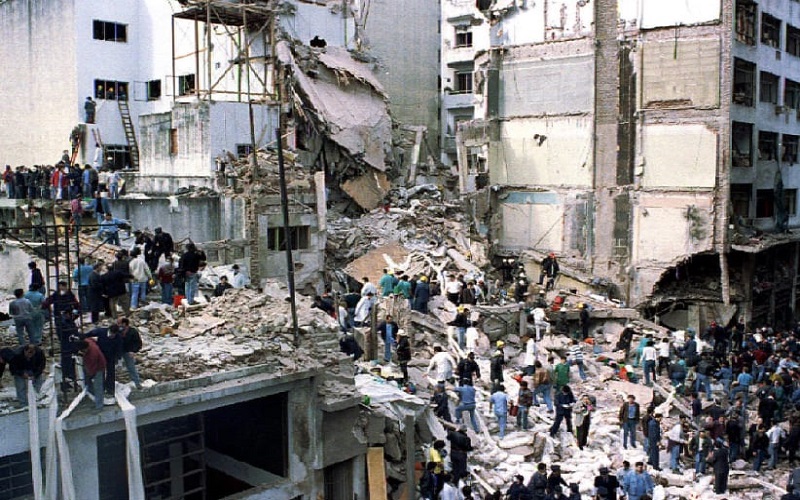

Argentina’s judiciary has declassified a confidential intelligence report from 2003 that sheds light on Iran regime’s involvement in the 1994 bombing of the Argentine Israeli Mutual Association (AMIA) headquarters in Buenos Aires.
The attack, which killed 85 people and injured hundreds more, has been a subject of investigation for nearly three decades.
The report, known as the Toma Report, was jointly prepared by Argentina’s former State Intelligence Secretariat (SIDE), the CIA, Israeli Mossad, and the FBI.
It focuses on the role of Moshen Rabbani, then-Iranian cultural attaché, in orchestrating the attack, and details how Iran enlisted Hezbollah to carry it out.
Federal Judge Ariel Lijo, currently overseeing the case, declassified the main report but withheld complementary material to protect informants’ identities.
The document reveals that the attack was motivated by former President Carlos Menem’s decision to halt a uranium purification project with Iran.
Key findings from the report include:
- Rabbani’s central role in expanding Iranian influence in Argentina, using a “radicalized discourse of the revolution”.
- Former Iranian Ambassador Hadi Soleimanpour’s use of multiple identities and diplomatic passports.
- Samuel El Reda’s leadership in the groups responsible for both the AMIA bombing and the 1992 Israeli Embassy attack.
- Hezbollah’s operational structure, including separate groups for explosives procurement, car bomb assembly, and post-attack cleanup.
The report concludes that the attack’s planning can be traced back to “the very heart of the fundamentalist regime of Iran,” with Hezbollah serving as its “armed wing”.
This declassification marks a significant step in the ongoing investigation of the AMIA bombing, which remains the deadliest terrorist attack in Argentina’s history.
It comes as part of a broader effort to bring those responsible to justice, including the issuance of Interpol red notices for several Iranian suspects.