


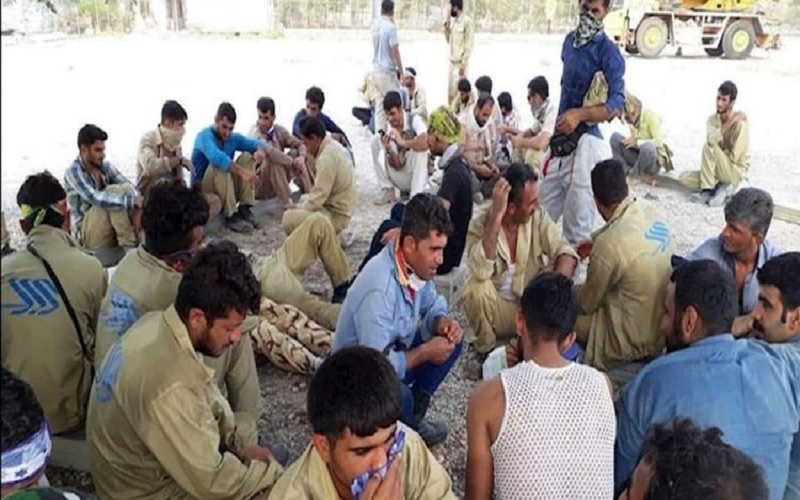

Iranian Oil and gas workers, including contract employees, have gone on strike once more in response to the ongoing neglect of their demands. This follows a similar strike in May 2024, where workers across several oil, gas, and petrochemical projects ceased work for several days. Their grievances stem from contractors’ refusal to implement a salary increase approved by the Supreme Labor Council, with workers still receiving wages based on 2023 rates.
The organizing council for the protests initiated on June 20. The council reported that contract workers from Dasht Abbas and Samin companies, along with scaffolders from Zamanpour contracts, have joined the strike. These workers are demanding higher wages and a revised work schedule of 14 days on and 14 days off. The strike began on Wednesday, June 26, with various sectors and projects forming “cores of protests.”
Since 2021, oil workers, project workers, and third-party contractors have called for a 45% wage increase, reduced workdays, increased rest days, better living conditions in hostels, improved food quality, and the elimination of contracting companies. Workers accuse these companies of acting independently and being unaccountable.
Tens of thousands of project workers in oil and gas companies are exploited by contractors, receiving lower wages than official Ministry of Oil employees and lacking wage and welfare benefits. The organizing council of informal oil workers’ protests has declared the removal of contractors as a primary demand. They assert that workers in the oil industry deserve equal wages and living conditions.
Despite the escalating situation, the regime’s Ministry of Oil and government officials in Bushehr province have yet to respond to the strike. In 2023, during a similar strike, Bushehr officials threatened to expel protesting workers. On May 14, 2023, the political and security deputy of Bushehr Governorate announced the arrest of eight protest leaders, including Sajjad Khosravi. Post-strike, many workers were reportedly fired and banned from future oil and gas projects.
The current strike occurs as some regime presidential candidates claim to support workers with empty promises. Mohammad Bagher Ghalibaf, Speaker of the Parliament, previously blocked a proposal to convert contract workers into official employees, referring to contract workers as “second-class citizens.” He promised to resolve this issue if elected president, but many workers remain skeptical. In a Telegram group, workers expressed doubts, noting that Ghalibaf could have addressed the problem of temporary contracts already if he were sincere.
Saeed Jalili’s campaign announced plans to eliminate contractors and change the status of contract workers in the oil industry, assigning Fereydoun Abbasi, who has been accused of corruption, to head his oil and energy committee. Other presidential candidates have not yet offered specific plans for project workers, merely promising wage increases and job creation.
Labor activists have launched the “Tell Work” campaign, urging presidential candidates to address workers’ concerns about job security, fair wages, and union organization. The campaign poses several critical questions to candidates:
- Will your government allow intermediary contracting companies to exploit workers with short-term and illegal contracts?
- Will there still be short-term work contracts like three-month, one-year, or one-month terms?
- Will workers and social groups continue to bear the costs of inflation due to ineffective government officials?
- Will your government maintain restrictive economic and security policies regarding worker organization and wages?
- Is there hope that labor organizations will be empowered to combat corruption, improve work safety, and prevent managerial and capitalist excesses?
- Will your government recognize workers as independent entities?
The outcome of this strike and the workers’ demands remain uncertain as they await a response from the authorities and potential future leaders.