


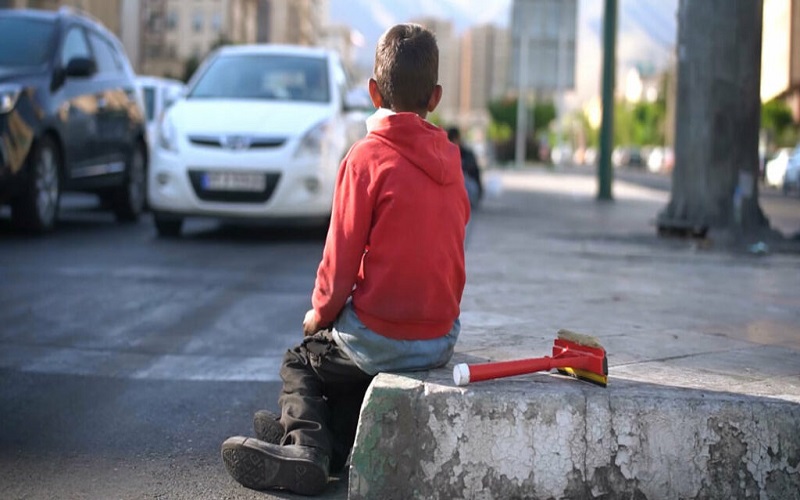

On the World Day Against Child Labour, Iran’s Ministry of Interior announced the identification of 2,600 working and street children.
However, official sources suggest that over seven million children are engaged in labor across the country.
Lawyers highlight the existence of a ‘garbage-collecting mafia‘ and criticize the regime’s harsh measures against civil organizations striving to combat this issue.
The Ministry of Interior claims that one of the objectives of its working group, established last year, is to ‘create sustainable employment’ for these children through skill training and empowerment. Despite these assertions, the reality on the ground remains grim.
In 2022, during nationwide protests, the Society of Students Against Poverty, an NGO focusing on social issues, reported that the regime used impoverished children in its repressive operations, offering them meager incentives such as small grocery bags.
Images of these children in anti-riot gear sparked outrage across social media, further highlighting the regime’s exploitation of vulnerable youth.
Working children in Iran face extreme hardships, often sleeping on the streets and engaging in vending, begging, and theft to survive.
The exploitation of these children is a severe issue in Iranian society, exacerbated by over four decades of the Islamic Republic’s rule, which has led to increased poverty, unemployment, addiction, and homelessness.
The brunt of this poverty and misery falls on the working class and lower-income families, with their children being the first victims.
Financially struggling families are unable to support their children, who are then forced into labor. The regime’s policies of inflation, high prices, unemployment, and job insecurity have perpetuated this cycle of poverty and exploitation.
Despite laws prohibiting the employment of children under 15, there are no effective regulations on the age, working hours, or types of work for children.
Children are employed in various sectors, including production, service, and commercial fields, often starting as young as 4 or 5 years old.
Carpet weaving, for instance, employs a significant number of young children, while others work in textile, clothing, and leather industries.
These children are seen as cheap, obedient, and silent workers, exploited and abused by their employers.
Many working children endure overtime without proper compensation, physical punishment, sexual abuse, and even forced drug trafficking.
The practice of using children for garbage collection has also grown significantly, with officials acknowledging a ‘waste mafia’ that exploits these young laborers.
These children, robbed of their childhood, live in constant fear and insecurity, subjected to the harsh realities imposed by the regime.
Their fundamental desires for education, play, and happiness are denied, with efforts by regime officials to normalize child labor from a very young age.
According to a report by the regime’s parliament Research Center, 15% of Iran’s child population are ‘working children,’ a figure that has risen due to ‘household poverty.’
Approximately ten percent of these children are unable to pursue education, trapped in a cycle of labor and deprivation.
The plight of working and street children in Iran is a profound social issue, calling for immediate and comprehensive action to protect the rights and future of these vulnerable young individuals.