


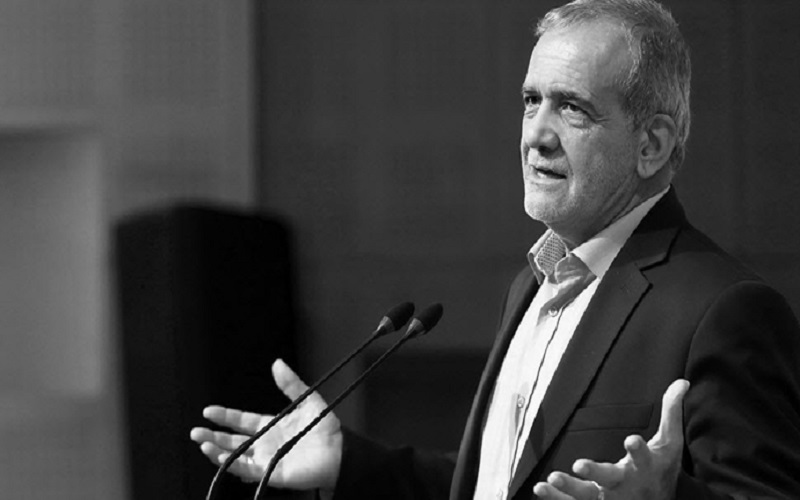

On Tuesday, September 24th, as the United Nations General Assembly convened, freedom-loving Iranians gathered outside the UN headquarters in a massive demonstration. The protest aimed to voice the Iranian people’s outrage and disdain over the presence of Masoud Pezeshkian, the president of the Iranian regime, at the international forum.
This large-scale demonstration highlighted the widespread discontent among the Iranian populace towards the mullahs’ regime and emphasized the existence of a nationwide resistance movement that offers a democratic alternative. The Associated Press and Reuters captured the event through videos and images, reporting on the protest that coincided with Pezeshkian’s planned address to the General Assembly.
The key question remains: What is the true intention behind the regime’s presence at the UN, especially amidst the annual gathering of world leaders?
In his speech, Pezeshkian urged the US and other Western powers to initiate a new phase of political relations and negotiations with the Iranian regime. He framed this as a call for respect towards the regime and its controversial actions, coupled with a plea for the lifting of sanctions. He also addressed broader strategic issues, including the ongoing crisis in the Middle East and the nuclear agreement between Iran and world powers, known as the Joint Comprehensive Plan of Action (JCPOA).
Pezeshkian’s message was not new; the regime’s delegation in New York had echoed similar sentiments in various interviews and meetings leading up to his address. Another pressing question is why the regime is now willing to return to the negotiating table over the JCPOA, despite the growing threat of domestic unrest.
It is evident that the regime sees this as an opportunity to secure financial gains to fund its malign activities in the Middle East and beyond, with little regard for the deteriorating conditions faced by the Iranian people. In a 2019 speech, former President Hassan Rouhani stated that the arms embargo on Iran, imposed by the UN, would be lifted if the JCPOA was upheld, allowing Iran to buy and sell weapons freely. Five years later, the regime has not only expanded its support for proxy forces but has also begun selling drones and missiles to Russia amid its conflict with Ukraine.
The problem with the JCPOA lies in the regime’s deceptive compliance. As long as Iran pretends to adhere to the agreement, it can continue its destabilizing activities unchecked. The delegation’s efforts in New York are focused on pushing the US and Western powers to engage in renewed negotiations under the JCPOA framework, hoping to alleviate the regime’s growing domestic crises, particularly after the widespread protests of 2022. The regime is acutely aware that similar unrest could erupt again at any moment.
One potential lifeline for the regime is the improvement of relations with the West and the lifting of sanctions within the JCPOA framework. It seems the regime is trying to buy time until the expiration of United Nations Security Council Resolution 2231 (UNSCR 2231).
Foreign Minister Abbas Araghchi, referring to the regime’s desire to return to the JCPOA and the lifting of sanctions, stated, “We have a deadline ahead of us regarding the end of Resolution 2231, which will take place in October of next year, and it will open a window for us until then.” The deadline Araghchi is referencing is October 2025, when the “snapback” mechanism, which allows for the re-imposition of all previous UN sanctions in the event of significant non-compliance by Iran, will expire. This is a critical milestone, as it limits the ability of UNSC members to unilaterally reinstate sanctions.
If the trigger mechanism is not activated during this period, the Iranian regime’s nuclear dossier will be normalized, and the lifespan of Resolution 2231, which underpins the JCPOA, will come to an end.
Now, the regime is attempting to present a more conciliatory image to prevent the trigger mechanism from being activated before October 2025, despite the expansion of its nuclear activities, which, according to experts, lack any civilian justification.
In a sudden shift, the regime is attempting to project a peaceful image, even as it remains a key instigator in the Gaza conflict. Pezeshkian declared, “We have no war with anyone and are ready to lay down our weapons if Israel does the same.”
This apparent shift in tone comes at a time when the Iranian regime is under intense pressure, both domestically and internationally. However, the international community must remain vigilant and recognize the regime’s attempts to buy time and secure its own survival at the expense of global security and the well-being of the Iranian people.