



The recent BRICS summits have sparked extensive debate about the coalition’s future role and identity, raising questions on how an expanded BRICS might reshape global alliances. This discussion evolved during the 2023 summit in South Africa and took a sharper turn at the 2024 summit in Kazan, Russia, where BRICS explored expanding its membership and influence.
In South Africa, the original BRICS members—Brazil, Russia, India, China, and South Africa—formally invited Iran, Egypt, Ethiopia, Saudi Arabia, and the UAE. By 2024, all had joined, except Saudi Arabia. The Kazan summit then proposed adding 13 more nations, potentially as associate or partner countries, signifying an ambitious transformation into BRICS+.
This expanded BRICS+ would represent nearly 3.5 billion people, about 45% of the world’s population, and a combined economic output of over $28.5 trillion, approximately 28% of global GDP. With energy powerhouses like Iran, Saudi Arabia, and the UAE on board, the coalition now controls 44% of global crude oil production.
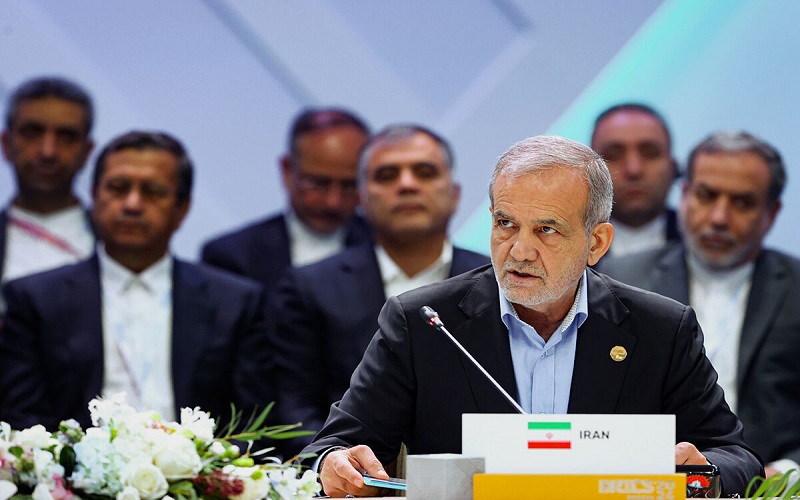
However, Iranian regime’s official entry into BRICS, led by its new president, Masoud Pezeshkian, comes amid internal economic turmoil and strained international relations. While some BRICS members remain cautious about Iran regime’s geopolitical ambitions in the Middle East, they largely sidestepped discussions on Iran’s struggling economy.
Iran’s situation is marked by persistent inflation and a deteriorating currency, with one in three citizens now living below the poverty line. At an average monthly minimum wage of just $120, most families struggle to cover basic expenses, especially given rising costs in housing and essentials.
Iran’s Stagnant Economy and Resource Challenges
Iran’s economy is forecasted to limp forward with a meager growth rate of around 2% and inflation near 34%. The country’s GDP has yet to recover to its 2011 levels, and according to IMF forecasts, this trend will likely persist until 2029.
The energy sector, the backbone of Iran’s economy, faces severe infrastructural decay, with gas and energy plants running at only 70% capacity. Without modernization efforts, largely due to resource constraints and political priorities, blackouts have become frequent, disrupting daily life and halting industrial output.
This stagnation extends internationally. In 2023, trade between Iran and its primary partners—including China, the UAE, Iraq, Russia, India, and Turkey—declined, suggesting that Iran’s economic and political trajectory may be isolating it even from allied nations.
Notably, Iran’s regime seems more committed to funding regional proxies than addressing domestic economic needs, placing significant strain on both public patience and national stability.
“Look to the East”: A Strategic Pivot or a Desperate Gamble?
Iran’s leaders have justified their pivot to BRICS within the framework of a “Look to the East” policy, a strategy designed to distance the nation from Western sanctions and forge alliances with non-Western powers. Even some so-called reformists within the regime, despite their previous stances, are now supporting this stance, seeing it as a potential counterbalance against Western isolation and their fear of the regime’s close fall. Yet, critics argue that the policy merely defers Iran’s economic crisis while exacerbating regional tensions.
At the summit, Iran regime’s Minister of Economy framed BRICS participation as a potential economic lifeline, stating, “Iran’s economic relations with BRICS member countries should be developed across dimensions of politics, security, culture, and people.” Pezeshkian also called for tangible action, asserting that “BRICS decisions should have an executive guarantee.” But while Iran hoped to finalize a Comprehensive Strategic Partnership Agreement with Russia at Kazan, the signing was postponed, leaving Pezeshkian to return home empty-handed.
Challenges with BRICS Banking and Compliance: A Limited Path Forward?
Iran’s aspirations in BRICS face structural hurdles. University professor Fereydon Majlesi highlights the incompatibility between Iran’s financial practices and BRICS banking requirements, which demand compliance with Financial Action Task Force (FATF) guidelines. Without FATF alignment, conventional banking operations within BRICS remain inaccessible to Iran, effectively barring the country from financial cooperation with member banks. Iran’s Minister of Economy has acknowledged that sanctions and FATF restrictions have isolated Iranian banks from the global financial system.
Even within BRICS itself, the proposal of a common currency faces long-term challenges. Majid Shakeri, an economic researcher, notes that any BRICS currency would likely take the form of a currency basket similar to the IMF’s Special Drawing Rights (SDR), rather than a conventional currency. South Africa’s central bank governor echoed this sentiment, noting that such a currency would require robust economic convergence among members—a far-off prospect given BRICS’ current diversity in economic priorities and practices.
Iran’s Quest for BRICS Membership: An Ambitious, Yet Limited Venture
While Iranian regime leadership celebrates BRICS membership as a strategic victory, the reality is more complex. Supporters of the regime’s Supreme Leader Ali Khamenei tout this membership as a milestone in stabilizing Iran’s international position and balancing foreign relations. Yet, despite this optimism, BRICS is unlikely to solve Iran’s economic woes or lessen the impact of international sanctions, especially as the regime continues funding regional conflicts.
In this light, Iran’s BRICS membership may ultimately serve as a symbolic gesture rather than a practical solution to its economic and political isolation. As Iran’s regime looks eastward, its citizens face economic hardship at home, and BRICS membership may do little to change their daily realities. The coalition may offer Iran a platform, but without structural reforms and international compliance, substantial economic relief remains elusive.