


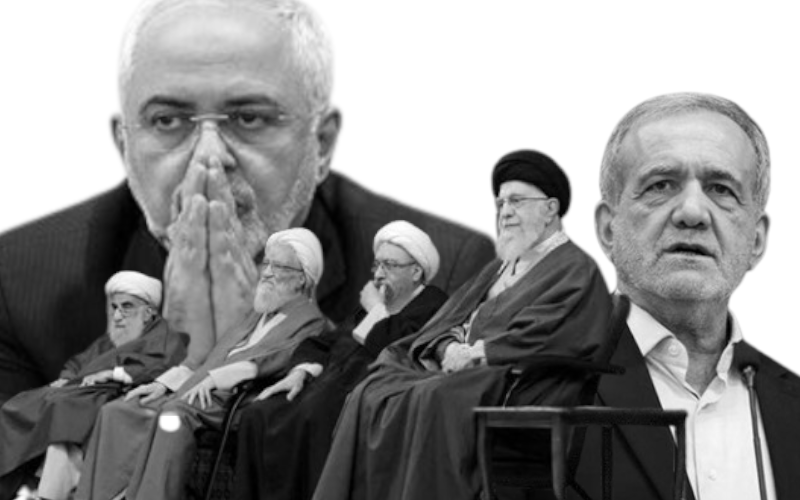

The recent speech by Iran’s Chief Justice, Gholam-Hossein Mohseni-Eje’i, at the 25th Conference of Public Prosecutors on January 27, 2025, reveals deep fractures within the Iranian regime. His remarks expose not only the increasing instability of the regime but also the growing anxiety within its leadership about the regime’s survival.
A Rebuke Against Zarif
One of the focal points of Mohseni-Eje’i’s address was a pointed criticism of former Foreign Minister Mohammad Javad Zarif for his remarks at the Davos summit. In his speech, the Chief Justice emphasized the supposed dangers of engaging with Western powers:
“Today, the embodiment of tyranny is the American regime. We cannot rely on a tyrannical government to solve our problems. We must not be intimidated by the power of tyranny; we must have the utmost perseverance and resistance.”
Mohseni-Eje’i further condemned Zarif’s statements, arguing that they weakened Iran’s position on the international stage:
“It is not appropriate for a person who is an agent of the system to speak in an international forum in a way that weakens the current of truth and makes the enemy delighted. It is not permissible for us to say something among foreigners that would suggest our country is weak.”
At the same time, Mohseni-Eje’i also warned hardliners against excessive attacks on Zarif and his allies:
“Criticizing any individual or institution is fine, but we should not use language that pleases the enemy. Is it Islamic morality to criticize others in a way that serves the interests of our adversaries?”
A Divided Regime Amid U.S. Negotiation Debate
Mohseni-Eje’i’s speech reflects broader tensions within the Iranian regime, particularly regarding negotiations with the United States. The dispute has ignited fierce debate among the regime’s factions.
Hardline commentator Hossein Shariatmadari, editor-in-chief of the ultraconservative Kayhan newspaper, launched an attack on Zarif, writing:
“A few days ago, Zarif, in his illegal position as the Vice President of Iran for Strategic Affairs, exposed his true feelings to the Americans, complaining about the revolution and the revolutionaries. From a despicable position, with unclear coordination within the system, he sat down and requested negotiations with Trump.”
Kayhan described Zarif’s remarks at Davos as “humiliating.”
Zarif’s Controversial Remarks on the Hijab Law
At Davos, Zarif made a statement that further enraged hardliners:
“If you go to the streets of Tehran, you will see women walking without head coverings. Although this is against the law, the government has decided that no pressure will be put on women. This is a promise that President Pezeshkian made, and he has kept his promise.”
He added that Pezeshkian’s decision was backed by senior officials but emphasized that it did not include Supreme Leader Ali Khamenei.
These remarks intensified backlash from conservatives, with Parliament Speaker Mohammad Bagher Ghalibaf warning:
“People who are considered agents of the system must be careful in their comments so that the message conveyed to the enemy does not endanger national interests.”
Pezeshkian Faces Internal Threats
President Masoud Pezeshkian also came under fire for his call for diplomacy. In a speech in Ahvaz on January 23, he said:
“We must speak to the world with the language of peace, with the language of greeting.”
This statement, interpreted as a signal toward potential negotiations with the West, sparked outrage among regime hardliners.
Mashhad’s Friday prayer leader, Ahmad Alamolhoda, denounced Pezeshkian and his allies as “people who have a heart for the West.” In Tehran, Guardian Council member Ahmad Khatami went further, invoking Khomeini’s anti-American stance:
“Has America become a smaller devil? Or has it become a bigger devil?”
The backlash escalated when the Minister of Intelligence warned:
“If these calls for negotiations, fascination, and fear take over, we will be the losers.”
He emphasized that the U.S. never seeks “win-win negotiations” but instead aims to “surrender and humiliate” Iran.
Calls for Zarif’s Arrest
In a chilling escalation, the secretary of Tehran’s Council of Enjoining Good and Forbidding Wrong called for Zarif’s detention:
“Anti-coup forces must arrest Zarif as soon as he enters the country and interrogate him; otherwise, the country will soon face more complex and dangerous crises.”
A Regime on the Brink
Mohseni-Eje’i’s speech underscores the growing fear within Iran’s ruling elite. The infighting between hardliners and so-called reformists is not merely a political dispute—it is a reflection of the regime’s struggle for survival amid deepening crises. As nuclear negotiations remain stalled and economic turmoil worsens, the Iranian regime leadership finds itself in an increasingly precarious position, desperately attempting to maintain unity in the face of mounting internal and external pressures.