


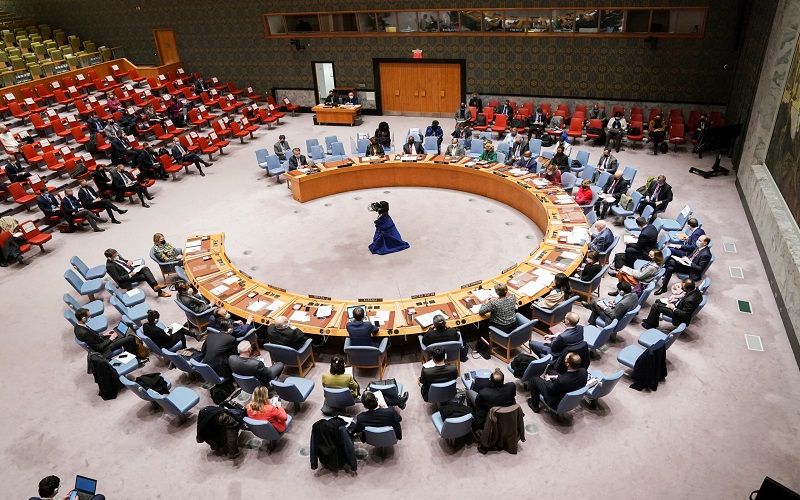

The United Nations Security Council is set to convene behind closed doors on Wednesday to discuss Iran regime’s growing stockpile of uranium enriched to near weapons-grade levels, diplomats reported on Monday.
This meeting has been requested by six of the council’s 15 members: France, Greece, Panama, South Korea, the United Kingdom, and the United States.
The primary concern among these nations is Iran’s obligation to cooperate with the International Atomic Energy Agency (IAEA) by providing necessary information regarding undeclared nuclear material detected at multiple sites within the country.
Western states argue that there is no legitimate civilian need for Iran’s regime to enrich uranium to such a high level and point out that no other nation has done so without developing nuclear weapons. Iran’s regime, however, insists that its nuclear program is strictly for peaceful purposes.
Potential Snapback of International Sanctions
The United Kingdom, France, and Germany have signaled their willingness to invoke the so-called “snapback” mechanism, which would restore all international sanctions on Iran’s regime in an effort to prevent it from acquiring a nuclear weapon.
However, their window for action is closing, as the 2015 UN resolution underpinning the Iran nuclear deal is set to expire on October 18 of this year.
This trigger mechanism, embedded in the Joint Comprehensive Plan of Action (JCPOA), allows member states to reinstate UN sanctions against Iran’s regime if it fails to meet its obligations.
Given that the United States withdrew from the JCPOA in 2018, only the remaining European signatories—Britain, France, and Germany—can activate the snapback before October 2025, when Resolution 2231, which is tied to the JCPOA, also expires.
US Ultimatum and Iran’s Response
Amid these escalating tensions, the US and its European allies have called for the Security Council meeting. Furthermore, US President Donald Trump has reportedly sent a letter to Iran regime’s Supreme Leader, Ali Khamenei, offering two choices: either agree to neutralize Iran regime’s nuclear activities and additional military concerns or face military action aimed at dismantling its nuclear infrastructure.
In response, Khamenei declared in a speech last Saturday that Iran’s regime would not engage in negotiations under pressure, especially given that Western demands have expanded to include the end of Iran regime’s regional influence and its missile program.
However, Russia subsequently stated that Tehran might be open to limiting its nuclear activities in exchange for the lifting of sanctions.
Iran regime’s delegation to the United Nations also suggested that nuclear negotiations could be considered in fear of recent US warnings regarding potential military action against its nuclear facilities.
Meanwhile, Iran regime’s Foreign Minister, Abbas Araghchi, confirmed that consultations with European nations to “build trust” were ongoing.
This stance indicates that Iran’s regime is still attempting to exploit divisions between the United States and its European allies, as it did during the first Trump administration, to weaken coordinated international pressure.