


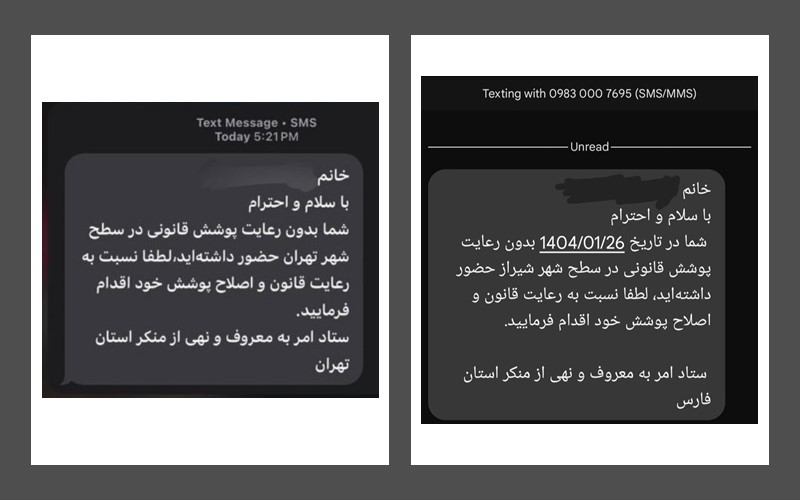

In the wake of escalating domestic repression and a surge in executions, the Iranian regime has renewed its crackdown on women defying the country’s compulsory hijab laws. A key instrument in this campaign is the regime’s Headquarters for Enjoining Good and Forbidding Wrong, which has begun sending threatening text messages to women and their family members, warning them of consequences for non-compliance.
This latest wave of repression is particularly concentrated in major Iranian cities such as Tehran, Shiraz, Rasht, and Isfahan, and follows a period during which some regime officials claimed to have relaxed enforcement of the so-called “Promotion of Chastity and Hijab” policy. Contrary to those statements, recent reports and images shared on social media reveal a significant technological escalation in identifying and punishing women who appear in public without a headscarf.
A Sophisticated Surveillance System
The regime has implemented an integrated surveillance infrastructure that combines multiple technologies to monitor and control women’s dress in public spaces. These technologies include:
-
IMSI-catchers (International Mobile Subscriber Identity catchers): Also known as “stingrays,” these devices mimic cell towers and force nearby mobile phones to connect. They collect SIM card identifiers (IMSI), phone serial numbers (IMEI), and geolocation data. IMSI-catchers are used in portable, vehicle-mounted, and fixed formats and can cover areas up to 35 square kilometers.
-
Public surveillance cameras: Installed throughout cities, these cameras capture images of women not adhering to the mandatory hijab and transmit them to centralized databases.
-
Contactless card readers: Officers reportedly use readers capable of extracting data from Iran’s smart national ID cards or metro passes at close range.
-
Telecommunications service integration: Mobile phone operators are allegedly complicit in triangulating data for user identification.
Collected data is cross-referenced with government databases, including the civil registry and a national surveillance platform known as SAPTAM (Surveillance and Public Tracking and Monitoring), which incorporates artificial intelligence and facial recognition software. These tools not only identify women but also locate and target family members with messages of warning, humiliation, and intimidation.
Psychological and Social Impact
Beyond the erosion of individual privacy and freedom, this technological campaign has deeper social consequences. The regime’s tactic of sending threatening SMS messages to male relatives—often fathers—has sparked increased violence against girls within their households. These messages frequently mention the time and location of a violation, heightening fear and social pressure.
The arrival of warmer weather has further intensified this confrontation. As more women resist the mandatory hijab during the hot season, the regime’s surveillance activities have expanded in both scope and intensity. Law enforcement officers continue to detain women in public and issue formal warnings, while digital threats serve to extend state control into the private sphere of family life.
A Legal and Ethical Vacuum
While facial recognition and surveillance systems are deployed worldwide to combat serious crimes, Iran’s use of such tools lacks transparency, oversight, and legal justification. There are no formal laws regulating the scope or limits of these systems in Iran, nor are there mechanisms for protecting citizens from abuse or the unauthorized collection and use of their personal data.
Instead, the regime has weaponized advanced surveillance technologies to enforce ideological conformity and stifle peaceful dissent, particularly among women who reject state-imposed dress codes.
A Growing Industry of Repression
In recent months, government tenders for video surveillance technology have surged. Contracts have been issued for the procurement of facial recognition software and AI-based identification tools. Private companies competing in this space are increasingly supplying the infrastructure that enables state repression, embedding surveillance deeper into the architecture of Iranian cities.
Conclusion
Iran’s escalating use of digital surveillance to enforce compulsory hijab laws marks a chilling evolution in authoritarian governance. By merging state power with sophisticated technology, the regime is not only suppressing women’s autonomy but also laying the foundation for a broader apparatus of control and intimidation. Without legal safeguards or public accountability, this system poses a grave threat to human rights and personal freedom in the country.