


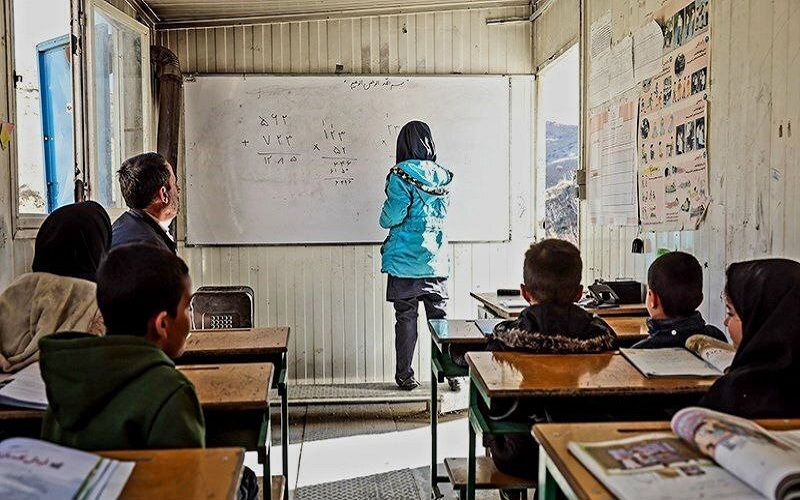

Rising economic hardship, shrinking education budgets, and systemic neglect have led to a dramatic decline in school quality and access across Iran.
A new report from Iran regime’s Parliamentary Research Center reveals the deepening crisis in the country’s education system, driven by widespread poverty and chronic underfunding. According to the report, the average grade of 12th-grade students has dropped below 10 in the past two years, and dropout rates are sharply increasing—symptoms of a wider collapse in educational quality.
Poverty’s Grip on Education
The report, titled Educational Poverty, investigates the relationship between household income levels and educational outcomes. Its findings are stark: economic deprivation is not only widening inequality but is also pushing Iran’s next generation toward a bleak future with limited opportunities.
Official statistics indicate that around 30% of Iranians—approximately 26 million people—live below the poverty line, a sharp increase from 20% in the early 2010s. This surge, the report notes, is directly linked to the government’s economic policies over the past decade. From 2011 to 2021 alone, 11 million people were added to the population living in poverty.
As inflation and the cost of basic goods rise, families are forced to prioritize food and housing over other expenditures—including education. This shift has had long-term consequences. According to data from the Central Bank and the Statistical Center of Iran, the share of urban household spending on education has fallen drastically, from 1.2% in 2004 to just 0.8% in 2023.
Dropout Rates Soar Amid Financial Strain
The Ministry of Education reported that in the 2023–2024 academic year, more than 928,000 students dropped out of school—over 200,000 more than the previous year. Financial pressure remains the dominant reason, especially in low-income and rural families, where children are often required to work to support household incomes.
Even students who stay in school face declining education quality, overcrowded classrooms, and a shortage of qualified teachers. The Parliamentary Research Center highlights that children from families with low parental literacy and income are significantly less likely to complete their education, perpetuating the cycle of poverty.
The Hidden Cost of Budget Cuts
Iran’s education budget has consistently fallen below global standards. In 2013, only 8% of the national budget was allocated to education—compared to the global average of 14%. By 2023, the figure had risen slightly to 10.53%, still below international norms.
Studies also show that between 2011 and 2022, the average annual per capita education spending per student was just 1.9 million tomans. Since the COVID-19 pandemic and the shift to virtual learning, this amount dropped to 1.52 million tomans and has yet to recover to pre-pandemic levels.
The regime’s longstanding shortage of education funding led to the proliferation of independent and specialized schools, pushing the cost burden onto families and exacerbating inequalities. Public schools, particularly in deprived provinces, have suffered as a result.
Illiteracy and Regional Disparities
The national illiteracy rate is estimated at 12.3%, but rural areas are disproportionately affected, with nearly one in five adults unable to read or write. In contrast, urban areas have a lower illiteracy rate of 8.6%. Provinces such as Sistan and Baluchestan, Kurdistan, and West Azerbaijan have some of the highest rates of illiteracy, while Yazd, Isfahan, and Hormozgan show the lowest.
The 2016 national census reported 8.8 million illiterate individuals aged 10 to 49, and over 2.3 million children between the ages of 6 and 19 who were not enrolled in school at all.
In some regions, the situation is dire. In Sistan and Baluchestan, for instance, nearly 58% of young adults aged 18 to 24 have not earned a high school diploma—limiting their chances of securing stable employment or continuing education.
Academic Performance in Decline
Nationally standardized 12th-grade exams have shown a continuous decline in student performance from 2019 to 2024, especially in the humanities. In the 2023 exams, the nationwide average score was just 9.44 out of 20. In 17 provinces, the average was below 10, with the lowest scores recorded in Khuzestan, Kohgiluyeh and Boyer-Ahmad, and Sistan and Baluchestan.
International assessments paint an equally grim picture. In the 2023 TIMSS test, Iranian fourth-grade students scored 420 in mathematics—well below the international benchmark of 500—ranking 53rd out of 58 participating countries. The 2022 PIRLS reading test showed that 41% of Iranian students failed to meet the minimum global standard for reading comprehension. By contrast, the international average failure rate was just 6%.
A Future in Jeopardy
While the COVID-19 pandemic worsened the educational crisis, experts stress that the decline in literacy and learning outcomes began long before. The deterioration in reading comprehension and analytical skills among Iranian students has been ongoing for over two decades.
Education is widely seen as a crucial pathway out of poverty, yet the data suggests that Iran is failing to equip its youth with the tools they need for economic mobility. The Parliamentary Research Center warns that without substantial investment and systemic reform, the country faces a future marked by deepening inequality and a shrinking pool of human capital.
In the words of the report’s authors: “Reducing government and household investment in education will expand inequality and intensify educational poverty. While the wealthy continue to access high-quality education, the rest are left behind.”
Conclusion
Iran’s education system stands at a critical juncture. As poverty deepens and public investment falters, millions of children are being denied the opportunity to build a better future. Without urgent reforms and increased support for vulnerable populations, the growing gap in educational outcomes threatens not only individual lives but the social and economic stability of the country itself.