


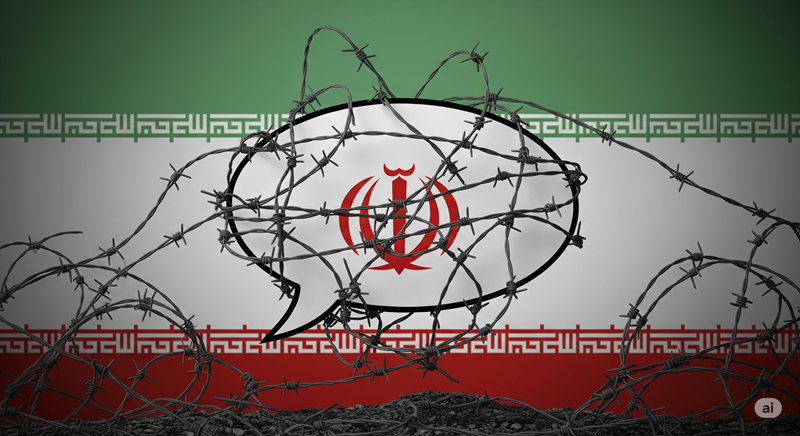

Despite years of systematic censorship and state control over the media, this latest measure signals a deepening of the regime’s efforts to stifle public dissent. The timing—coming on the heels of the 12-day conflict with Israel—has led many to view the bill as part of a broader campaign to tighten control over the digital space and suppress critical voices in a moment of heightened political sensitivity.
Widespread Criticism from Within
Although the Iranian regime has never allowed true freedom of expression since its inception, this bill has nevertheless drawn public dissent from several prominent figures within the regime’s establishment. Critics argue that the law undermines even the limited space for discourse that previously existed and betrays the promises of regime president Masoud Pezeshkian, who campaigned on pledges of greater openness.
A group of regime lawmakers had previously submitted a formal objection to the president, warning that the bill poses a serious threat to what they described as “freedom of expression,” endangers independent media, and narrows Iran’s already restricted social media environment.
In a scathing editorial in Etemad newspaper, commentator Abbas Abdi warned that the bill would monopolize the dissemination of information under the regime’s control. “This would be the biggest blow to the truth,” Abdi wrote, noting that the law would not stop lies or rumors, but rather amplify them.
Alarming Legal Expansion
Former regime telecommunications minister Mohammad Javad Azari Jahromi also denounced the bill on his Telegram channel, saying its overly broad definitions and disproportionate penalties make it highly likely that basic freedoms would be violated. “This was not the president’s promise to the people,” he sharply added.
In Shargh newspaper, regime legal scholar Mohsen Borhani offered a detailed legal critique, warning that the bill replaces the existing term “spreading lies” with the far vaguer phrase “untrue content.” This shift, he argued, criminalizes even partial truths and opens the door to arbitrary interpretation and abuse. He cautioned that activists and journalists could be prosecuted for merely failing to include all facts—intentionally or otherwise.
Even more disturbing are the escalated punishments embedded in the bill. While the previous law imposed jail terms of three months to two years for “spreading lies online,” the new bill increases these penalties drastically, potentially up to fifteen years in prison. Borhani drew attention to Article 14, which, according to reports, opens the possibility of first investigating such offenses as cases of “corruption on earth”—a charge that can carry the death penalty under the regime’s legal code.
Chilling Effect on Society
Borhani further warned that the law would push society into a state of self-censorship and silence. “People will avoid expressing themselves out of fear of punishment,” he wrote, adding that this silence marks the beginning of “social degeneration.”
In an unusual rebuke, Nournews—a media outlet close to Iran regime’s Supreme National Security Council—questioned the political motivations behind the bill, writing: “Does the current bill reflect the government’s spirit of transparency or is it the result of pressure from supranational institutions and security concerns?”
Farid Mousavi, one of the regime’s own MPs opposing the legislation, warned that the bill could deepen the rift between the government and society. “In a country with economic hardship, a crisis of trust, and the need for transparency, should our priority really be a poorly defined crackdown on so-called ‘false news content’?”
Regime Pushes Forward
Despite the backlash, the regime has pushed forward with its justification, arguing that the bill respects the Constitution and includes enough safeguards to protect free speech. Kazem Delkhosh, Legislative Deputy of the President’s Parliamentary Deputy, defended the move by citing the regime’s Supreme Leader’s longstanding call for tighter control over cyberspace. “By voting for the urgent issue of this bill, it will help organize cyberspace,” he said.
In a heavily choreographed session, the parliament approved the bill with 205 votes in favor, 49 against, and only three abstentions, out of 257 members present.
A Further Blow to Rights
For decades, the Iranian regime has exercised firm control over all forms of communication, and this bill only formalizes and intensifies those mechanisms. While it purports to target “untrue content,” its actual impact is likely to be the silencing of dissent, the criminalization of truthful reporting, and the expansion of state propaganda.
In reality, freedom of expression has never been protected under the Iranian regime. This new legislation confirms once again that any promise of reform or openness is not only hollow but dangerous for those who believe in basic human rights and accountability.