


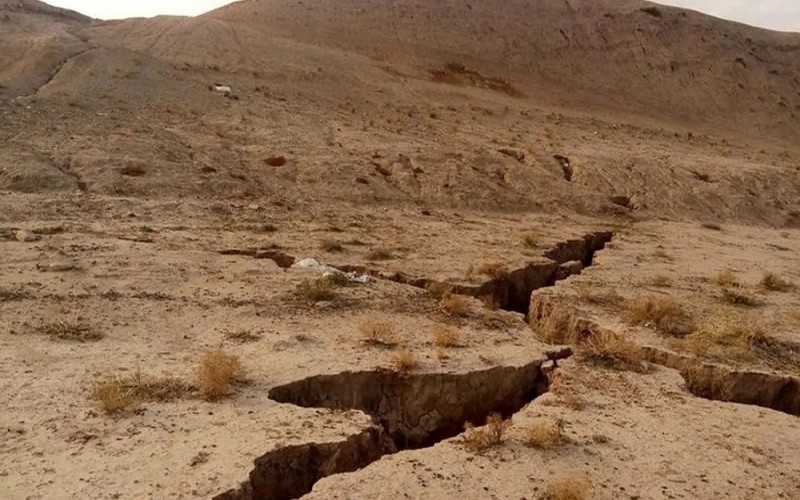

Groundwater depletion and decades of destructive regime policies have triggered irreversible land subsidence, endangering Iran’s environment, infrastructure, and cultural heritage.
Iran is facing one of the gravest environmental disasters in its modern history—land subsidence that threatens not only farmlands and infrastructure but also the very territorial stability of the country. What began as a hidden crisis beneath the ground has now emerged as a national threat that endangers entire cities and even world-renowned cultural monuments.
A Silent Disaster Beneath Iran’s Soil
Ali Baitollahi, head of the Engineering Seismology and Risk Department of the Iranian Road, Housing, and Urban Development Research Center, warned on August 23 that Iran ranks third globally in the scale of land subsidence. This crisis, he explained, is the direct result of decades of reckless groundwater exploitation and the destruction of natural reserves.
Baitollahi illustrated the severity of the problem by noting that the volume of groundwater lost over the past four decades is equivalent to filling a canal one kilometer wide, 100 meters deep, and stretching from the Caspian Sea to the Sea of Oman. The official warned that the depletion of aquifers has left vast parts of Iran vulnerable to collapse as underground layers compact, the soil loses fertility, and agricultural lands turn into barren deserts.
Water Tables Collapsing Across the Country
Once accessible at depths of 20 to 30 meters around Tehran, groundwater now lies more than 120 meters below the surface—and in some areas, there is no water left to extract even at that depth. According to the Iranian Disaster Management Organization, 254 plains are currently affected by subsidence, with some sinking as much as 18 centimeters per year. Critical provinces—including Tehran, Isfahan, Fars, Kerman, and Khorasan Razavi—are among the hardest hit, placing both population centers and vital infrastructure in danger.
Railway lines between Tehran, Mashhad, and Isfahan, as well as major roads and pathways around Lake Urmia, are already damaged by ground collapse. In Golestan and Mazandaran provinces, experts have observed subsidence in areas previously considered immune, underscoring the scale of the crisis.
Cultural Heritage Under Threat
The danger extends far beyond infrastructure and agriculture. Iran’s ancient cultural treasures are also at risk. Experts warn that 27 of the country’s 67 registered UNESCO heritage sites lie in subsidence zones. These include Persepolis, Naqsh-e Rostam, Naqsh-e Jahan Square, and the historical monuments of Shiraz and Isfahan. Visible cracks in these monuments are an ominous warning that, unless urgent action is taken, parts of Iran’s identity and history may be irreparably destroyed.
The Regime’s Destructive Policies
This crisis is not solely the result of natural forces or climate change. A significant share of responsibility lies with the regime’s reckless policies over the past four decades. The push for so-called “self-sufficiency in agriculture” has led to water-intensive farming in arid regions, coupled with fruitless dam construction, inter-basin water transfers, and the absence of scientific water management.
Instead of preserving aquifers, these policies have drained them beyond recovery. Water industry experts note that transferring water from dams such as Latian and Lar to Tehran has caused sharp groundwater declines in other regions, including the Varamin Plain and parts of Mazandaran, effectively shifting the crisis from one area to another.
Issa Kalantari, former head of Iran’s Environmental Organization, openly admitted in July: “We have destroyed Iran in these forty years. This is not water exploitation, but suicide.” He warned that Isfahan may literally sink into the ground within half a century, as it is already subsiding by 20 centimeters annually.
An Irreversible Catastrophe
Unlike other environmental challenges, land subsidence is irreversible. Once soil compacts and aquifers collapse, there is no natural recovery. Each year of delay in managing water resources results in the permanent destruction of more of Iran’s soil, cities, and heritage.
Experts such as Mehdi Zare of the Iranian Seismological Research Institute warn that groundwater depletion in western Tehran could even trigger active seismic faults, raising the risk of catastrophic earthquakes in the capital. Thus, Iran’s water crisis and subsidence are not just environmental threats—they are national security and humanitarian dangers.
A Choice Between Collapse and Change
Rather than reforming agricultural policies, managing consumption, or investing in sustainable practices, the regime continues to rely on costly and destructive projects such as dam-building and water transfers, paired with empty promises. This short-sightedness has allowed subsidence to spread nationwide—from Tehran to Fars, from Isfahan to Khorasan, and from Varamin to Golestan.
If this trend continues, vast plains will become deserts, ancient monuments will crumble, and major cities may face collapse. Experts warn that Iran’s neglect of water management will provoke harsh consequences: deeper droughts, forced mass migrations, devastating earthquakes, and the erasure of cultural heritage.
Iran today stands at a critical crossroads: persist with failed regime policies and face irreversible destruction, or make fundamental changes in governance and resource management. What is certain is that every day of delay brings the loss of another piece of Iran’s land, history, and future.