


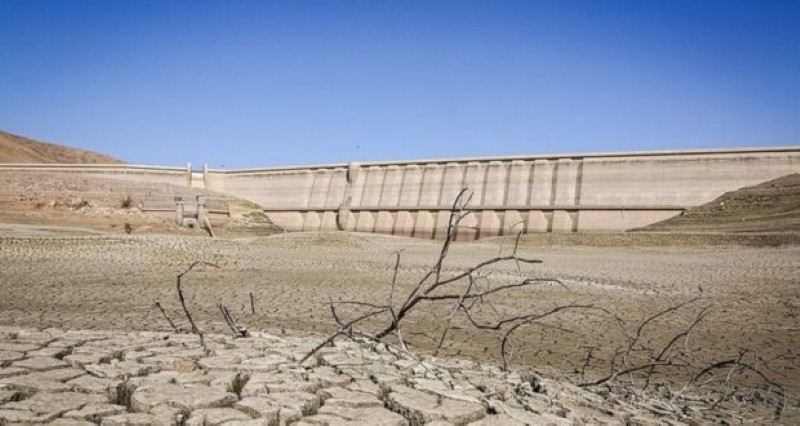

While other Middle Eastern nations invest in modern water management and technology, Iran’s deepening water crisis exposes years of corruption, mismanagement, and destructive policies.
Iran is sinking deeper into one of its most severe water crises in decades, as new data exposes the devastating consequences of decades of mismanagement, unsustainable policies, and neglect of environmental priorities by the regime.
According to the latest figures from Iran regime’s Ministry of Energy and the Water Resources Management Company, more than 90% of the Karaj Dam is empty, while 22 dams across the country hold less than 15% of their capacity. In 21 provinces, not a single drop of rain has fallen since the beginning of the autumn season.
Officials confirm that water inflow into reservoirs during the current water year (2025–2026) has dropped by nearly 39% compared to the previous year. Current stored water stands at 17.66 billion cubic meters, down from 23 billion last year—leaving the nation’s dam network at an average 34% capacity.
The crisis is especially dire in several provinces. Data from early November shows Amir Kabir Dam at only 11%, Lar Dam at 2%, and Latian Dam at 9% capacity. In Khuzestan, water levels in the Karun, Dez, and Karkheh dam systems have fallen by as much as 70%, while reservoirs in Fars, Sistan and Baluchestan, and Hormozgan are virtually dry. Three major dams in northeastern Iran—Voshmgir, Golestan, and Boostan—are now completely empty.
Ahmad Najafian, head of Alborz Regional Water Company, said that unprecedented heat has caused massive evaporation losses and that this year marks “one of the hardest hydrological years in recent decades.” He also warned that underground water reserves have reached critical levels.
Despite the escalating emergency, regime’s president Masoud Pezeshkian’s administration is pressing ahead with costly and ecologically destructive inter-basin water transfer projects, instead of reforming consumption patterns or investing in sustainable technologies. Issa Bozorgzadeh, spokesperson for the Water Industry, told ISNA news agency that “to ensure Tehran’s autumn water supply, we have developed a pessimistic scenario and pressure reduction will continue until resources stabilize.” The main solution, he confirmed, is the Talaghan water transfer project.
Environmental experts argue that such projects merely shift the crisis rather than solve it. Environmental researcher Mohammad Darvish told Tose’e Irani daily:
“We brought Talaghan’s water to Tehran just to delay the Titanic moment for the capital—just as we diverted the headwaters of the Karun, Dez, and Zab to Isfahan and Yazd. What was the result? More migration from the Zagros and Khuzestan regions. Soon, the waterless people of Talaghan will join Tehran’s new wave of migrants. Why don’t we learn from Isfahan’s tragedy and stop these futile transfer projects?”
Over the past three decades, Iran’s experience with large-scale water transfer schemes has been catastrophic, leading to river depletion, land subsidence, and the collapse of agriculture in donor regions. Experts warn that the Talaghan project will likely trigger severe shortages for local communities and force further displacement.
While regime officials often cite climate change and low rainfall as the main culprits, even government data contradicts this narrative. Najafian admitted that household water consumption in Iran is twice the global average, while the country has access to only one-third of the global per capita renewable water resources. In other words, Iran’s looming disaster stems not from “a rainless sky,” but from “a leaderless land.”
By contrast, other arid Middle Eastern states—including Saudi Arabia, the UAE, Qatar, and Bahrain—have managed their water challenges through desalination, wastewater recycling, and sustainable agricultural planning, despite receiving less annual rainfall than Iran. Tehran’s reliance on outdated, costly, and inefficient projects, coupled with pervasive corruption and lack of oversight, has prevented similar progress.
With rainfall down 75% compared to long-term averages, signs of environmental collapse are already visible. Land subsidence exceeds 40 centimeters per year in areas around Tehran, Varamin, and Isfahan, rendering much of central Iran increasingly uninhabitable. Experts warn that even if rainfall returns to normal, the country’s depleted aquifers and dams will not recover without deep structural reform.
Environmental analysts caution that unless Iran immediately overhauls its water management system, halts inter-basin transfers, invests in new technologies, and educates the public on conservation, the crisis could soon escalate into a nationwide social and security emergency.
Iran now stands on the verge of becoming one of the first countries in the Middle East to experience “water bankruptcy.”