

Amid rising regional tensions, Iran’s regime reframes war not merely as a geopolitical confrontation, but as a calculated instrument to suppress domestic unrest and preserve its grip on power.
As tensions and both direct and indirect confrontations between the United States, Israel, and Iran’s regime enter a new and volatile phase, understanding the true nature of this “war” — and its relationship to Iran’s internal dynamics — becomes critically important. While the conflict unfolding at the regional and international level carries real and destructive consequences, for Tehran it serves a function far beyond foreign confrontation: it is a strategic instrument to contain domestic uprisings and obscure deep internal crises.
Iranian society in recent years has been defined by sustained and accumulating discontent — a condition marked by explosive potential. Widespread protests, a widening chasm between state and society, and the steady erosion of political legitimacy have created a fragile structure in which even a minor spark could ignite a nationwide uprising. Within such a context, external conflict offers the regime an opportunity to recalibrate the internal environment in its favor.
The past four decades provide ample evidence that crisis production and management constitute a central pillar of the regime’s survival strategy. The eight-year Iran-Iraq war in the 1980s, despite its immense human and economic toll, was framed by the ruling religious establishment as a “divine blessing” and “sacred defense” — narratives used to justify the suppression of dissent and consolidate power. Today, under altered global and regional conditions, that same logic is being reproduced in a new form.
The current confrontation with Israel and hostility toward the United States are increasingly framed as a civilizational or religious struggle — a battle between “Islam and infidelity.” This ideological framing serves a precise purpose: shifting the axis of conflict away from Iran’s internal contradictions toward an external enemy. Within this narrative, any critical or dissenting voice can be readily labeled as aligned with the enemy or acting as a “fifth column.”
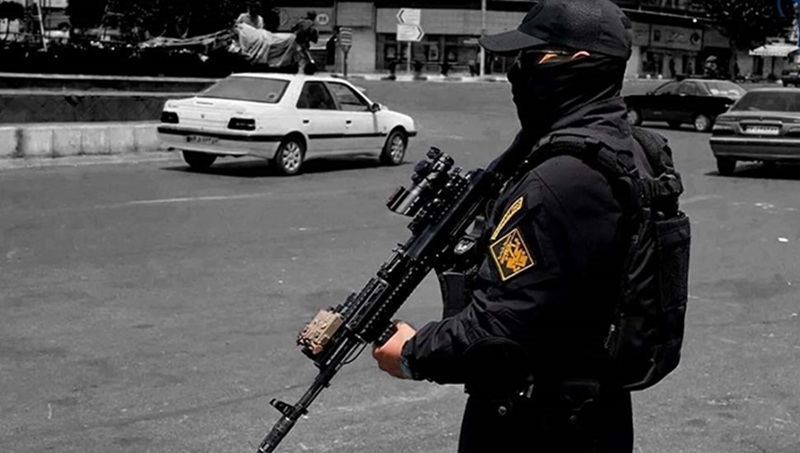
The consequences of this strategy are visible on the ground. The growing presence of security forces in urban spaces, the proliferation of checkpoints, and the intensification of social controls are not merely defensive measures against external threats. Rather, they function as preemptive mechanisms to deter the emergence of domestic unrest under the cover of wartime conditions. War, in this sense, becomes a permanent state of exception — one in which civil liberties are suspended and repression is normalized.
Political prisoners are among the first victims of such an environment. Increased pressure, harsher sentences, tighter restrictions and executions can all be understood within the broader framework of the securitization of society. By cultivating fear and instability, the regime seeks to dismantle any possibility of social organization and collective solidarity.
Yet a critical question remains: can this strategy succeed in the long term? While war and crisis may temporarily constrict political space, they simultaneously deepen underlying fractures within society. Economic strain driven by conflict, growing international isolation, and the continued erosion of social capital all contribute to intensifying public dissatisfaction.
At the same time, societal awareness of these mechanisms is rising. A significant segment of Iran’s population increasingly recognizes that the primary conflict does not lie at geographic borders, but within the very structure of power itself. While this awareness may not immediately translate into large-scale collective action, it lays the groundwork for more profound transformations over time.
In such a landscape, distinguishing between “real war” and “diversionary war” becomes essential. The real and decisive struggle is not the one portrayed on regional battlefields, but the one unfolding within Iranian society — between a population seeking freedom, justice, and human dignity, and a system that secures its survival by suppressing those very demands. The diversionary war, by contrast, is an attempt to obscure this reality and replace it with an externally focused narrative.
What is therefore most urgent today is maintaining focus on domestic demands and resisting imposed polarizations. The call for peace is not separate from the call for freedom — it is inherently intertwined with it.
Ultimately, ending the cycle of war-making pursued by this regime requires a clear and decisive alternative: recognizing the struggle of the Iranian people and acknowledging their democratic alternative, the National Council of Resistance of Iran, as a viable path toward the overthrow of clerical rule. Democratic change in Iran is not only possible through this alternative — it is increasingly inevitable.