


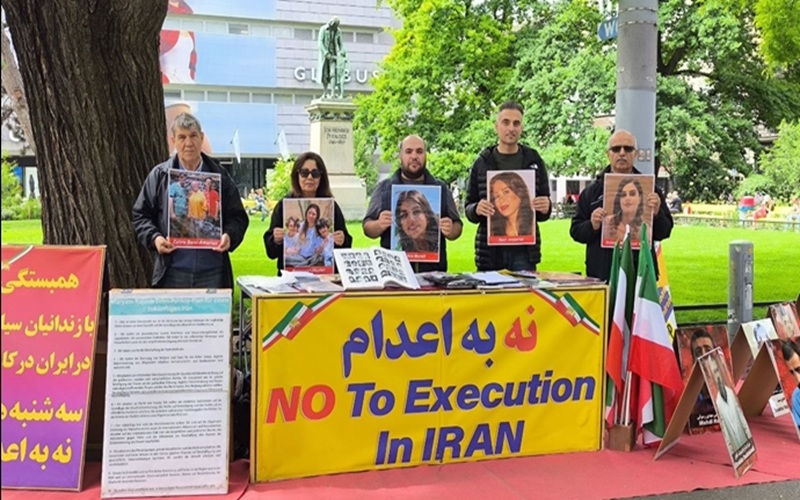

As executions accelerate under the cover of national security and wartime conditions, Iran regime’s judiciary faces growing accusations of systematic unfair trials and state-sponsored repression.
Iran regime’s judiciary announced on May 21 the execution of two men, Ramin Zaleh and Karim Maroufpour, on charges of “membership in separatist groups.” As in many recent execution cases, the judiciary’s news agency, Mizan, provided virtually no verifiable details about the arrests, legal proceedings, evidence, or trial process. The vague and formulaic language surrounding the executions has once again raised serious questions about the regime’s accelerating use of capital punishment under the cover of national security.
The executions come amid a broader surge in state repression following the recent conflict involving the United States, Israel, and Iran. In the atmosphere created by war, internet blackouts, and intensified security measures, the Iranian regime has reportedly executed more than 30 people in just a matter of weeks under sweeping accusations such as “collaboration with hostile states,” “espionage,” and “acting against national security.”
At the same time, regime-controlled media outlets have attempted to frame these executions as acts of “justice” and necessary measures against “enemy infiltration,” often broadcasting televised confessions and edited security footage to justify the crackdown. Yet the growing reliance on propaganda instead of transparent legal procedures only deepens public skepticism.
Those executed in recent weeks come from a wide range of backgrounds — athletes, technology specialists, and ordinary citizens. Among the most shocking cases was the execution of 19-year-old wrestler Saleh Mohammadi alongside two others in the city of Qom. The diversity of the accused reflects a widening net of repression that increasingly targets not just political activists, but anyone the regime perceives as potentially disloyal.
What is particularly alarming is the judiciary’s open emphasis on speed and severity. Judiciary chief Gholamhossein Mohseni Ejei has publicly demanded “special and extraordinary handling” of cases involving individuals he describes as “foot soldiers of the enemy.” He has explicitly stated that there should be “no delay and no leniency” in carrying out sentences, whether executions or confiscation of property.
In practice, such rhetoric amounts to an institutionalized call for rapid state-sanctioned killings. When the head of the judiciary openly prioritizes swift punishment over due process, the meaning is unmistakable: legal safeguards have become secondary to political objectives.
Human rights lawyers and activists have warned that the accelerated pace of executions and the opaque judicial process amount to systematic unfair trials. In many cases, there is little public information about court proceedings, defense attorneys, or the evidence presented against defendants. The absence of transparency has become so extreme that many observers describe the death sentences as arbitrary and unlawful.
This pattern is not new. It is part of a broader continuum of crimes against humanity that has defined the Iranian regime since its establishment more than four decades ago. What has changed is the speed and scale with which executions are now being carried out under wartime conditions and heightened political tension.
International human rights organizations have repeatedly condemned Iran’s judicial practices. In its latest annual report, Amnesty International once again described Iran’s trials as systematically unfair. According to the organization, access to legal counsel is severely restricted during investigations, convictions frequently rely on forced confessions obtained under torture, and state media routinely broadcast those confessions before trial outcomes are finalized.
In another report published earlier this year, Amnesty warned that the regime was using executions as a tool of political repression during periods of ceasefire and military tension, while simultaneously intensifying internet restrictions and security pressure.
Mai Sato, the United Nations Special Rapporteur on human rights in Iran, also warned that internet shutdowns and wartime conditions have made documentation of executions increasingly difficult. She noted that communication blackouts obscure the true number of executions and hinder efforts to identify prisoners at risk of imminent execution.
Meanwhile, judiciary spokesman Asghar Jahangir has escalated threats even further, warning that individuals accused of providing photographs or videos to “the enemy” could face execution and total confiscation of their property.
A review of reports published by Mizan reveals a strikingly repetitive pattern in the regime’s security-related prosecutions. Broad accusations such as “acting against national security,” “espionage,” “operational activity,” and even merely having the “intent” to conduct operations are repeatedly cited as grounds for execution. In several cases categorized as espionage, individuals were reportedly arrested not for carrying out actions, but simply for allegedly intending to do so.
Another revealing aspect is the near-total invisibility of defense attorneys in these cases. Reports rarely mention any meaningful legal defense. Typically, the only reference to lawyers appears at the end of official statements, noting that requests for clemency or appeals were rejected.
At the center of this judicial structure is the notorious Note to Article 48 of Iran’s Criminal Procedure Code. Implemented in 2015 after years of controversy, the provision allows defendants accused of national security crimes to choose lawyers only from a list approved by the judiciary chief. In 2018, the judiciary released a list of just 20 approved lawyers for such cases — effectively institutionalizing state control over legal defense in political prosecutions.
The regime has further strengthened this machinery of repression through new legislation adopted after the recent 12-day conflict. Under a parliamentary measure titled “Intensifying Punishment for Espionage,” the scope of espionage charges and the speed of judicial proceedings have both expanded significantly.
The law stipulates that any “intelligence activity,” “espionage,” or “operational action” carried out on behalf of “hostile states or groups” can be punished by execution and confiscation of assets. While the legislation explicitly identifies the United States and Israel as hostile states, it also grants Iran’s Supreme National Security Council the authority to designate other governments and groups as enemies — effectively creating a flexible legal framework for broader political repression.
The current wave of executions demonstrates that Iran regime’s judiciary is functioning less as an independent legal institution and more as an instrument of political intimidation. Under the pretext of national security, the regime is expanding its use of fear, secrecy, and capital punishment to silence dissent and tighten control over society during one of the most volatile periods in its recent history.