


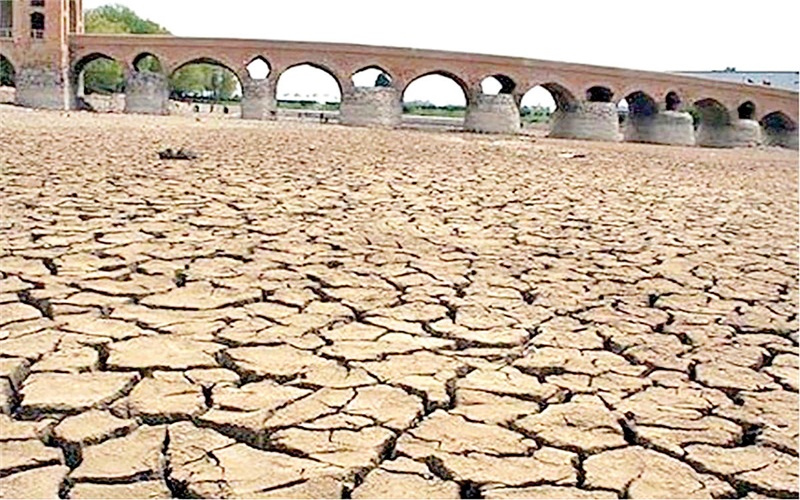

As reservoirs decline and major cities face severe water stress, Iran’s leadership continues shifting responsibility onto citizens instead of confronting decades of environmental destruction and failed policies.
Iran’s deepening water crisis is no longer a distant environmental warning. It has become an immediate threat to public health, food security, economic stability, and the survival of millions living in the country’s largest urban centers. Yet despite years of escalating alarms, the ruling establishment continues to respond with denial, deflection, and demands for public “sacrifice” rather than meaningful structural reform.
Recent statements by officials from Iran’s meteorological and water management agencies reveal the scale of the crisis now unfolding across the country. Authorities have warned of severe water stress in Tehran, Karaj, Mashhad, Saveh, and Arak, while official figures show that one-third of the country’s dam reservoir capacity remains empty despite increased rainfall in parts of Iran.
The contradiction itself is telling.
Although regime officials claim national rainfall averages have approached or even slightly exceeded long-term norms this year, uneven distribution, infrastructure failures, environmental degradation, and chronic mismanagement have left vast areas of the country dangerously vulnerable. The crisis is no longer simply about rainfall. It is about governance.
Ahad Vazifeh, head of the National Climate Center and Crisis Management Organization, acknowledged that residents of several major cities may face drinking water shortages unless they drastically reduce consumption. According to his statements, Tehran received only 155 millimeters of rainfall during the current water year, far below the province’s long-term average of 250 millimeters.
Even more alarming, Tehran reportedly recorded a 38 percent rainfall deficit this year after already enduring nearly 50 percent below-normal precipitation during the previous water cycle. Such consecutive shortages place enormous pressure on reservoirs, groundwater systems, and already deteriorating urban infrastructure.
Yet officials continue presenting the crisis primarily as a matter of public consumption habits.
This narrative ignores the central drivers behind Iran’s environmental collapse: decades of reckless dam construction, unsustainable groundwater extraction, destruction of wetlands, politically driven agricultural policies, corruption within state-controlled development projects, and the absence of long-term resource planning.
The regime’s own statistics reveal the severity of the imbalance. Despite a reported 72 percent increase in water inflow to dams during the current water year, approximately 33 percent of national reservoir capacity remains unfilled. Experts warn that uneven rainfall patterns and poor resource management continue to undermine water security across the country.
Meanwhile, the crisis is now directly threatening Iran’s agricultural sector and food supply.
Peyman Alami, head of the Agricultural Guild Chamber, warned that repeated electricity outages affecting agricultural wells could reduce crop production by 25 to 30 percent. Each power interruption reportedly wastes nearly an hour of irrigation water, further straining already depleted underground water reserves.
This reflects another structural contradiction inside Iran’s failing infrastructure system: an energy crisis now intensifies the water crisis, which in turn deepens food insecurity and economic instability.
Even officials within Iran’s Water Resources Management Company admit that at least 12 provinces continue receiving below-average rainfall despite national precipitation increases. Provinces such as Qom, Semnan, Markazi, Yazd, Isfahan, and even parts of Gilan remain under serious pressure.
The timing and geographic distribution of rainfall have become increasingly erratic — a pattern intensified by climate change but made significantly worse by poor state planning and environmental neglect.
Yet instead of presenting a comprehensive national strategy, regime officials repeatedly shift responsibility onto ordinary citizens.
In recent months, senior figures in the Iranian government have intensified calls for “maximum conservation” of water, electricity, gas, and fuel. Regime president Masoud Pezeshkian recently warned that the crisis would worsen unless people reduced consumption.
But asking citizens to consume less while ignoring the structural roots of the disaster has become a familiar pattern in the Islamic Republic’s governance model. Public hardship is treated not as evidence of policy failure, but as a burden society itself must absorb.
Critics inside and outside Iran increasingly argue that the government has no coherent or effective plan to confront the crisis. Instead, authorities continue relying on temporary restrictions, public warnings, and emergency appeals while avoiding accountability for decades of environmental destruction and failed resource management.
Iran’s water crisis therefore represents far more than a technical or climatic challenge. It is the outcome of a political system that prioritized ideological projects, corruption networks, and short-term survival over sustainable national development.
The consequences are now visible everywhere: shrinking reservoirs, collapsing agriculture, forced migration, environmental degradation, food insecurity, and growing public distrust.
A country facing chronic water stress cannot afford governance built on denial and improvisation. Yet that is precisely the reality confronting millions of Iranians today.