


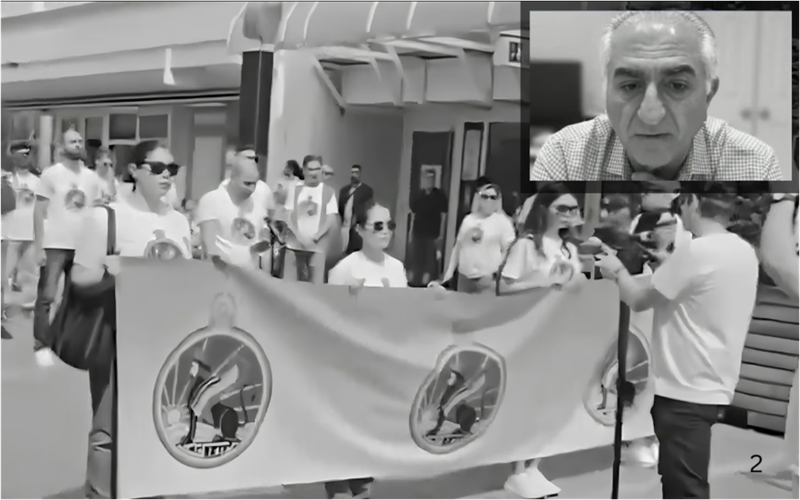

The recent SAVAK-symbol march in Germany exposed the authoritarian instincts within Reza Pahlavi’s monarchist movement and highlighted its growing disconnect from Iran’s democratic struggle.
Rehabilitating Tyranny in the Name of “Liberation”
At a time when the Iranian people are paying the price of freedom with executions, imprisonment, torture, and poverty, one would think that no political current claiming to oppose the clerical dictatorship could possibly sink lower in helping the regime damage the democratic movement.
Yet once again, the monarchist camp surrounding Reza Pahlavi has managed to do precisely that.
The recent march in Germany featuring the emblem of SAVAK—the Shah’s notorious secret police—was not merely a political embarrassment. It was a moral and historical catastrophe. Even more revealing were the reports that the demonstration had been encouraged by circles close to Reza Pahlavi himself, exposing once again the dangerous mentality dominating today’s monarchist movement: the normalization of dictatorship under the disguise of opposition politics.
For millions of Iranians, SAVAK is not a nostalgic symbol. It is synonymous with torture chambers, disappearances, censorship, surveillance, fear, and the violent suppression of dissent. Its reputation was so infamous that even during the Shah’s final years, openly identifying as a SAVAK operative could provoke public outrage in the streets. SAVAK became one of the defining symbols of why the monarchy collapsed in the first place.
Now, nearly five decades later, a faction claiming to speak in the name of “freedom” has chosen to revive that symbol publicly in Europe.
This is not a political mistake. It is a revelation.
Freedom Cannot Be Built With the Tools of Repression
The contradiction is staggering.
A movement that claims to seek democracy now openly tolerates, excuses, or romanticizes one of the most notorious repression apparatuses in modern Iranian history. It is equivalent to claiming that tyranny can produce liberty, or that surveillance and intimidation can somehow pave the road toward human rights.
You cannot clean a mirror with a hammer.
You cannot build democracy with the symbols of political torture.
And you cannot claim to oppose dictatorship while glorifying one of its most infamous instruments.
For years, critics warned that sections of the monarchist current were not genuinely committed to democratic values, pluralism, or political freedoms. Instead, they cultivated a cult-like political culture centered on personality worship, historical revisionism, and hostility toward dissenting opposition voices.
The SAVAK march exposed that reality with brutal clarity.
Reza Pahlavi’s Retreat Changes Nothing
Following widespread backlash, legal complaints, and growing condemnation from Iranians and international observers alike, Reza Pahlavi eventually issued a short video statement distancing himself from the scandal.
But his response was not a principled rejection of authoritarianism.
Notably, he refused even to directly condemn SAVAK’s historical crimes. Instead, he described the incident primarily as “controversial” and problematic because it gave political opponents an excuse to attack his movement.
That distinction matters.
At no point did he clearly state that glorifying a torture organization is morally unacceptable. At no point did he confront the authoritarian culture that has flourished within parts of his own political network. And at no point did he acknowledge the pain inflicted on generations of Iranians who suffered under both dictatorship and theocracy.
His remarks sounded less like a democratic reckoning and more like crisis management after a public relations disaster.
This retreat was not voluntary. It was imposed by public outrage.
Monarchism and the Recycling of Authoritarianism
The deeper issue goes beyond one march or one slogan.
The crisis lies in the political project itself.
Over recent years, the monarchist current around Reza Pahlavi has increasingly adopted rhetoric that mirrors the same intolerance and exclusionary politics practiced by the clerical regime. Opposition activists, dissidents, ethnic minorities, republicans, women’s rights advocates, and democratic organizations have all faced online harassment, threats, and smear campaigns from radicalized monarchist networks.
The language may differ from the Mullahs regime’s propaganda machinery, but the underlying instinct is disturbingly similar: silence critics, delegitimize opponents, and centralize power around an unelected figure marketed as a national savior.
This is not democratic culture.
It is the recycling of authoritarianism in a different costume.
Iranian society did not endure decades of repression merely to exchange one form of dictatorship for another. The people of Iran are fighting for a democratic republic based on popular sovereignty, political pluralism, secular governance, freedom of expression, gender equality, and human rights—not for the restoration of dynastic rule wrapped in nationalist nostalgia.
Iran’s Future Belongs to Democracy, Not Political Necromancy
The attempt to rehabilitate SAVAK imagery reveals a profound disconnect between monarchist elites abroad and the lived historical memory of ordinary Iranians.
The younger generation inside Iran is risking everything for freedom from all forms of dictatorship. They reject both the turban and the crown. They are demanding a future built on democratic legitimacy, not inherited authority.
Every time monarchist factions glorify authoritarian symbols, they do more than insult the victims of the Shah’s repression. They hand the clerical regime exactly what it desperately wants: propaganda material to portray the entire opposition as anti-democratic and reactionary.
This is why such actions are not merely reckless. They are politically destructive.
Iran’s path to liberation cannot pass through the rehabilitation of SAVAK, the romanticizing of monarchy, or the resurrection of authoritarian culture.
A free Iran will not emerge from the ghosts of dictatorship.
It will emerge from the struggle of a people who refuse to bow to any tyrant—whether crowned or turbaned.