


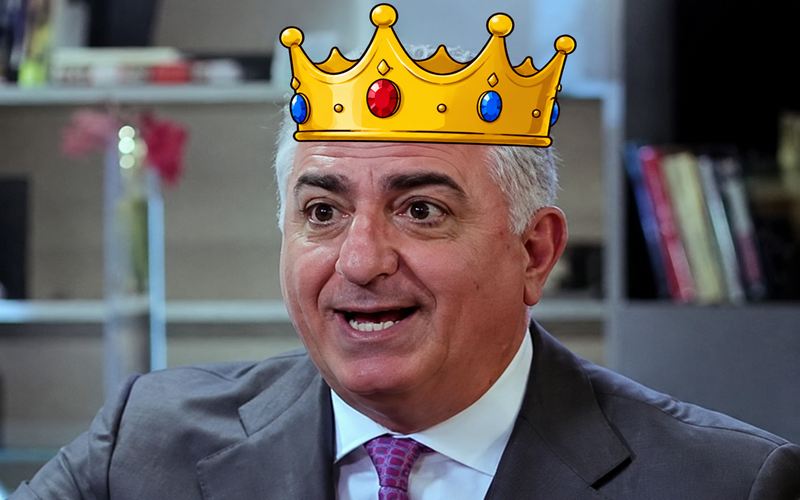

German Report Raises Serious Questions About Monarchist Intimidation, Violence, and Democratic Credibility
For years, Reza Pahlavi has attempted to present himself as a democratic alternative to Iran’s ruling clerical regime. Promoted by some Western politicians and media outlets as a potential leader for a future Iran, the son of the last Shah has carefully cultivated an image of moderation, democracy, and national unity.
However, a recent investigation by the German public broadcaster ARD’s political magazine Kontraste paints a very different picture. The report raises troubling questions not only about the behavior of Pahlavi’s supporters but also about the broader political culture surrounding the monarchist movement.
The findings reveal a pattern of intimidation, threats, harassment, and even alleged violence directed against critics of Reza Pahlavi—behavior that stands in stark contrast to the democratic values his movement claims to represent.
A Movement That Cannot Tolerate Criticism
The ARD report begins with Reza Pahlavi’s visit to Berlin in April 2026, where he was welcomed enthusiastically by supporters while simultaneously facing protests from opponents. During a press conference, tensions surfaced when taz journalist Pauline Jäckels challenged Pahlavi with questions regarding his support for military action in Iran.
According to the report, Pahlavi reacted irritably and attempted to limit her questioning. Shortly afterward, the journalist became the target of a massive online harassment campaign.
Jäckels told ARD:
“I received thousands of messages in the days afterward containing the worst insults and threats against me. People wrote that they would track me down in Berlin.”
She described receiving messages calling her a “communist whore,” a “puppet of the mullahs,” and other abusive slurs. She stated that she had never experienced such a level of intimidation while covering any other political issue.
For a movement that claims to champion freedom of expression, the treatment of a journalist asking legitimate questions is deeply revealing.
Human Rights Activists Under Attack
The report documents similar experiences faced by Iranian human rights activist Shadi Amin, a prominent supporter of the Woman, Life, Freedom movement.
Because of her criticism of Reza Pahlavi, Amin says she has become a target of systematic harassment and threats from monarchist supporters. According to the report, she now requires police protection at some public events.
Amin told ARD:
“The supporters of Reza Pahlavi are famous for how they deal with their political opponents. Usually it involves death threats and rape threats. That has happened to me. They are truly dangerous.”
The report further cites a video in which a monarchist supporter issued a graphic rape threat against her.
Such incidents raise a fundamental question: if critics cannot safely express dissent within the monarchist camp today, what would political pluralism look like under a movement led by its most prominent figure?
The Shadow of Violence
Perhaps even more disturbing are the allegations connecting violent acts to radical supporters of Reza Pahlavi.
The ARD report notes that Canadian activist Masoud Masjoudi, a vocal critic of Pahlavi whom it describes as questioning the former crown prince’s democratic legitimacy, was killed earlier this year. According to the report, Canadian authorities arrested two Pahlavi supporters following the discovery of his body and investigated whether they could have been involved in the crime.
While legal proceedings remain ongoing and guilt has not been established, the case highlights the increasingly aggressive atmosphere surrounding parts of the monarchist movement.
The Unresolved Legacy of the Shah
The report also revisits a central issue that Reza Pahlavi has never convincingly addressed: the authoritarian legacy of his father’s rule.
While monarchist supporters often emphasize modernization and secularization under the Shah, the ARD investigation reminds viewers that the monarchy was also marked by political repression and brutality.
The report specifically references the activities of SAVAK, the Shah’s notorious secret police, which became synonymous with surveillance, torture, and persecution of political opponents. During a visit to Berlin in 1967, demonstrators protesting the Shah were violently attacked by forces associated with his security apparatus.
Critics argue that Reza Pahlavi has never clearly and unequivocally confronted this legacy. Instead, nostalgia for the monarchy often overshadows an honest reckoning with the abuses committed under the previous regime.
Limited Support Inside Iran
Another major weakness highlighted by the report concerns Pahlavi’s actual support among Iranians.
Despite monarchist claims that millions of Iranians view him as their future leader, experts interviewed by ARD dispute this narrative.
Middle East scholar Reinhard Schulze observed that while Pahlavi may function as a symbolic opposition figure, there is little evidence that he is widely accepted as a genuine political leader.
According to Schulze:
“He was more a symbolic figure of resistance than necessarily the great hope for Iran itself.”
This assessment reflects a broader reality within the Iranian opposition. While many Iranians reject the clerical regime, that rejection does not automatically translate into support for restoring the monarchy.
Attacks Against Other Opposition Groups
The report also documents hostility directed at members of other opposition movements.
In Hamburg, activist Farbod Mahoutchiyan displayed photographs of political prisoners and execution victims in Iran. According to his testimony, monarchist supporters repeatedly disrupted the event, chanting slogans against the MEK and physically attacking him. He stated that he had been punched and kicked on multiple occasions.
The Hamburg prosecutor’s office confirmed to ARD that investigations related to these incidents were underway.
Such behavior reflects a recurring pattern within monarchist circles: rather than building unity against dictatorship, some supporters appear more focused on attacking rival opposition movements.
A Leader Without Accountability
When confronted with allegations against his supporters, Reza Pahlavi largely avoided direct engagement.
According to ARD, he did not respond to the broadcaster’s inquiries. Instead, he later stated to Politico that he condemns violence and aggression while claiming that the Iranian regime seeks to create divisions within the opposition.
Yet experts interviewed by ARD argue that Pahlavi benefits from a structure that allows him to distance himself from extremist supporters whenever controversies emerge.
Professor Schulze noted that the monarchist movement lacks a formal organizational structure, making accountability difficult:
“Reza Pahlavi can always say these people are not part of him. Under his name, almost anything can gather.”
A Warning for Those Seeking Democracy
Perhaps the most revealing scene in the ARD investigation comes near its conclusion.
The report documents a march in Regensburg by Pahlavi supporters who openly identified themselves with the tradition of SAVAK—the very organization remembered for torture, political repression, and systematic human rights violations under the Shah.
For many Iranians who have spent decades fighting dictatorship, this is a warning sign.
The struggle for a democratic Iran cannot be reduced to a choice between two forms of authoritarianism. The Iranian people overthrew the Shah in 1979 because they rejected repression and political absolutism. They continue to resist the current religious dictatorship for the same reason.
The ARD Kontraste investigation demonstrates that serious questions remain unanswered about Reza Pahlavi, his movement, and the conduct of many of his most vocal supporters. If a political movement responds to criticism with intimidation, glorifies symbols of past repression, and fails to establish clear democratic accountability, it cannot credibly claim to represent Iran’s democratic future.
Source: ARD Kontraste, “Reza Pahlavi and Criticism of the Monarchist Movement,” broadcast on 28 May 2026.