


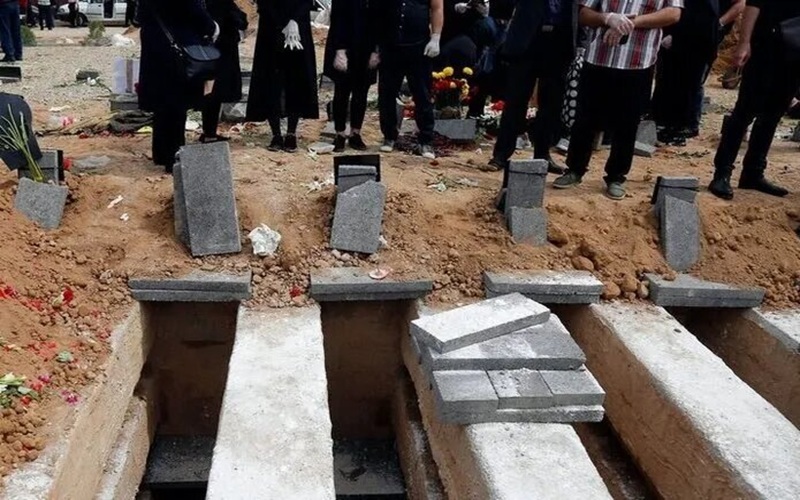

As inflation continues to erode living standards across Iran, even the cost of burying a loved one has become a growing financial burden, highlighting how deeply the country’s economic crisis has penetrated everyday life.
Inflation Expands into Every Corner of Daily Life
For years, Iranians have struggled with rising prices in nearly every aspect of life. Housing, food, healthcare, transportation, and education have all become significantly more expensive as inflation continues to undermine household purchasing power.
Now, another essential service has been added to the growing list of financial concerns facing Iranian families: the cost of burial and funeral services.
According to a June 2026 report published by the state-affiliated economic outlet Donya-e-Eghtesad, new rates approved for Tehran’s Behesht-e Zahra cemetery indicate substantial increases in the cost of funeral-related services. The report stated that fees for a wide range of services—from transportation of the deceased and ritual washing to burial arrangements and funeral ceremonies—have risen by an average of approximately 40 percent, while some services have seen increases of as much as 50 percent.
The sharp increase has drawn public attention not only because of its scale, but because it affects families at one of the most difficult moments of their lives.
Mourning Under Economic Pressure
For many Iranian households already struggling to meet basic needs, the death of a family member now carries an additional financial burden.
The new tariffs approved by Tehran’s City Council come at a time when many citizens are facing declining real incomes and rising living expenses. Families that have been forced to reduce spending on food, healthcare, or education are now confronted with higher costs even when arranging a funeral for a loved one.
As a result, burial expenses have become yet another indicator of the broader economic pressures weighing on society.
Unlike many other household expenditures, funeral costs are largely unavoidable. While families may postpone purchases, reduce consumption, or eliminate discretionary spending during difficult economic times, burial and funeral arrangements must be made regardless of financial circumstances.
This reality makes rising funeral costs particularly significant as a measure of economic hardship.
Transportation and Burial Services See Significant Increases
One of the areas most affected by the new pricing structure is the transportation of the deceased.
The cost of private ambulance services and the transfer of bodies within Tehran has reportedly increased considerably, creating additional expenses for families that must transport loved ones from hospitals or other locations across the city.
At the same time, other essential services associated with burial—including ritual washing, shrouding, interment, and related cemetery services—have also experienced substantial price increases.
Taken together, these changes mean that the total cost of a funeral has risen sharply compared to previous years, adding yet another layer of financial strain to households already under pressure.
A Reflection of a Broader Economic Crisis
Economists and analysts have long warned that persistent inflation eventually affects every sector of society. In Iran, years of economic instability, currency depreciation, and rising prices have steadily reduced the purchasing power of ordinary citizens.
The expansion of inflation into funeral and burial services demonstrates how deeply the economic crisis has penetrated daily life.
In recent years, Iranian families have witnessed repeated increases in the cost of housing, food, medicine, utilities, transportation, and education. Many households have responded by cutting back on essential spending, taking on debt, or relying on informal support networks to make ends meet.
The growing cost of funeral services suggests that even the most basic and unavoidable human needs are no longer insulated from economic deterioration.
When Inflation Extends Beyond Life Itself
The increase in burial costs has become a powerful symbol of the broader economic realities confronting millions of Iranians.
For many citizens, the issue is not simply the price of cemetery services. Rather, it reflects a wider concern about the continuing erosion of living standards and the inability of incomes to keep pace with rising costs.
As inflation continues to spread across every sector of the economy, public concern is increasingly focused on a central question: how much more financial pressure can Iranian families absorb?
The rising cost of burial services offers a stark answer. The economic crisis is no longer confined to employment, housing, or consumer goods. It has reached one of life’s most inevitable moments, underscoring the extent to which inflation now shapes the experience of ordinary Iranians from birth to death.
The latest increases at Behesht-e Zahra are therefore more than a municipal pricing decision. They serve as another reminder of the widening gap between household incomes and the cost of living—and of an economic crisis that continues to touch virtually every aspect of life in Iran.