


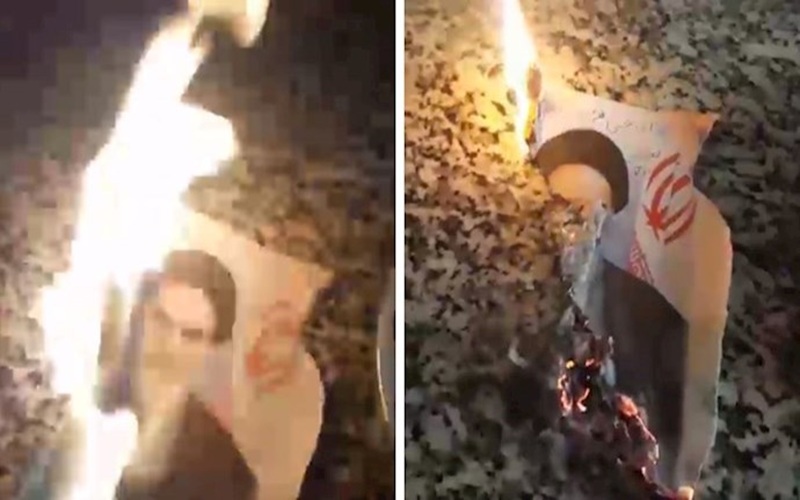

While much of Iran’s political landscape remained trapped in illusions about Ruhollah Khomeini, the Iranian Resistance and its supporters were among the first to expose the authoritarian nature of the emerging theocracy and challenge the doctrine of absolute clerical rule.
Every year, the anniversary of Ruhollah Khomeini’s death prompts renewed discussion about the founder of the Mullahs’ regime. Yet the central question is not how Khomeini died, but what he left behind. More than three decades after his death, the consequences of the system he created continue to shape Iran’s political, economic, and social realities.
At a time when many political actors remained captivated by the image of Khomeini as a revolutionary leader, a different assessment was already emerging from within the Iranian Resistance. In October 1981, the Swedish publication Proletären quoted Resistance leader Massoud Rajavi as warning that Khomeini stood at the center of the regime’s machinery of repression and executions, arguing that the Iranian people would one day seek to hold him accountable before history and the world.
Those words were spoken when challenging Khomeini publicly carried immense risks. The atmosphere of the early years of the Mullahs’ regime was dominated by a cult of personality that portrayed him as an unquestionable authority. Many political figures either remained silent or actively supported the consolidation of clerical power. Some even advocated expanding the regime’s coercive apparatus as dissent was increasingly suppressed.
Against this backdrop, a historic turning point emerged. Young supporters of the Resistance took to the streets and openly challenged the doctrine of Velayat-e Faqih—the principle of absolute clerical rule that formed the ideological foundation of the new regime. Their protests shattered a political taboo that many believed could not be broken. They paid a heavy price, but their defiance established one of the earliest organized challenges to the theocracy.
The events of October 1981 became a defining moment in the confrontation between the regime and a movement that refused to accept the monopolization of political power. The sacrifices of those young activists exposed what the Resistance viewed as the betrayal of the democratic aspirations that had fueled the anti-monarchical revolution.
From the Resistance’s perspective, Khomeini did not emerge as the product of a long struggle against dictatorship. Rather, he capitalized on widespread public dissatisfaction and revolutionary momentum before imposing a new form of authoritarian rule. Promises of political freedom, democratic participation, and a constituent assembly quickly gave way to a system centered on clerical supremacy.
The years that followed were marked by expanding repression. Political opponents were imprisoned, dissent was criminalized, and executions became a central instrument of governance. Economic hardship, corruption, and institutionalized discrimination spread alongside an increasingly powerful security apparatus.
For many critics of the regime, one of the most devastating consequences of Khomeini’s rule was the prolonged Iran-Iraq War. While the conflict began with Iraq’s invasion of Iran, opponents argue that the continuation of the war beyond opportunities for a negotiated settlement came at an enormous human cost and served the regime’s interest in consolidating power during a period of domestic instability.
The darkest chapter associated with Khomeini’s rule remains the 1988 massacre of political prisoners. Following a handwritten fatwa, thousands of prisoners—many of them supporters of the opposition—were executed after summary proceedings. Human rights organizations and survivors continue to regard the massacre as one of the most significant crimes in the history of the Mullahs’ regime.
Today, supporters of the Resistance argue that Khomeini’s true legacy is reflected not in official commemorations but in the realities confronting Iranian society: economic decline, systemic corruption, political repression, international isolation, and decades of unfulfilled promises.
Shortly after Khomeini’s death in 1989, Massoud Rajavi summarized his assessment of the former supreme leader in stark terms, describing him as a historic calamity whose rule represented a defining test for Iran and its people.
Whether one agrees with that characterization or not, the debate surrounding Khomeini’s legacy remains inseparable from the question of resistance. The significance of those who challenged him during the height of his power lies not only in their opposition to one individual, but in their rejection of a system that continues to dominate Iran decades later.
The young activists who confronted the regime in its earliest years are no longer merely part of history. Their legacy survives in new generations of protesters who continue to reject authoritarian rule in all its forms. The slogans heard in Iran’s streets today reflect a broader demand for political change—one that challenges both religious dictatorship and any return to past forms of autocracy.
More than thirty years after Khomeini’s death, the struggle over his legacy continues. It is a struggle not between memory and forgetting, but between competing visions of Iran’s future: one rooted in absolute rule and repression, and another seeking democratic change and popular sovereignty.