



Official statistics expose the growing gap between the regime’s claims and the daily realities facing millions of Iranians struggling with inflation, unemployment, and declining living standards.
When even state-affiliated media begin sounding the alarm, it becomes increasingly difficult for Iran’s ruling establishment to conceal the depth of the country’s economic crisis. On May 31, the regime-linked outlet Khabar Fori published figures showing that Iran’s misery index has reached a staggering 61.3 percent—a level that reflects not merely economic weakness but a profound deterioration in the living conditions of millions of citizens.
According to the report, the figure is derived from an inflation rate of 53.7 percent combined with an unemployment rate of 7.6 percent. By international standards, such a number signals severe economic distress. Yet for many Iranians, even this alarming statistic may underestimate the hardship they face every day.
A Crisis Measured in More Than Numbers
The misery index, calculated by adding inflation and unemployment rates, is widely used as a measure of economic pressure on society. It captures two of the most painful realities confronting ordinary households: the rising cost of living and the inability to secure stable employment.
A misery index above 60 percent suggests an economy struggling on multiple fronts simultaneously. Prices continue to rise while employment opportunities remain limited, creating a situation in which many families find themselves trapped between shrinking incomes and growing expenses.
The official figure of 61.3 percent is one of the highest recorded in recent years and reflects a broader trend of economic decline that has accelerated under the rule of the clerical establishment.
The Regional Face of Economic Hardship
The crisis is not distributed evenly across the country. According to the published data, the western provinces are among the hardest hit.
Kurdistan tops the list with a misery index of 77 percent, followed by Kermanshah at 75 percent and Lorestan at 74.4 percent. These figures reveal the disproportionate burden carried by provinces that have long suffered from underinvestment, unemployment, and economic neglect.
The regional disparities also highlight a persistent structural problem within Iran’s economy. While some areas experience slightly lower levels of hardship, virtually every part of the country is moving in the same direction: toward greater economic insecurity.
The Official Numbers May Understate Reality
Perhaps the most revealing aspect of the report is the acknowledgment that the official misery index may not fully capture the true scale of the crisis.
Many economists have repeatedly pointed out that official unemployment statistics fail to account for hidden unemployment, underemployment, temporary work arrangements, and declining working hours. A person working only a few hours per week may not be classified as unemployed, yet still lacks the income necessary to meet basic needs.
Similarly, the misery index cannot adequately measure the collapse in purchasing power that many households have experienced in recent years.
Food prices have surged. Housing costs have become increasingly unaffordable. Healthcare and education expenses continue to rise. Meanwhile, wages have failed to keep pace with inflation, leaving millions of families poorer even when they remain employed.
As a result, the economic pain felt by ordinary Iranians often exceeds what official indicators suggest.
Even Tehran Is Struggling
The report identifies Tehran as having the lowest misery index in the country. Yet even the capital recorded a figure of 51.3 percent.
Far from indicating prosperity, that number underscores the extent of the nationwide crisis. Residents of Tehran continue to face soaring rents, rising household expenses, and declining purchasing power. Many middle-class families have seen their economic security steadily eroded over the past decade.
If the least affected region of the country is experiencing a misery index above 50 percent, it speaks volumes about the overall condition of the economy.
The Human Cost of Economic Failure
The consequences of these trends are visible across Iranian society.
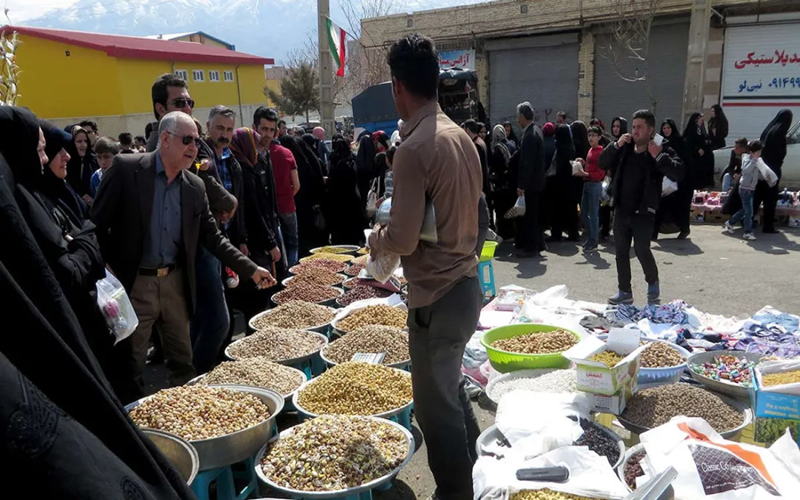
Long lines for discounted goods have become increasingly common. More families rely on installment purchases to afford basic necessities. Foods that were once considered staples have gradually disappeared from household budgets.
Housing has become one of the most severe sources of pressure. Across many cities, tenants have been forced to leave their neighborhoods due to rising rents and relocate to distant suburbs or informal settlements. The dream of home ownership has become unattainable for a growing segment of the population.
At the same time, many educated young Iranians face a labor market incapable of absorbing their skills. Years of education often lead not to economic opportunity but to unemployment, underemployment, or emigration.
The result is a growing sense of uncertainty about the future.
A Warning Sign for the Regime
Economic experts have repeatedly warned that prolonged hardship carries consequences beyond the financial sphere. Rising poverty, declining social mobility, and growing inequality can deepen social fractures and fuel public frustration.
For a regime already facing widespread dissatisfaction, the continued rise of the misery index represents more than an economic challenge. It is a political warning sign.
Official statistics may provide numerical snapshots of the crisis, but they cannot fully capture the daily realities experienced by ordinary citizens. The true measure of economic distress is found not in government reports but in the lives of people who struggle every day to afford food, housing, healthcare, and education.
The fact that the official misery index has surpassed 61 percent is alarming enough. The possibility that the lived experience of millions of Iranians is even worse should be a source of far greater concern.
Ultimately, the misery index is not merely a statistic. It is a reflection of a society burdened by years of economic mismanagement, corruption, and failed policies. Behind every percentage point are families whose standard of living continues to decline and whose hopes for a better future grow increasingly distant.