


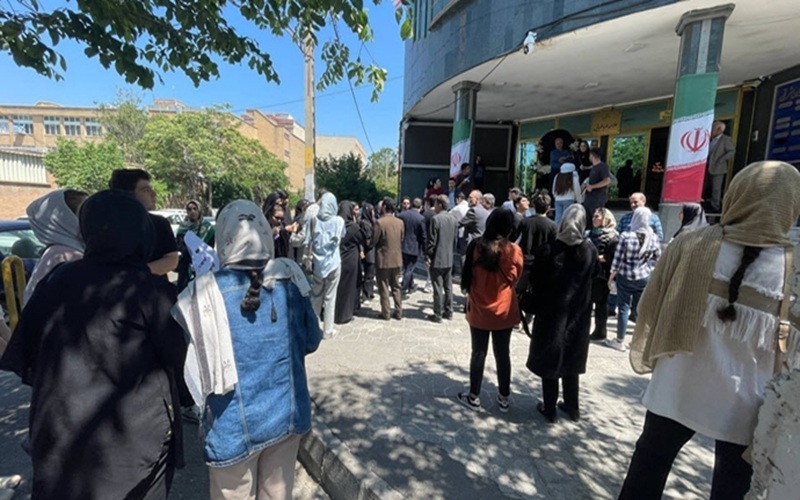

Remarks by a prominent establishment figure highlight growing concerns within the ruling system over declining legitimacy, widespread dissatisfaction, and the lasting impact of the January crackdown.
Regime Insider Admits Growing Gap Between Society and the State
For years, officials of Iran’s regime have attempted to portray nationwide protests and social unrest as the product of foreign influence or opposition activity. However, recent comments by veteran regime figure Hossein Marashi have once again drawn attention to the internal roots of Iran’s political and social crises.
In an interview with the state-affiliated newspaper Etemad, later highlighted by regime media outlets, Marashi offered a rare assessment of the challenges facing the regime. His remarks focused on government inefficiency, corruption, declining public trust, and the widening distance between the ruling establishment and Iranian society.
The interview has generated considerable debate because it departs from the official narrative that frequently attributes unrest to external actors rather than systemic domestic failures.
Acknowledging Government Failure and Public Distrust
One of the most striking aspects of Marashi’s comments was his acknowledgment that the regime has failed to establish a system viewed by most citizens as effective and free of corruption.
According to Marashi, administrative corruption, economic hardship, and a lack of trust in official institutions have pushed a significant portion of society away from the government. His assessment effectively recognizes that public dissatisfaction is rooted in long-standing structural problems rather than isolated incidents or foreign influence.
Such remarks are notable because they come from a figure closely associated with the political establishment rather than from opposition groups or independent observers.
Warning of a Deep Social Divide
Marashi devoted a significant portion of his interview to discussing what he described as a widening gap between the state and society.
He argued that no government can remain stable while being fundamentally at odds with the majority of its population. Pointing to cultural and social differences between official policies and public preferences, he suggested that many aspects of everyday life in Iran increasingly diverge from the vision promoted by the ruling establishment.
In one of his most revealing observations, Marashi indicated that the government must eventually adapt to the demands and expectations of a large majority of the population. He warned that continuing to ignore these realities could carry serious consequences.
For many observers, such statements amount to a rare acknowledgment from within the regime that a profound social divide exists between the authorities and much of Iranian society—a divide repeatedly reflected in years of protests and public discontent.
Rare Admission of the Consequences of the January Crackdown
Among the most controversial aspects of the interview were Marashi’s comments regarding the events of January 2026.
Referring to the developments of January 18 and 19, he suggested that if the situation had been handled differently, the country’s current circumstances might also be different. While stopping short of direct criticism, the remarks were widely interpreted as an implicit acknowledgment that government decisions played a significant role in shaping the crisis and its aftermath.
The significance of these comments lies in the fact that, rather than denying the events outright, a prominent insider pointed to mismanagement and its lasting consequences.
The January crackdown, which resulted in the deaths of thousands of Iranian youths according to opposition reports, remains one of the most contentious and politically sensitive episodes in recent Iranian history.
Unresolved Grievances Behind Repeated Protests
Marashi also linked recent unrest to years of accumulated frustration across Iranian society.
He referenced major protest movements in 1999, 2009, 2017, 2019, and 2026, arguing that many grievances were never adequately addressed. Instead, he suggested, public anger continued to build beneath the surface, creating conditions for repeated cycles of unrest.
His comments reflect a growing recognition that Iran’s protest movements are not isolated events but manifestations of deeper and unresolved social, economic, and political problems.
The persistence of these grievances has contributed to an atmosphere in which dissatisfaction remains widespread despite repeated efforts by authorities to suppress dissent.
Concerns Over Future Unrest
Looking ahead, Marashi warned that the underlying causes of public anger remain unresolved.
He argued that social frustration continues to exist across the country and could re-emerge under new circumstances. Political agreements or regional developments, he suggested, are unlikely by themselves to eliminate the deep reservoir of dissatisfaction that has accumulated over many years.
Among the factors he identified were economic hardship, youth unemployment, corruption, and government inefficiency—issues that continue to affect millions of Iranians and fuel public resentment.
His warning reflects growing concern within segments of the ruling establishment that ignoring these problems could lead to renewed instability and future waves of protest.
Signs of a Broader Legitimacy Crisis
The importance of Marashi’s remarks lies in their departure from the regime’s traditional narrative. Rather than attributing unrest solely to external factors, he pointed directly to internal governance failures, social discontent, and the consequences of security-based responses to public protests.
His acknowledgment of widespread dissatisfaction, declining public trust, and the impact of the January events offers a revealing glimpse into concerns circulating within the establishment itself.
Taken together, Marashi’s statements represent one of the clearest admissions by a regime insider that the Islamic Republic faces a growing crisis of legitimacy. His references to majority public dissatisfaction, ineffective governance, and the widening gap between the people and the ruling establishment suggest that concerns about future unrest are no longer confined to critics of the regime.
Instead, they are increasingly being voiced from within the system itself—a sign that anxieties over Iran’s political future are spreading even among those who have long been part of the ruling structure.