


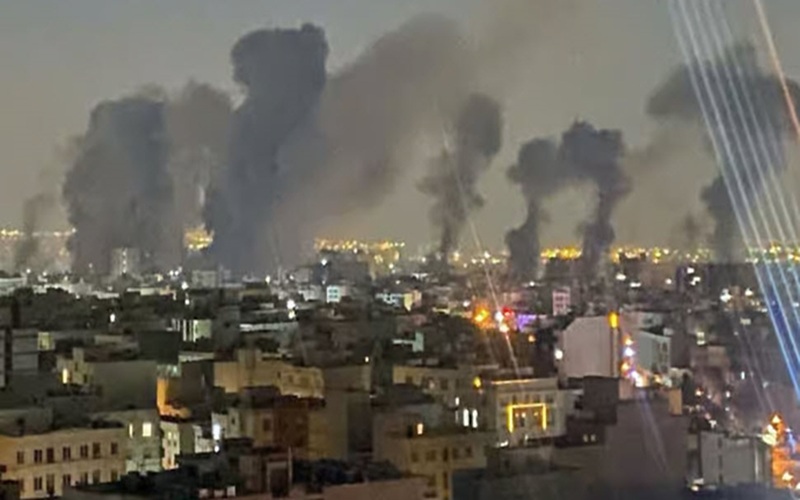

As external conflict dominates the headlines, the Iranian regime is intensifying executions and repression at home, revealing where it sees its greatest threat.
The shadow of war has once again spread across Iran. Yet while the public’s attention is drawn to regional conflict and military developments, another war continues with relentless intensity inside the country—a war waged by the Iranian regime against its own people.
History has shown that whenever this regime faces an external crisis, it seeks to convert that crisis into an opportunity for survival. Under the cover of war, domestic repression is expanded, political space shrinks further, and executions become an increasingly prominent instrument of intimidation. Rather than addressing the country’s mounting economic and social crises, the regime falls back on the tools it knows best: fear and violence.
The contrast between official rhetoric and everyday reality could hardly be starker.
The regime’s president Masoud Pezeshkian recently declared that “the most important battlefield today is the economy and people’s livelihoods.” On paper, such statements suggest that the government recognizes the devastating impact of inflation, unemployment, and declining living standards. For ordinary Iranians, however, the daily reality tells a different story.
The headlines that define life inside Iran are not about meaningful economic reforms. They are about executions, political prisoners, labor strikes, unpaid wages, and demonstrations by teachers, retirees, workers, and other marginalized groups whose grievances remain unanswered. While officials speak of economic priorities, the state’s machinery continues to prioritize repression.
Even voices within the regime’s own media acknowledge the depth of the country’s structural crisis.
An article published by the state-affiliated newspaper Donya-e-Eqtesad questioned why meaningful change has failed to materialize, arguing that years of security-driven and ideological policymaking have themselves become obstacles to reform. Without explicitly naming the Supreme Leader or the ruling establishment, the paper effectively admitted that the political system has become incapable of correcting its own course.
Such observations are significant because they come not from opposition media but from publications operating within the regime’s own framework. They reflect a growing recognition that Iran’s economic crisis is inseparable from its political structure.
Yet instead of reconsidering its priorities, the authorities continue to expand the use of capital punishment.
Reports of prisoners being transferred to solitary confinement ahead of execution have become a recurring feature of the news cycle. Human rights organizations and activists continue to warn of imminent executions across the country. One recent alert by the Association of Iranian Academics in Exile reported that 14 prisoners had been transferred to solitary confinement in Dastgerd Prison in Isfahan, placing at least 12 individuals at immediate risk of execution.
These developments suggest that, even amid wartime conditions, the regime’s principal security concern remains domestic opposition rather than foreign adversaries.
Perhaps the clearest indication of growing public unease came from an unexpected source. The state-run newspaper Ettelaat recently published an appeal urging the judiciary to suspend executions temporarily. Its argument was revealing: there would be plenty of time for punishments later, but the current surge in executions should not be interpreted as a sign of strength.
For a newspaper closely aligned with the establishment to make such a request reflects an awareness that the escalating use of executions is producing widespread public revulsion rather than reinforcing the regime’s authority.
This exposes a deeper reality.
The external conflict may dominate international headlines, but the leadership in Tehran appears convinced that its greatest danger comes from within. The continued use of executions during wartime demonstrates that the regime sees an increasingly dissatisfied society—not foreign armies—as the primary threat to its survival.
Executions are therefore not merely judicial punishments. They are political instruments designed to instill fear, discourage protest, and delay the resurgence of nationwide unrest. The authorities understand that economic hardship, demands for justice, and public anger over decades of repression have not disappeared beneath the fog of war.
Nor are they likely to.
Wars eventually end. Military confrontations subside. Diplomatic negotiations resume. But none of these developments can erase the unresolved crises that continue to shape everyday life in Iran: economic collapse, political repression, demands for accountability, and a society that has repeatedly demonstrated its desire for fundamental change.
The regime may believe that war provides temporary cover for expanding executions and suppressing dissent. In reality, it merely postpones confronting the crisis that has haunted it for years: a widening gap between an entrenched ruling establishment and a population that increasingly rejects its rule.
As long as that divide remains, no amount of wartime rhetoric or intensified repression can eliminate the forces driving Iran’s demand for freedom and democratic change.