


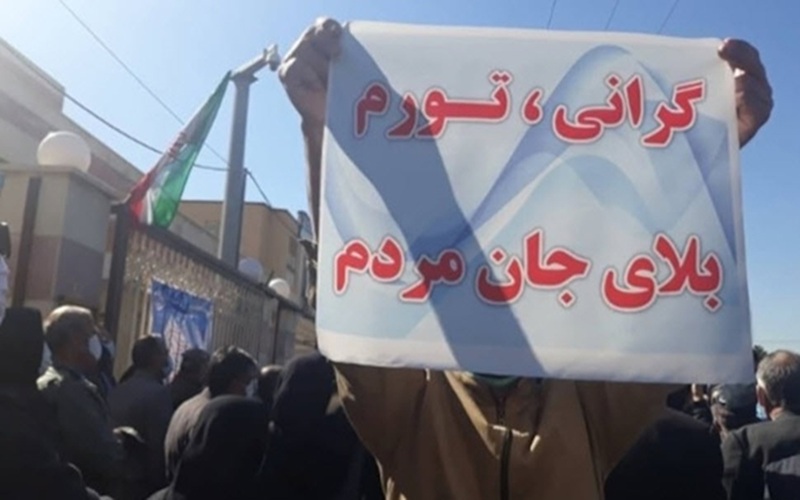

Growing concern among economists close to the regime reflects mounting fears that currency depreciation and the absence of an effective anti-inflation strategy could push Iran’s economy into an even deeper crisis.
Warnings from economists affiliated with the Iranian regime have highlighted growing alarm over the country’s deteriorating economic outlook, with experts cautioning that continued depreciation of the national currency could ultimately trigger hyperinflation.
The latest warning came from Hossein Raghfar, an economist known for his proximity to the regime, who described Iran’s economic situation as “extremely unfavorable” and argued that current monetary and exchange-rate policies risk driving the country toward a far more severe inflationary crisis.
Currency Depreciation Fuels Inflation Concerns
Speaking to the state-affiliated ILNA news agency on Saturday, Raghfar responded to recent remarks by fellow regime economist Masoud Nili, who warned that Iran has reached what he described as the “station before hyperinflation.”
While Raghfar argued that Iran has not yet entered a state of hyperinflation in the technical sense, he acknowledged that the country’s economic indicators are moving in a deeply troubling direction.
He pointed out that prices of many goods have increased by more than 100 percent over recent months. However, he noted that economists generally define hyperinflation as a period in which monthly inflation reaches approximately 40 to 50 percent, a threshold Iran has not yet crossed.
Nevertheless, Raghfar warned that continued depreciation of the Iranian rial could rapidly accelerate inflation and push the economy into that dangerous phase.
Exchange Rate Policy Under Fire
Raghfar identified the regime’s exchange-rate policies as one of the principal drivers of Iran’s worsening economic conditions.
According to his assessment, the persistent weakening of the rial has become a major source of inflationary pressure. Unless policymakers abandon this approach and adopt effective measures to stabilize prices, he warned, Iran could face an uncontrolled inflationary spiral.
His comments add to growing criticism from within the regime itself over the lack of a coherent strategy to combat inflation despite years of worsening economic performance.
Earlier Warning: Iran Between Chronic Inflation and Hyperinflation
Raghfar’s remarks follow similar concerns expressed by Masoud Nili, a professor of economics at Sharif University of Technology and another economist closely associated with the regime.
Speaking at the Iran Economy Outlook 2026 conference in late July, Nili argued that Iran has moved beyond the stage of chronic inflation and is now experiencing an exceptionally high level of price growth.
He described the country’s current condition as lying between chronic inflation and full-scale hyperinflation, warning that failure to reverse existing trends could push the economy into a much more destructive phase.
According to Nili, inflation in Iran has evolved beyond ordinary or persistent price increases and now represents a systemic threat to economic stability.
Ordinary Iranians Bear the Cost
The warnings come as ordinary Iranians continue to struggle with soaring prices, declining purchasing power, and the rising cost of essential goods and services.
Inflation has steadily eroded household incomes, leaving many families unable to keep pace with the cost of food, housing, healthcare, and other necessities. Despite mounting economic pressure, critics argue that the regime has failed to implement an effective program to control inflation or restore confidence in the economy.
Instead, officials have frequently emphasized the need for citizens to demonstrate “resilience” in the face of worsening economic conditions rather than introducing structural reforms capable of addressing the underlying causes of the crisis.
Internal Warnings Reflect a Deepening Crisis
The fact that economists with longstanding ties to the regime are now publicly warning of a possible slide toward hyperinflation underscores the severity of Iran’s economic deterioration.
Although experts differ on whether the country has already reached the threshold of hyperinflation, there is growing consensus that continued currency depreciation, persistent inflation, and the absence of credible economic reforms are significantly increasing the risk.
As inflation continues to erode living standards and public confidence, these warnings provide further evidence of the structural weaknesses confronting Iran’s economy and the regime’s inability to reverse its downward trajectory.