


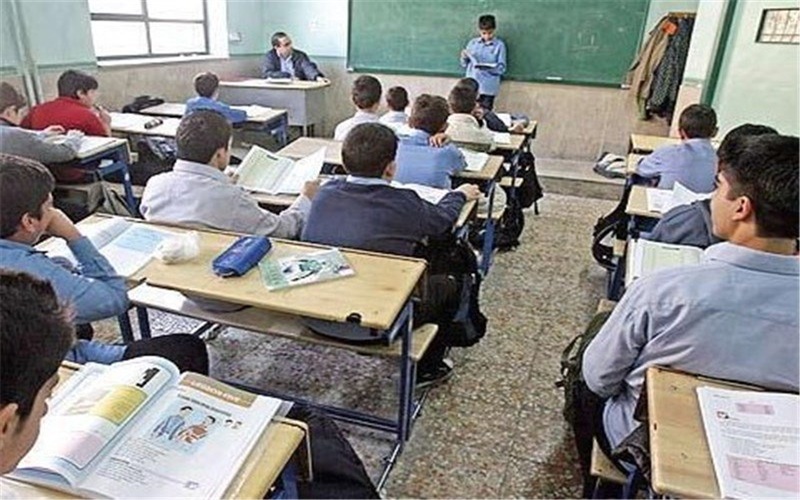

Nearly three million students have yet to finalize enrollment, while poverty, educational inequality, repeated school closures, and declining learning outcomes threaten to deepen Iran’s education crisis.
As the new school year approaches, growing numbers of Iranian students who have not yet finalized their enrollment are raising renewed concerns about the expansion of school exclusion and dropout rates across the country.
Reports indicate that around three million students have yet to complete their enrollment process. This figure cannot be equated with three million confirmed school dropouts, since many students will likely enroll before classes begin. Nevertheless, its sheer size is a serious warning sign, particularly amid worsening economic conditions and years of disruption to Iran’s education system.
The problem is no longer confined to a small number of children in deprived areas. Poverty, rising living costs, inadequate educational infrastructure, geographical isolation, gender-based barriers, child labor, and repeated interruptions to in-person schooling are combining to place more children and adolescents at risk of leaving education altogether.
A persistent and growing problem
Iran’s education crisis is not new. Data from the Parliament Research Center covering the period from 2015–16 to 2021–22 showed that the number of children and adolescents excluded from education increased from 777,862 to 911,272, representing an increase of roughly 17 percent in less than six years.
Sistan and Baluchestan, Razavi Khorasan, Tehran, Khuzestan, and West Azerbaijan recorded some of the highest absolute numbers.
The problem persisted in subsequent years. In 2024, Iran’s education authorities reported that approximately 216,000 children of primary-school age had been identified as being out of school during the 2023–24 academic year. Following efforts to bring them back into education, around 164,000 remained outside the education system.
That same year, an educational adviser to the presidency put the number of children between six and 18 years of age who were out of school at more than 900,000.
Because these figures use different definitions, age groups, and collection periods, they cannot simply be added together or compared as identical indicators. They nevertheless demonstrate a persistent failure to bring the problem under control.
Poverty is the central driver
Across studies of school exclusion in Iran, household poverty repeatedly emerges as one of the most important causes of dropout.
The Parliament Research Center has identified a significant relationship between economic poverty and educational deprivation. The share of household expenditure allocated to education reportedly fell from around 4.72 percent in 2018 to approximately 1.01 percent in 2023, as families were forced to devote an increasing proportion of their income to food, housing, medicine, and other necessities.
For a household struggling to pay rent and buy food, the costs of school supplies, clothing, transportation, extracurricular classes, and other educational expenses can become prohibitive.
The pressure is particularly severe during secondary education. Adolescents are old enough to enter the labor market, creating an incentive for economically vulnerable families to prioritize even a small income over continued schooling.
Other factors compound the problem, including early marriage among girls, child labor, long distances to schools, shortages of secondary schools in rural areas, inadequate transportation, gender discrimination, and declining motivation to continue education.
The consequences extend far beyond the loss of classroom time. Children who leave school to work generally face fewer opportunities for skilled employment and stable incomes later in life, reinforcing the cycle of poverty across generations.
The geography of educational deprivation
The distribution of illiteracy across Iran also reflects the country’s deep socioeconomic inequalities.
Data for 2023 show that among the population aged six and above, Sistan and Baluchestan had an illiteracy rate of approximately 20.07 percent, followed by Kurdistan at 18.08 percent and West Azerbaijan at 17.14 percent. Ilam, North Khorasan, Lorestan, and Kerman also ranked among provinces with comparatively high illiteracy rates.
The national average was approximately 12.23 percent, with rates above the national average recorded in 16 provinces.
This geographical pattern overlaps substantially with maps of poverty and deprivation. Sistan and Baluchestan, for example, has repeatedly been identified as one of Iran’s most deprived provinces. In one estimate, 51.3 percent of households in the province were classified as experiencing “absolute poverty.” West Azerbaijan was also reported at a high level, while Kurdistan has similarly ranked among provinces with elevated poverty.
Household income data provide another indication of the disparity. In 2022, average rural household income in Sistan and Baluchestan was reportedly more than 55 percent below the national rural average, while urban household income was more than 35 percent below the national average.
These figures alone do not prove a direct causal relationship between poverty and illiteracy. But their repeated overlap across provinces points to a strong correlation between economic deprivation and educational exclusion.
Years of disrupted schooling
Economic hardship is now compounded by repeated disruptions to in-person education.
Over the past two years, schools have faced closures linked to energy shortages, air pollution, and later wartime conditions. In several areas, classes were moved online, including periods when schools in Kurdistan and other provinces suspended in-person education.
But online education does not provide equal opportunities for all students.
A child without a suitable smartphone or computer, reliable internet, a quiet place to study, or parents able to provide educational support is immediately disadvantaged compared with a better-off classmate.
The education minister has acknowledged that virtual education cannot fully replace classroom instruction and that extensive reliance on online learning has affected educational quality.
Psychologist and university professor Hossein Salimi Bejestani has also warned that repeated school closures have damaged the social role of schools. As he put it, school is not merely a place for grades and academic instruction; it is where children develop social skills, interact with peers, and mature.
For vulnerable students, prolonged separation from school can have an especially damaging effect. A child already under economic pressure may gradually lose their connection with education and eventually leave the system altogether.
Enrollment is only part of the crisis
Even students who remain in school are facing declining educational outcomes.
According to Education Ministry assessment data, the average score in final examinations in 2024 was around 10.98 out of 20. Figures published for June 2025 showed average scores of approximately 11.12 for Grade 10, 10.36 for Grade 11, and 10.6 for Grade 12.
Although some indicators showed limited improvement, the overall level remains a serious concern. Education officials have themselves acknowledged the impact of repeated school closures on students’ academic performance.
Taken together, these indicators reveal a two-sided crisis: hundreds of thousands of children are outside the education system, while millions of those who remain in school are facing declining learning quality and unequal access to educational resources.
The nearly three million students who had not finalized enrollment by mid-summer are not necessarily three million dropouts. But in a country facing severe inflation and an education system weakened by years of disruption, the figure cannot simply be dismissed as an administrative delay.
The consequences of today’s educational failures may become most visible years from now, when a generation with weaker skills and fewer educational opportunities enters higher education and the labor market.
What is unfolding is therefore not simply a school enrollment problem. It is a growing education and social crisis whose long-term costs could extend to Iran’s scientific capacity, skilled workforce, economic productivity, and social development for years to come.