


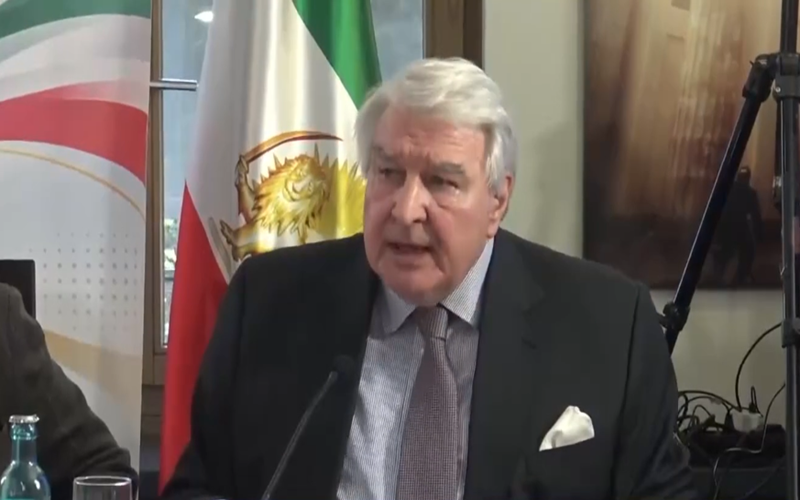

At a Berlin conference, the German Committee in Solidarity for a Free Iran chairman warned that the regime is targeting the PMOI and urged German lawmakers to engage directly with Iran’s organized opposition.
Leo Dautzenberg, chairman of the German Committee in Solidarity for a Free Iran, warned that Iran’s regime has intensified political executions since the renewed outbreak of war in March 2026 in an effort to prevent another popular uprising. Speaking at the Berlin conference “The Crisis in Iran and the Democratic Solution,” he identified the People’s Mojahedin Organization of Iran (PMOI/MEK) as a primary target of the regime’s crackdown.
Drawing on nearly three decades of engagement with Iran and its resistance movement, Dautzenberg described the personal sacrifices made by activists and their families, including imprisonment, persecution, exile, and the loss of loved ones.
He said 11 members of the resistance movement had been executed in recent months, describing them as freedom fighters who refused to submit to the ruling theocracy. He added that resistance networks had continued to develop even inside Iran’s prisons.
Dautzenberg said these experiences had reinforced his commitment to supporting the Iranian resistance and its struggle against dictatorship.
Executions Reflect Fear of Another Uprising
Dautzenberg challenged the regime’s portrayal of its survival through the war as evidence of strength. He argued that remaining in power does not demonstrate political stability, pointing instead to weakened leadership, deepening internal divisions, and worsening economic conditions.
Inflation, the declining value of Iran’s currency, energy shortages, unemployment, and poverty have all compounded the difficulties facing ordinary Iranians, he said.
A regime unable to resolve the population’s everyday problems cannot overcome its fundamental weaknesses simply by acquiring new missiles, Dautzenberg argued.
He warned that political executions serve as an instrument of repression designed to intimidate opponents and prevent renewed nationwide protests. In his assessment, the targeting of the PMOI reflects the regime’s concern about an organized opposition capable of turning public discontent into sustained political action.
Organized Resistance Is Essential to Political Change
Dautzenberg stressed that widespread dissatisfaction alone cannot bring down a dictatorship. Even when millions oppose a political system, he argued, meaningful change requires organization, established networks, perseverance, political leadership, and a clear vision for the period following the regime’s overthrow.
He urged policymakers to distinguish between spontaneous public discontent and organized resistance, emphasizing the importance of a structured political alternative capable of sustaining a democratic transition.
Dautzenberg also called on Germany’s Bundestag to broaden its understanding of Iran beyond official government accounts. German lawmakers, he said, should listen directly to political prisoners, victims’ families, civil society representatives, and Iran’s organized opposition.
Iranian Regime’s Intelligence Activities in Germany
Dautzenberg further warned that the Iranian regime has devoted substantial resources to discrediting its opponents, particularly the organized resistance.
Citing findings by North Rhine-Westphalia’s domestic intelligence authority, he referred to Iranian intelligence operations targeting opposition groups in exile, particularly the PMOI and the National Council of Resistance of Iran (NCRI), both of which have a presence in the German state.
He also warned that individuals presented as Iran experts could contribute to propaganda serving the regime’s interests. He argued that German institutions must independently assess information and sources rather than accept narratives designed to undermine the opposition.
According to Dautzenberg, Iranian regime representatives have openly urged Western governments to restrict the resistance and avoid contact with it. Complying with such demands, he said, would not constitute neutrality but would allow Tehran to dictate the terms of political debate abroad.
“We must not give the Iranian regime a veto over whom we talk to and which realities we are allowed to see,” he said.
Dautzenberg concluded that Germany and its European partners should recognize Iran’s organized resistance as a serious interlocutor and a strategic factor in shaping future policy toward the country. He argued that an effective approach must be grounded in independent assessment, direct engagement with the opposition, and recognition of the Iranian people’s struggle for democratic change.